
Hello! Welcome back to our module on lucid dreaming.
In our last lesson, we defined lucid dreaming as the state of being aware that you are dreaming while the dream is happening. We established that it is not just a fantasy or a misremembered dream, but a real, scientifically verifiable state of consciousness. The definitive proof came from experiments where dreamers, while in physiologically confirmed REM sleep, sent pre-arranged signals to researchers using their eye movements.
This lesson addresses the next logical question: what is happening in the brain to make this hybrid state of consciousness possible? Our learning outcome is to describe the neurological markers of lucid dreaming, contrasting brain activity with non-lucid REM sleep.
Understanding these biological signatures is a critical step in our journey. It demystifies the experience and demonstrates that consciousness isn't a simple on/off switch but exists on a spectrum. This scientific concept of a "hybrid state" of awareness provides a powerful parallel to the philosophical goal of maintaining consciousness during states of rest, which is central to the Jain contemplative practices we will explore later.
1. The Brain in a Typical Dream: Logic Offline
To understand what makes a lucid dream unique, we first need to remember what the brain is doing during a typical, non-lucid dream in REM sleep.
As you know, REM sleep is a period of intense brain activity. Emotional centers like the amygdala and visual processing areas in the occipital lobe are highly active, which is why dreams can be so visually rich and emotionally charged.
However, a crucial set of brain regions is largely deactivated: the prefrontal cortex (PFC). Think of the PFC, located at the very front of your brain, as your mind's "executive suite." It's responsible for:
- Logical reasoning and critical thinking
- Self-awareness and reflection
- Decision-making
- Working memory (holding information in mind)
With the executive suite offline, you accept the bizarre and illogical events of a dream without question. You might dream you're having tea with a talking squirrel or that you can breathe underwater, and it all feels perfectly normal. Your capacity for critical thought—the part of you that would say, "Wait a minute, squirrels can't talk!"—is simply not active.
2. The Neurological Shift: Waking Up Within the Dream
The transition to a lucid dream is marked by a dramatic and measurable change in brain activity. This isn't a full awakening; it's the creation of a unique hybrid state of consciousness.
The primary neurological marker of lucid dreaming is the reactivation of parts of the prefrontal cortex, particularly a region called the right dorsolateral prefrontal cortex (DLPFC), along with other frontal areas.
The Psychology of Lucid Dreaming - Charlie Morley
In this video, lucid dreaming expert Charlie Morley provides a very clear explanation of this neurological shift. He uses a simple brain model to show what's offline during a non-lucid dream and what 'switches on' the moment you become lucid.
Please watch from 19:03 to 22:15. Pay close attention to the contrast he draws between the brain's state in a non-lucid dream and a lucid dream, focusing on the role of the prefrontal cortex.
As the video explains, when the prefrontal cortex comes back online, you regain the cognitive functions that were absent in the typical dream:
- Self-reflection: The ability to think, "I am here, having this experience."
- Memory Access: You can access memories from your waking life, allowing you to recognize inconsistencies (e.g., "I'm supposed to be at home in bed, not on a pirate ship").
- Critical Thinking: You can reason about your situation, leading to the insight: "This must be a dream!"
This reactivation is what allows you to be an aware observer or participant rather than just a passive character in the dream's plot. Your "executive suite" is open for business again, but within the sensory and emotional landscape of the dream world.
To get a more detailed textual overview of the brain regions involved, the following article is very helpful.
How to Lucid Dream: Complete Guide for Dream Control
The article 'How Your Brain Creates Conscious Dreams' from BetterSleep provides an excellent summary of the neuroscience. We will focus on the role of the prefrontal cortex.
Please read the sections titled 'REM sleep and dream states' and 'The role of the prefrontal cortex.' These sections reinforce what you just saw in the video and provide more detail on how increased blood flow and communication in the PFC supports self-awareness.
3. The Electrical Signature: Gamma Waves
Beyond which regions are active, neuroscientists can also measure the type of electrical activity using an electroencephalogram (EEG). This reveals another key marker of lucidity.
During lucid dreaming, there is a significant and distinct increase in brainwave activity in the gamma frequency band (around 30-50 Hz), particularly in the frontal regions of the brain.
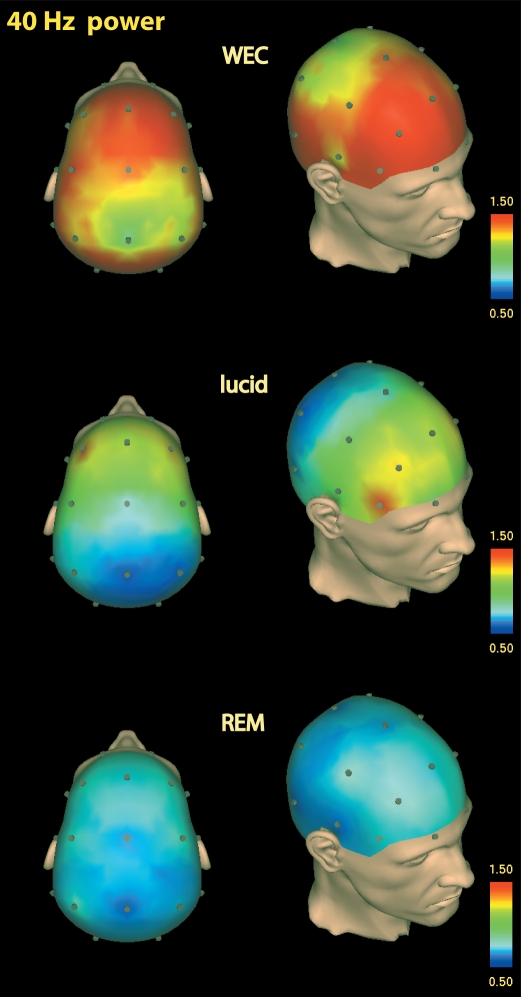
Gamma waves are associated with higher-level cognitive processing, insight, and the "binding" of different pieces of information into a single, coherent conscious experience. This spike in gamma activity during a lucid dream is thought to be the direct electrical signature of the "aha!" moment of becoming aware and the subsequent state of heightened consciousness.
The following image provides another comprehensive look, contrasting brain regions, overall activity, and brainwave coherence.

Test your understanding!
Imagine you are a neuroscientist looking at the live brain scan of a sleeping person. You notice they are in REM sleep, but suddenly you see a sharp increase in activity in their right dorsolateral prefrontal cortex and a corresponding spike in 40 Hz gamma waves. What would you conclude is most likely happening?
Show answer
You would conclude that the person has just entered a lucid dream. The combination of ongoing REM sleep physiology with the reactivation of the prefrontal cortex and the spike in gamma-band activity are the classic neurological markers of becoming aware within a dream.
4. The Neurochemical Balance of Lucidity
These changes in brain activity are supported by a specific chemical environment. The state of lucid dreaming depends on a delicate balance of neurotransmitters.
How to Lucid Dream: Complete Guide for Dream Control
The same BetterSleep article also has a concise section explaining the key neurotransmitters involved. Understanding this chemical cocktail helps explain how the brain can be alert enough for consciousness but calm enough to remain asleep.
Please read the short section titled 'Neurotransmitters and chemical signals.'
To summarize the key players:
- Acetylcholine: High, just as in normal REM, driving the vivid imagery of the dream.
- Dopamine: Potentially elevated, linked to the motivation and rewarding feeling of lucidity.
- Serotonin and Norepinephrine: Remain low. This is crucial, as these are "waking" neurotransmitters. Keeping them low prevents the body from waking up fully.
This specific neurochemical balance creates the perfect conditions for a "waking mind in a sleeping brain."
5. Probing the Dream: Two-Way Communication
The discovery of these neurological markers, combined with the signaling method we discussed in the last lesson, has opened up a fascinating new frontier in dream research: two-way communication.
Scientists are no longer limited to asking people about their dreams after they wake up. They can now ask questions and receive answers while the person is in a lucid dream.
The Dreaming Mind: Waking the Mysteries of Sleep
In this segment from the World Science Festival, neuroscientist Dr. Ken Paller explains his groundbreaking research on communicating with lucid dreamers. This showcases how the scientific principles we've discussed are being used in real-time experiments.
Please watch from 25:13 to 30:00. Listen for how they use pre-arranged signals (like eye movements or sniffing) to get answers to questions, and how this allows them to study the dreaming brain with unprecedented precision.
This research is incredible because it allows scientists to correlate a person's subjective experience with objective brain data in real time. They can ask a lucid dreamer a math problem, observe the brain activity as the dreamer calculates the answer, and then receive the correct answer via eye movements—all while the person is verifiably asleep. This solidifies the link between the activation of cognitive brain regions and the conscious experience of lucidity.
Conclusion
Today, we've moved from the "what" of lucid dreaming to the "how" in terms of brain function. We have seen that it is not a mystical state, but a measurable neurophysiological phenomenon with clear, identifiable markers.
Key Takeaways:
- Lucid dreaming is a hybrid state of consciousness, distinct from both non-lucid REM sleep and full wakefulness.
- The primary neurological marker is the reactivation of the prefrontal cortex, particularly the dorsolateral prefrontal cortex (DLPFC), which restores logic, self-awareness, and critical thinking.
- The key electrical signature is a spike in gamma-band brainwave activity (around 40 Hz) in the frontal lobes, associated with higher consciousness.
- This state is supported by a unique neurochemical balance (high acetylcholine, low serotonin/norepinephrine) that allows for mental alertness while the body remains asleep.
Preview of the Next Lesson:
Now that we understand the neurological signature of lucidity, we can begin to explore how to encourage our own brains to produce this state. In the next lesson, we will start learning the practical, evidence-based methods for inducing lucid dreams, beginning with a foundational technique called reality testing.