Introduction
Welcome to the final lessons of our module on production inference frameworks. Over the past few sessions, you have gained hands-on experience deploying and benchmarking the leading inference engines: vLLM, SGLang, and TensorRT-LLM. You've also explored advanced serving paradigms like the disaggregated architecture of llm-d, which targets extreme-scale workloads by separating prefill and decode stages.
Today, we will synthesize this knowledge. As an AI Systems Engineer, your role isn't just to use these tools but to make critical architectural decisions. The most common question you'll face is not "How do I run this model?" but "Which serving engine should I use for my specific workload?"
This lesson is designed to answer that question. Your learning outcome is to create a decision matrix for selecting between vLLM, SGLang, and TensorRT-LLM based on workload characteristics. We will break down the key differentiating factors, analyze the strengths and weaknesses of each framework, and build a structured tool to guide your choices in a production environment.
Defining the Axes of Comparison
Choosing a serving engine is a multi-dimensional optimization problem. There is no single "best" framework; there is only the best fit for a given set of constraints and goals. To build our decision matrix, we first need to define the axes—the critical factors that differentiate these systems.
These factors can be grouped into two categories: characteristics of the workload you need to serve, and properties of the system itself.
1. Workload Characteristics:
- Concurrency: How many simultaneous requests do you expect? This is arguably the most important factor. Is it a low-concurrency internal tool (1-10 users) or a high-concurrency public API (50-100+ users)?
- Latency Sensitivity (TTFT vs. TPOT): What does "fast" mean for your application?
- For an interactive chatbot, low Time-To-First-Token (TTFT) is critical for perceived responsiveness.
- For an offline document summarization task, Time-Per-Output-Token (TPOT) and overall throughput are more important than initial delay.
- Input/Output Structure:
- Generation Length: Are you dealing with short Q&A pairs or generating multi-page documents?
- Output Constraints: Does the model need to produce open-ended text, or must it strictly adhere to a format like JSON for tool-calling and agentic workflows?
- Prompt Diversity & Prefix Sharing: Do requests share a common prefix (like a system prompt in a chatbot), or is every prompt unique? Efficiently caching shared prefixes can significantly boost performance.
2. System and Operational Properties:
- Ease of Use & Iteration Speed: How quickly can you deploy a new model or experiment with changes? Systems that are Python-native and require no compilation offer faster iteration cycles.
- Hardware Specificity: Is the framework optimized for a specific vendor's hardware (e.g., NVIDIA GPUs), or is it more general? Does it support advanced features like FP8/FP4 quantization?
- Customizability: How easy is it to modify the core logic, such as the scheduling algorithm or attention mechanism? This is crucial for advanced use cases or research.
With these axes in mind, let's analyze how each of our three contenders—vLLM, TensorRT-LLM, and SGLang—measures up.
Analyzing the Contenders
The following two blog posts provide excellent, data-backed comparisons of these frameworks. We'll use them as our primary references to populate the decision matrix.
First, let's look at a post from LMSYS, the creators of SGLang, which provides detailed benchmarks.
Achieving Faster Open-Source Llama3 Serving with SGLang
This blog post from LMSYS compares SGLang against vLLM and TensorRT-LLM on various Llama models and hardware. It contains valuable performance graphs and a concise summary table.
First, read the introduction to understand the motivation behind SGLang. Then, skim the benchmark setup and the graphs for Llama-8B and Llama-70B to get a feel for the performance characteristics. Finally, pay close attention to the summary table at the end of the 'SGLang Overview' section, which directly compares the frameworks on key attributes like performance, usability, and customizability.
Next, this detailed guide offers a production-oriented perspective, framing the choice in terms of specific use cases.
vLLM vs TensorRT-LLM: Production Serving Guide
This guide provides a pragmatic breakdown of when to choose vLLM, TensorRT-LLM, or SGLang, complete with performance insights and a clear 'Decision Matrix' section.
Read the sections describing each framework: 'vLLM V1: High-Concurrency Champion', 'TensorRT-LLM: Hardware Efficiency Leader', and 'SGLang: Structured Output Specialist'. Then, carefully study the 'Performance Benchmarks' and 'Concurrency Scaling' sections to understand the trade-offs in practice.
Synthesizing the information from these resources, we can build a profile for each engine.
vLLM: The High-Throughput Champion
- Core Strength: Maximizing throughput under high concurrency. Its core innovation, PagedAttention, minimizes memory waste and enables high batch sizes.
- Performance Profile:
- TTFT: Generally the fastest, making it ideal for interactive applications.
- Throughput: Scales exceptionally well as concurrent requests increase. The benchmarks in the "Production Serving Guide" show it pulling ahead of competitors at 100 concurrent requests.
- Best For: Public-facing APIs, chatbots, and any service where handling many simultaneous users efficiently is the primary goal.
- Operational Cost: Very easy to use. It's Python-native, requires no ahead-of-time compilation, and integrates smoothly with the Hugging Face ecosystem, allowing for rapid iteration.
TensorRT-LLM: The Hardware Efficiency Leader
- Core Strength: Squeezing maximum performance from NVIDIA GPUs. It achieves this through ahead-of-time compilation, where the model graph is fused into highly optimized CUDA kernels.
- Performance Profile:
- TPOT: Unmatched performance for token generation, especially on long sequences. The "Production Serving Guide" notes a 2.72x speedup over vLLM on long outputs.
- TTFT: The slowest due to the compilation step, though this is a one-time cost per model. In a running system, its batching can still introduce latency compared to vLLM's scheduler.
- Best For: Low-concurrency, high-throughput batch processing. Think offline document analysis, summarization pipelines, or single-user applications on long contexts where total generation time matters most. It is the go-to for leveraging the latest NVIDIA hardware features like FP8.
- Operational Cost: High. The C++-based architecture and mandatory compilation step make it difficult to use and customize. Iteration is slow. It represents a trade-off: you sacrifice flexibility and ease of use for raw, bare-metal performance.
SGLang: The Structured Generation Specialist
- Core Strength: Flexibility and first-class support for structured generation (e.g., JSON output, regex constraints). Its frontend language allows for complex generation logic that is executed efficiently by the backend.
- Performance Profile:
- Performance: Highly competitive, often matching or outperforming vLLM and TensorRT-LLM in various scenarios, as shown in the LMSYS blog. Its Python-based scheduler is surprisingly efficient.
- Prefix Caching: Excels in workloads with high prompt overlap (e.g., chatbots with long system prompts, RAG) due to its efficient RadixAttention implementation and cache-aware scheduling.
- Best For: Agentic workflows, tool calling, and any application requiring reliable, structured outputs. It's also a strong choice for multi-tenant deployments serving multiple LoRA adapters.
- Operational Cost: A great middle ground. It's Python-native and easy to use like vLLM but offers higher customizability due to its pure Python scheduler. It provides a balance of top-tier performance and developer-friendly ergonomics.
The Decision Matrix
Now we can consolidate this analysis into a practical decision matrix. This tool will serve as your primary reference when architecting an LLM serving solution.
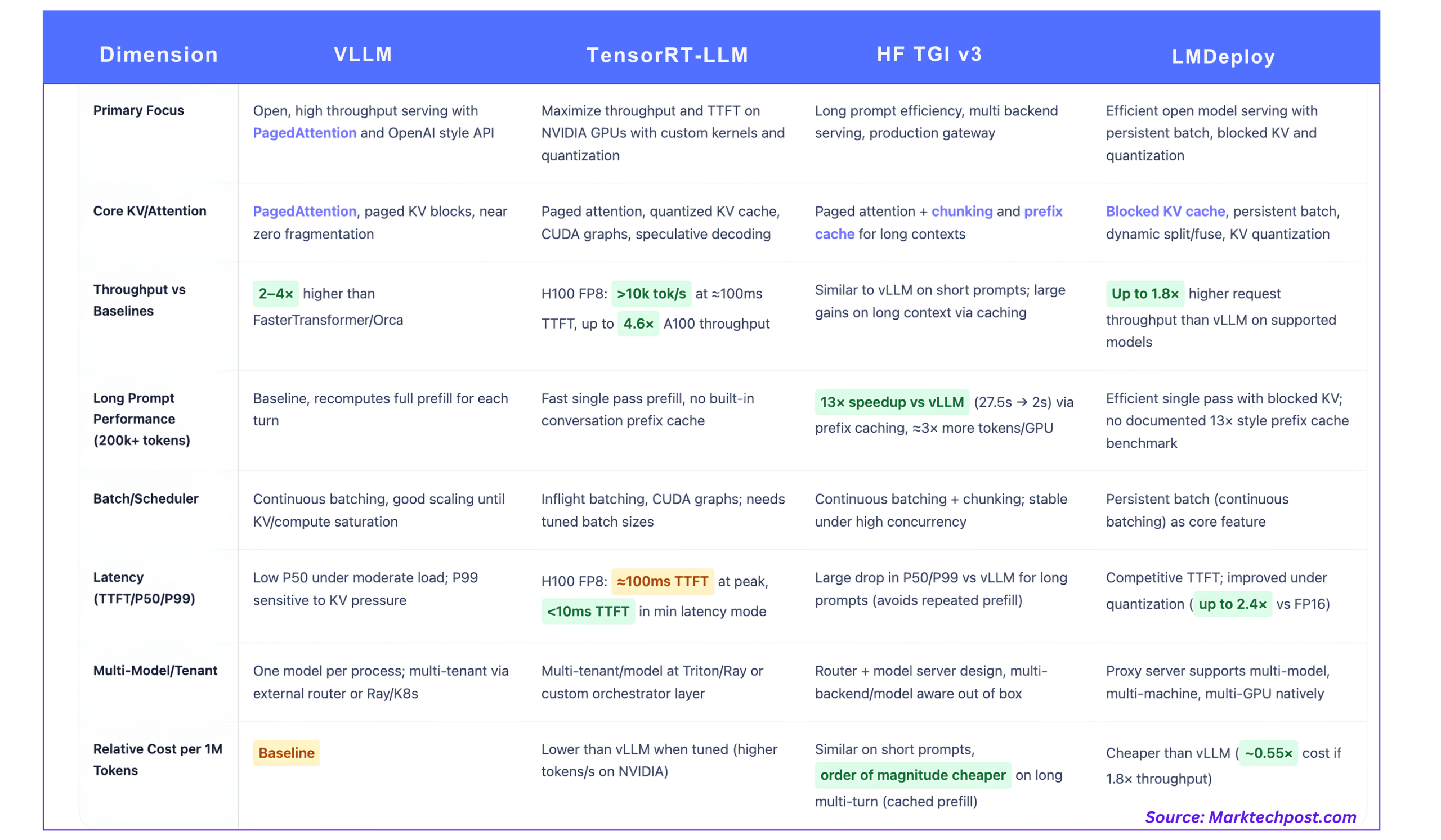
Here is our more detailed matrix tailored to the three frameworks we've analyzed:
| Feature / Workload | vLLM | TensorRT-LLM | SGLang |
|---|---|---|---|
| Primary Goal | High Throughput @ Concurrency | Max Hardware Efficiency | Structured Generation & Flexibility |
| Concurrency Sweet Spot | High (50+) | Low (1-10) | Medium (10-50) |
| Time-to-First-Token (TTFT) | Fastest | Slowest | Moderate |
| Time-Per-Output-Token (TPOT) | Good | Fastest (esp. long seq) | Very Good |
| Structured Output (JSON/Regex) | Basic Support | Limited | Excellent (Core Feature) |
| Prefix Caching | Good (RadixAttention) | Limited | Excellent (Cache-aware scheduling) |
| Ease of Use & Iteration | Excellent (Python, dynamic) | Poor (C++, compilation) | Excellent (Python, dynamic) |
| Hardware Optimization | Good (CUDA Kernels) | Excellent (NVIDIA-native, FP4/FP8) | Very Good (FlashInfer, torch.compile) |
| Customizability | Medium (Python/C++) | Low (Mostly C++) | High (Pure Python scheduler) |
How to Use the Matrix: Scenario-Based Decisions
To make this concrete, let's walk through three common scenarios. For a final reinforcement, the "Production Serving Guide" you read has an excellent section that codifies these exact choices.
vLLM vs TensorRT-LLM: Production Serving Guide
This section of the guide explicitly lays out the decision criteria for each framework, providing a perfect summary of our analysis.
Read the final section, 'Decision Matrix: Choosing Your Engine'. Compare its recommendations for when to choose vLLM, TensorRT-LLM, and SGLang against the scenarios below.
-
Scenario 1: You are building a public-facing AI chatbot.
- Constraints: High, unpredictable concurrency. User experience is paramount, so TTFT must be minimal to feel responsive.
- Analysis: Look at the
ConcurrencyandTTFTrows. vLLM is the clear winner. It's designed to handle high user loads while providing the fastest initial response. - Decision: vLLM.
-
Scenario 2: You are deploying a 70B model for an internal RAG pipeline to summarize legal documents.
- Constraints: Low concurrency (a few analysts using it at a time). Prompts and outputs are very long (32k+ context). Total job completion time is more important than initial latency. You are running on H100s and want maximum cost efficiency.
- Analysis: Look at
Concurrency,TPOT, andHardware Optimization. TensorRT-LLM is built for this. Its industry-leading TPOT will process the long generation much faster, and its compilation step maximizes hardware utilization. The slow iteration speed is acceptable for a stable internal model. - Decision: TensorRT-LLM.
-
Scenario 3: You are creating an API for an AI agent that controls other services.
- Constraints: The model must reliably output JSON to call other APIs. Concurrency is moderate. The agent has a complex system prompt that is shared across many requests.
- Analysis: The critical constraint is
Structured Output. SGLang is the specialist here. Its frontend language and efficient backend are designed for this. Its excellentPrefix Cachingwill also provide a significant performance boost from the shared system prompt. - Decision: SGLang.
Conclusion
You have now moved beyond simply using inference frameworks to strategically selecting them. This is a cornerstone skill of an AI Systems Engineer. The choice is never about a single metric but a holistic evaluation of the workload, performance requirements, and operational overhead.
Key Takeaways:
- No Universal "Best": The optimal serving engine is context-dependent. Your primary task is to correctly diagnose the context.
- The Core Trade-off Triangle: The choice often boils down to a trade-off between:
- High-Concurrency Throughput (vLLM)
- Raw Hardware Performance (TensorRT-LLM)
- Flexibility and Advanced Features (SGLang)
- The Decision Matrix as a Tool: Use the matrix we developed as a systematic guide. Start with your non-negotiable constraints (e.g., "must support JSON output" or "must handle 500 concurrent users") to narrow the options, then optimize for secondary metrics.
Preview of the Next Lesson:
Having established the principles of framework selection, you will put them into practice. In the next lesson, you will be tasked with deploying a 70B+ model on a multi-GPU setup using a framework of your choice. You will justify your selection based on a set of target SLOs and then load-test the deployment with 500 concurrent users, bringing together everything you've learned in this module into a final, large-scale practical exercise.