
Good to see you again. In the last lesson, you defined customer-facing SLIs, SLOs, and error-budget policies so that reliability decisions are tied to measurable user impact. Disaster recovery uses a different lens: an SLO measures ongoing service behavior over a window, while DR asks what happens when a larger event makes a workload—or an entire Region—unusable.
For a senior AWS DevOps interview, avoid saying “we use Multi-AZ and backups” as though that is a complete DR design. You need to establish the business recovery targets, distinguish AZ-level high availability from regional recovery, choose a proportionate strategy, protect against data corruption as well as infrastructure loss, and demonstrate that the plan works through evidence from tests.
By the end of this lesson, you should be able to propose and defend a DR design for a critical exchange-style service, including its RTO, RPO, backup controls, failover and failback runbooks, and test plan.
1. Begin with the failure scope and recovery objectives
A resilient platform needs both high availability and disaster recovery, but they answer different questions.
- High availability (HA) limits the impact of common component, instance, network, software, load, or single-AZ failures.
- Disaster recovery (DR) restores the whole workload when a larger event makes the primary operating site unavailable, or when corruption or a security incident makes the active data unsafe.
A Multi-AZ ECS service behind an ALB, with tasks distributed across AZs and an RDS Multi-AZ database, is strong HA. If an ECS task, node, or AZ fails, healthy capacity continues serving requests; RDS can fail over to its standby. That does not constitute regional recovery:
- A full AWS Region disruption can affect the application, database, IAM and service dependencies in that Region.
- Multi-AZ replication does not protect against an accidental
DELETE, faulty migration, ransomware encryption, or malicious administrative action. The destructive change can be replicated quickly. - Multi-AZ does not give you a separately deployable environment, separately available data, or a tested means to reroute users across Regions.
The first architectural decision is therefore not “which AWS DR service?” It is: what event are we recovering from, for which business capability?
Disaster Recovery of Workloads on AWS
Read the relevant portions of this AWS whitepaper to ground the terminology and strategy choices in AWS’s Reliability guidance. Focus on the distinction between availability and DR, the business meaning of RTO/RPO, the four strategy patterns, and the testing requirement.
In “Disaster recovery and availability” (pp. 2–7), read the distinction between common availability events and disaster events. Then, in “Recovery objectives (RTO and RPO)” (pp. 10–11), read the RTO definition and the following RPO discussion. Next, in “Disaster recovery options in the cloud” (pp. 14–29), read from the strategy overview through the descriptions of backup and restore, pilot light, warm standby, and multi-site active/active. Finally, in “Testing disaster recovery” (pp. 30–31), read the testing guidance, noting why an untested recovery path is not credible.
RTO and RPO are business commitments
Two targets drive the design:
- Recovery Time Objective (RTO): the maximum acceptable duration from service interruption to restored service.
- Recovery Point Objective (RPO): the maximum acceptable amount of data loss, expressed as time since the latest recoverable data point.
They are related but independent:
- Restoring a database snapshot from ten minutes ago might give an RPO of ten minutes, but rebuilding infrastructure and validating the application could take hours, producing a much longer RTO.
- A warm standby may be ready to accept traffic in minutes, providing a low RTO, but asynchronous data replication may still leave a non-zero RPO.
For an exchange platform, “RPO = zero” should not be accepted casually. It has a significant engineering and business meaning: no accepted transaction may be lost. Asynchronous cross-Region replication alone cannot guarantee that. A defensible design may instead state:
“For a regional outage, we target an RTO of 15 minutes and an RPO of less than one minute for operational order data. For financial correctness, accepted orders are idempotent and reconcilable against an authoritative event or ledger record. Orders whose final state is uncertain during the recovery window are reconciled before they are treated as final.”
This is far stronger than promising “zero data loss” without a mechanism to deliver it.
Use recovery tiers, not one target for the whole platform
An exchange is not a single homogeneous workload. The customer impact and compliance risk differ materially across services.
| Capability | Example RTO | Example RPO | Recovery intent |
|---|---|---|---|
| Public order submission and risk checks | 15 minutes | Under 1 minute | Restore controlled order entry quickly; prevent duplicate or uncertain processing |
| Order-status and account views | 30 minutes | Under 5 minutes | Restore customer visibility and support investigation |
| Market-data cache or public price display | 15–30 minutes | Seconds to minutes | Rebuild or refresh from the authoritative feed where possible |
| Ledger, audit trail, and reconciliation records | 1–4 hours for full access | Business-defined; integrity is primary | Restore a verified, auditable state rather than merely a fast database endpoint |
| Analytics, reporting, batch ETL | 24 hours | 24 hours | Use backup and restore; do not pay warm-standby cost without business need |
| Infrastructure definitions and deployment artifacts | Hours | Near current version | Recreate through versioned Terraform, immutable images, and artifact replication |
The important senior-level move is to state assumptions. If the business says an order is accepted only after a durable database commit and event publication, then the recovery plan must preserve or reconcile both facts. If the product tolerates a short “trading temporarily unavailable” state during a regional event, warm standby may be appropriate. If it cannot tolerate it, the architecture and its cost must change.
2. Choose a strategy that satisfies, rather than exceeds, the requirement
AWS DR approaches form a spectrum. Lower RTO and RPO normally require more continuously running capacity, replication, operational sophistication, and cost.
| Strategy | Typical RPO | Typical RTO | Recovery-region state | Main trade-off |
|---|---|---|---|---|
| Backup and restore | Hours | Hours, up to a day | Backups only; infrastructure and data restored during incident | Lowest cost, longest restoration |
| Pilot light | Minutes | Tens of minutes | Core data and minimal foundational components live; application capacity created during recovery | Low operating cost, depends on deployment and scaling actions |
| Warm standby | Seconds to minutes | Minutes | Fully functional workload operates at reduced capacity | Faster recovery, ongoing regional cost |
| Multi-site active/active | Near real time | Potentially near zero | Multiple Regions actively serve production traffic | Highest complexity, especially for multi-Region writes |
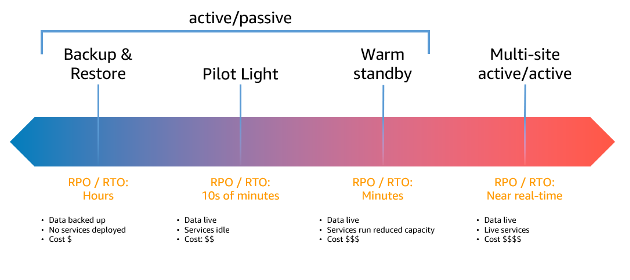
The diagram is useful in interviews because it prevents a common mistake: treating active/active as automatically “best.” It is only appropriate when the business impact justifies its cost and data-consistency complexity.
A proportionate design for the scenario
For a critical order-management platform with a 15-minute regional RTO and under-one-minute operational-data RPO, I would normally propose:
- Multi-AZ HA in the primary Region for ordinary infrastructure and AZ failures.
- Warm standby in a second Region for the critical order, risk, and customer-status services.
- Cross-Region data replication for live operational recovery, with replication lag monitored against the RPO.
- Independent point-in-time backups to protect against logical corruption, deletion, ransomware, and a bad deployment.
- Manual authorization with automated execution for regional failover, rather than a fully automatic regional switch.
Warm standby is appropriate because the secondary Region can already process controlled requests at reduced scale. Recovery primarily involves promoting the data layer where required, increasing service capacity, validating dependencies, and shifting traffic.
Pilot light can be defensible if the RTO is closer to 30–60 minutes and the organization accepts dependency on control-plane actions to create compute capacity. Backup and restore is appropriate for reporting, analytics, and lower-tier workloads, but not for the customer-facing trading path under this target.
Why active/active is not the default
Multi-site active/active reduces application unavailability when one Region fails because the other Region is already serving traffic. But the hard problem becomes data ownership.
For example, routing writes to both Regions requires a defined conflict model:
- Single-writer model: all writes go to one Region; other Regions serve reads or forward writes. This simplifies consistency but does not make writes fully active/active.
- Write partitioning: a customer, instrument, account, or shard has one designated write Region. The partitioning rule prevents conflicting writes.
- Conflict-tolerant writes: only appropriate where the application can safely resolve concurrent updates. “Last writer wins” is usually dangerous for balances, orders, risk limits, and settlement state.
For an exchange workflow, a simple statement such as “we will use DynamoDB Global Tables for active/active” is incomplete. You must explain whether an order can be written in either Region, how duplicate submissions are prevented, how sequence and causality are maintained, and what happens if replication lags or a Region returns after an outage.
3. Protect the complete recovery set, not just the database
A recoverable application needs more than database backups. A useful interview framework is to inventory five categories:
| Recovery category | Examples | Required protection |
|---|---|---|
| Authoritative data | RDS or Aurora data, ledger events, object records | Replication where needed, point-in-time recovery, cross-Region backups |
| Stateful supporting data | EBS, EFS, caches with important state, queues | Backup, replication, or explicit rebuild procedure |
| Application artifacts | Container images, versioned binaries, configuration bundles | Immutable artifact promotion and regional replication |
| Infrastructure and configuration | VPCs, subnets, ALBs, ECS services, IAM roles, WAF rules, DNS settings | Terraform in version control, separate regional state, tested deployment |
| Security and access dependencies | KMS keys, secrets, certificates, break-glass roles | Regional key and secret availability, controlled replication, tested recovery authorization |
The architecture must answer a practical question: could an authorized operator build and operate the secondary Region without improvising during an outage?
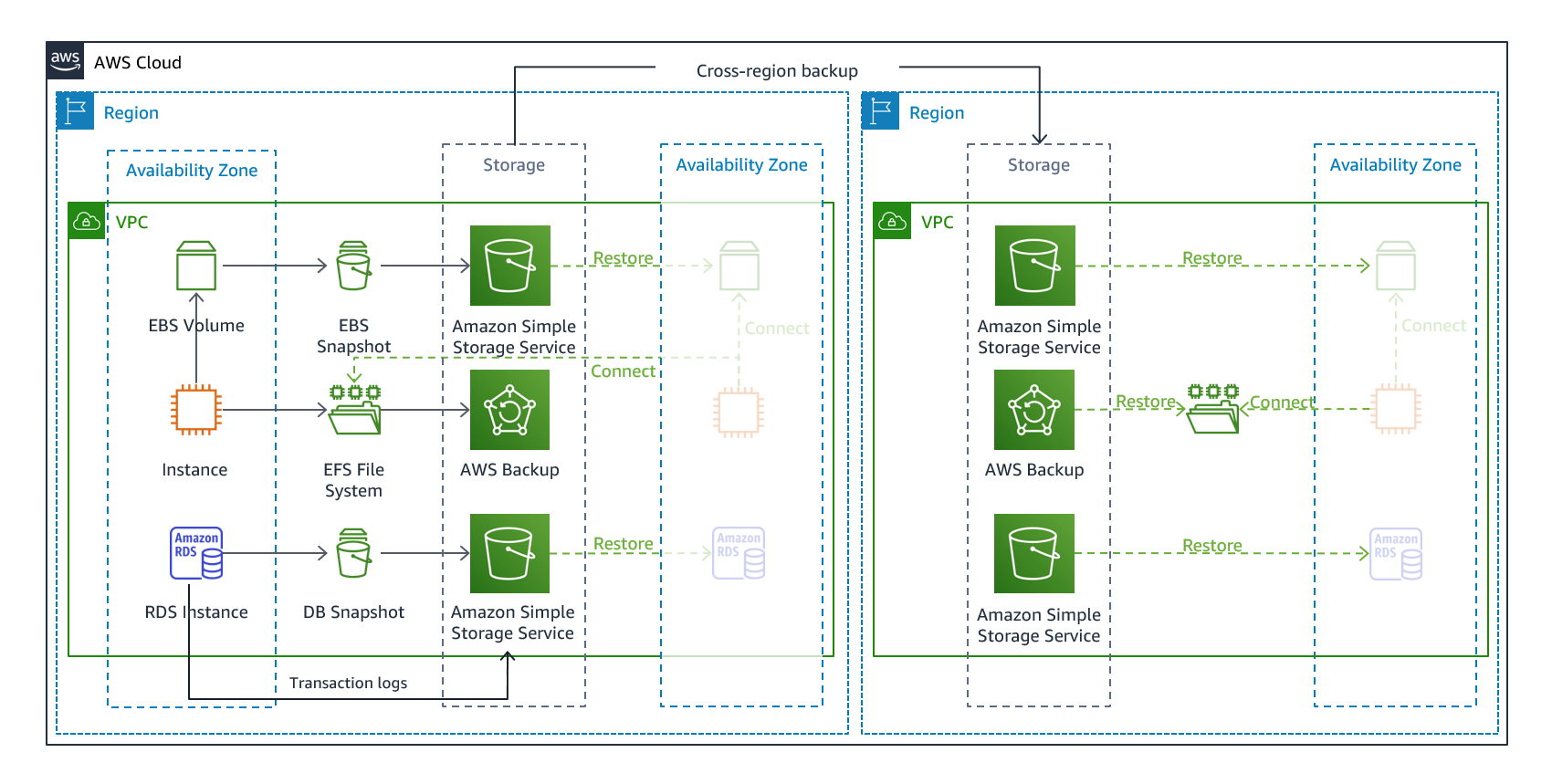
A concrete AWS implementation
For a containerized ECS order platform, a credible warm-standby design could contain the following.
Primary Region
- ALB distributes traffic to ECS services across at least two AZs.
- RDS Multi-AZ or Aurora provides local HA.
- RDS automated backups and point-in-time recovery protect from accidental changes within the primary Region.
- Order processing emits durable, idempotent domain events with correlation and idempotency keys.
- S3 holds immutable or versioned artifacts, documents, reports, and exports as needed.
Recovery Region
- A separate VPC, subnet tiers, security groups, route configuration, ALB, ECS services, CloudWatch alarms, and IAM roles are deployed by Terraform.
- ECS services run a reduced but validated task count. Their configuration points to the recovery data path, not the unavailable primary endpoint.
- Service quotas are pre-reviewed. A DR plan that requires scaling from two tasks to 200 but lacks regional ECS, Fargate, EC2, NAT, or database quota capacity is not a plan.
- Images are available in the Region at the approved immutable digest. Do not assume that a container image can be pulled from an unavailable primary Region.
- Secrets and KMS access are available according to the security design. Encryption keys are regional resources, so key policy and decrypt permissions require explicit DR testing.
Data protection
- For a relational workload requiring low operational RPO, use an appropriate cross-Region replication pattern. For example, an Aurora Global Database can keep a secondary cluster ready for promotion, while traditional RDS read replicas may be appropriate where their replication and promotion characteristics meet the stated target.
- Monitor replication lag. “Typically low lag” is not proof that the RPO is met.
- Use AWS Backup for centralized backup policy, retention, recovery-point monitoring, and cross-Region or cross-account backup copies where supported.
- Enable S3 Versioning for protected object data; use cross-Region replication where regional availability is required.
- Keep point-in-time backups in addition to live replication. A replicated bad write is still a bad write.
Ransomware and account compromise require isolation
A backup in the same compromised production account may not be a usable backup. An attacker with broad privileges may disable backup plans, shorten retention, alter encryption access, or delete recovery points.
A stronger pattern uses:
- A dedicated backup or data-vault account.
- Cross-account backup copies into a vault controlled by separate administration.
- Separate KMS keys and narrowly scoped key policies.
- AWS Backup Vault Lock, where retention and regulatory requirements support immutable recovery points.
- Alerts generated outside the production account for backup-job failures, disabled plans, altered retention, and unusual deletion or access events.
- A separate recovery account or clean recovery environment for restoration when the production account itself may be untrustworthy.
AWS re:Invent 2023 - Backup and disaster recovery strategies for increased resilience (ARC208)
Watch AWS Events’ “Backup and disaster recovery strategies for increased resilience” for the operational reasoning behind isolated, immutable backup vaults. It is especially useful for explaining why replication alone is insufficient during ransomware or account-compromise scenarios.
Watch isolated backups. Focus on the separation between the production account, the protected data-vault account, and a recovery environment; also note the need to alert when backup controls are altered rather than waiting for an actual restore request.
A concise interview phrase is:
“Replication supports availability and a low operational RPO. Independent, immutable point-in-time backups support recovery from corruption and compromise. We need both.”
4. Make failover an operational process, not a diagram
An RTO is consumed by more than database promotion. The real recovery clock includes:
- Detection of the customer-impacting condition.
- Incident declaration and authorization.
- Fencing or isolating the impaired primary Region.
- Database promotion or selection of a clean restore point.
- Scaling application capacity.
- Routing traffic.
- Functional validation of critical customer journeys.
- Communication and controlled resumption of service.
If the target RTO is 15 minutes, assign a budget:
| Activity | Target budget |
|---|---|
| Detect and confirm regional impact | 2 minutes |
| Declare incident and authorize DR action | 2 minutes |
| Fence primary writes and initiate recovery workflow | 2 minutes |
| Promote regional data path and scale critical services | 5 minutes |
| Shift traffic and execute synthetic validations | 3 minutes |
| Resume controlled service and communicate status | 1 minute |
This is not a guarantee; it is a testable operational hypothesis. If an approved incident commander cannot be reached for 20 minutes, a 15-minute RTO cannot be met, regardless of technical design.
Failover runbook for a warm standby
The exact implementation varies, but a robust runbook should make these decisions explicit:
- Confirm impact and declare the event. Use customer-journey synthetics, SLO symptoms, dependency health, and AWS Health information. A simple TCP or ALB health check alone is not sufficient.
- Establish a single writer. Stop, fence, or otherwise prevent writes to the former primary where possible. This protects against split-brain behavior if partial connectivity remains.
- Assess the data state. Confirm the latest replication checkpoint and whether the event is availability-related or a data-integrity incident. For corruption or ransomware, select a known-good point-in-time recovery point rather than promoting corrupted live data.
- Activate the recovery application. Promote the designated database secondary where applicable; set the secondary ECS desired count or capacity policy to the recovery profile; verify secrets, configuration, dependencies, and deployment version.
- Shift traffic deliberately. Use a prebuilt data-plane routing mechanism where possible, such as Route 53 Application Recovery Controller routing controls. A human should commonly authorize the switch, while the mechanics remain automated.
- Validate before broad release. Run authenticated synthetic checks for order submission, a harmless business validation, order-status retrieval, read/write database health, queue processing, and critical third-party dependencies.
- Operate in DR mode. Communicate customer impact, record the declared RPO gap, preserve evidence, and apply heightened change control.
- Reconcile. Identify transactions around the recovery boundary using idempotency keys, event records, and ledger reconciliation. Do not silently assume every request timed out without effect.
This is especially relevant for financial transactions. A customer whose order submission timed out might retry. The platform must ensure that a retry is recognized as the same idempotent request, not processed as a second order.
Failback is a separate design problem
Failback is not “switch DNS back.” During the outage, the recovery Region becomes the source of truth and accumulates new writes. Before returning:
- Rebuild or repair the former primary Region using the same Terraform and artifact pipeline.
- Re-establish replication from the active recovery Region to the former primary.
- Validate data consistency, replication lag, capacity, security controls, and customer journeys.
- Plan a controlled write transition with the same single-writer protection used in failover.
- Shift traffic in a defined maintenance or progressive-release window.
- Keep the former recovery Region ready as the next recovery target.
A useful operational model is that the recovery Region may remain the new primary after a real incident. The original primary can be rebuilt as the standby. This reduces pressure to rush an unsafe reversal.
5. Test recovery and collect evidence
A backup policy is an intention. A completed restoration and validated application workflow are evidence.
Testing must prove both objectives:
For a warm standby, establish a recurring test program:
| Test | Example frequency | What it proves |
|---|---|---|
| Backup restore test in isolated environment | Monthly | Recovery points are readable, decryptable, complete, and usable |
| Recovery-region deployment validation | Per infrastructure or application release | Terraform, artifacts, configuration, secrets, and quotas remain current |
| Data replication-lag review | Continuous alerting; weekly review | Operational RPO is being maintained |
| Application-level DR drill | Quarterly | Recovery Region can process critical journeys at its intended capacity |
| Controlled regional failover game day | Semi-annually or according to business criticality | End-to-end RTO, traffic routing, roles, communications, reconciliation, and failback |
| Corruption or ransomware recovery scenario | At least annually | Teams can select a clean recovery point rather than promoting replicated corruption |
A drill should record:
- Start and finish timestamps for every recovery stage.
- Actual RTO and RPO achieved.
- Replication lag at the decision point.
- Terraform and image versions deployed in the recovery Region.
- Capacity and service-quota constraints encountered.
- Results of customer-journey checks.
- Reconciliation results for test records.
- Runbook gaps, owners, and due dates.
Test safely. Many teams validate the recovery stack through an isolated endpoint, separate test tenant, synthetic records, or a restricted traffic segment before they conduct a broader production game day. The purpose is not simply to prove that an ALB returns 200; it is to prove that the application can perform its critical business operation with the right data and controls.
Interview-ready response
If asked, “How would you design DR for a critical AWS workload?”, a strong answer is:
“I would first separate Multi-AZ high availability from regional disaster recovery. The primary Region would be multi-AZ to survive ordinary instance and AZ failures, but that does not protect us from a regional outage, data corruption, or account compromise.
I would run a business impact analysis by service tier. For the order path, if the requirement is a 15-minute RTO and less than one minute RPO, I would use a warm standby in a second Region: the VPC, security controls, ALB, ECS services, observability, and deployment artifacts are already deployed, while the recovery service fleet runs at reduced capacity. The data layer uses monitored cross-Region replication appropriate to the database technology, but I would retain independent point-in-time backups because replication can propagate deletions and corruption.
Backups would be centrally governed, copied to a separate backup account, protected by appropriate immutability controls, and periodically restored into an isolated environment. Failover would be manually authorized but automated through a runbook: detect customer impact, fence primary writes, establish the recovery Region as the single writer, scale services, shift traffic, validate critical transactions, and reconcile the recovery window.
Finally, I would measure the actual RTO and RPO through regular drills, track configuration drift and regional quotas, and treat failback as a deliberate data synchronization event rather than a DNS change.”
Key takeaways
- Multi-AZ provides high availability within a Region; it is not sufficient protection from a full regional outage, data corruption, or account compromise.
- RTO is the maximum tolerable service-restoration time; RPO is the maximum tolerable time span of data loss. Both must come from business impact and risk analysis.
- Select backup and restore, pilot light, warm standby, or active/active according to the required RTO/RPO, cost, and operational complexity. Do not over-engineer a lower-tier service or under-design a critical transaction path.
- Live replication reduces operational data loss but does not replace point-in-time backups, versioning, and isolated immutable recovery copies.
- A credible DR design includes infrastructure, application artifacts, data, secrets, keys, quotas, traffic routing, access controls, reconciliation, and failback.
- The only convincing RTO and RPO are measured through restoration and failover tests.
Next, you will bring the course together in an end-to-end AWS production-readiness review, defending your network, compute, data, security, observability, scaling, and DR decisions under senior-level interview questioning.
Can't find a good explanation? Sign up and we'll make it for you
Sign up