
Hello! Welcome to your next lesson in Fluid Mechanics.
In our previous lesson, we established the fundamental properties of fluids, such as density (), specific weight (), and viscosity (). These properties describe the intrinsic nature of a fluid. Now, we will use these concepts to understand how fluids behave when they are at rest, a field known as hydrostatics.
Your learning outcome for this lesson is to apply the hydrostatic pressure equation to determine pressure in static fluids. This is a cornerstone of fluid mechanics and is crucial for many aerospace applications, from calculating fuel pressure inside an aircraft's tanks to understanding how atmospheric pressure changes with altitude, which affects everything from engine performance to flight instruments.
1. The Origin of Hydrostatic Pressure
When a fluid is static (not moving), the only forces acting within it are pressure and gravity. The pressure at any point is caused by the weight of the fluid column above it. The deeper you go, the more fluid is above you, and therefore, the higher the pressure.
We can derive the fundamental equation for hydrostatic pressure by considering a simple force balance on a small column of fluid.
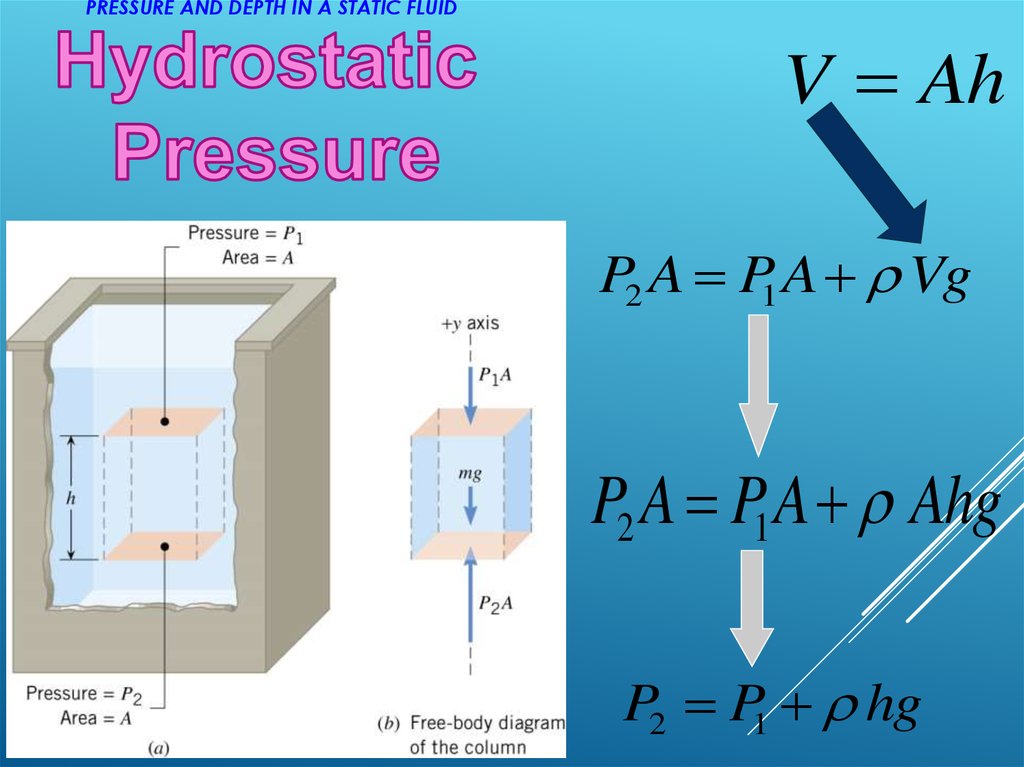
As shown in the diagram, balancing the forces in the vertical direction gives:
The weight of the fluid is its mass () times gravity (). We know from the last lesson that mass can be expressed as density times volume (), and the volume of the column is . Substituting this in:
Dividing by the area , we get the fundamental relationship:
This equation tells us that the pressure at a depth below point 1 is greater than the pressure by an amount .
Often, we are interested in the change in pressure, , due to a change in depth, .
Recalling from our last lesson that specific weight is , we can also write this compactly as:
2. Gauge Pressure vs. Absolute Pressure
When we measure pressure, it's important to distinguish what our reference point is. This leads to two common pressure scales: gauge and absolute.
- Absolute Pressure (): This is the total pressure at a point, measured relative to a perfect vacuum (zero pressure).
- Gauge Pressure (): This is the pressure measured relative to the local atmospheric pressure ().
The relationship is simple:
For example, a tire pressure gauge reads gauge pressure. If it shows 32 psi, the absolute pressure inside the tire is actually 32 psi plus the atmospheric pressure (around 14.7 psi at sea level). A negative gauge pressure indicates a pressure below atmospheric pressure (a partial vacuum).
Most of the time, the hydrostatic equation calculates a gauge pressure, as it gives the pressure due to the fluid column alone, relative to the pressure at the surface. If the surface is open to the atmosphere, the pressure at the surface is , and the pressure at depth is simply .
To solidify your understanding of this crucial concept, please watch the following video. It provides clear definitions and practical examples.
Absolute Pressure vs Gauge Pressure - Fluid Mechanics - Physics Problems
This video from The Organic Chemistry Tutor clearly explains the difference between gauge and absolute pressure and provides several worked examples, including the derivation of the hydrostatic pressure formula from first principles.
Watch the video from the beginning to 08:46. Focus on: The definition and relationship: P_{abs} = P_{gauge} + P_{atm}. The derivation of the pressure formula P = \rho g h. How to apply these concepts to find the pressure on a diver.
3. Key Principles for Hydrostatic Calculations
Solving problems in hydrostatics usually relies on applying a few key principles. A good way to learn them is to see them in action. The following video introduces these principles and then applies them to solve a classic engineering problem involving a manometer.
Fluid Mechanics - Fluid/Hydrostatic Pressure in 11 Minutes!
This video from Less Boring Lectures covers the core concepts of hydrostatic pressure in a very clear and concise way, leading up to a practical manometer problem.
Please watch from 02:40 to 08:47. Pay close attention to: How pressure changes with depth (02:40). The principle that pressure is the same at the same height in a continuous fluid (04:29). The examples showing when pressure is equal and when it's not (06:59).
Let's summarize the rules for "navigating" through a static fluid to find pressure:
- Moving Down: When you move vertically down a distance in a fluid, the pressure increases by .
- Moving Up: When you move vertically up a distance in a fluid, the pressure decreases by .
- Moving Horizontally: The pressure remains the same at any two points at the same elevation within the same continuous fluid. This is a very powerful principle.
4. Application: The Manometer
A manometer is a U-shaped tube containing one or more fluids, used to measure pressure differences. It's a perfect application of the hydrostatic principles we just discussed.
Let's look at a typical problem.

To solve this, we start at a point of known pressure and move through the tube, adding or subtracting pressure terms until we reach the point of unknown pressure.
The video you just watched demonstrates exactly how to solve this problem.
Fluid Mechanics - Fluid/Hydrostatic Pressure in 11 Minutes!
Let's now watch the worked example from the 'Less Boring Lectures' video, which solves the exact manometer problem shown in the diagram above.
Watch the segment from 08:47 to 10:55. Follow the step-by-step calculation, starting from the outside (atmospheric pressure) and working towards the inside of the tank.
The general method is:
- Start at a point with a known pressure (e.g., the open end of the manometer, where pressure is atmospheric, or ).
- Move through the fluid column to the other end.
- Add when moving down.
- Subtract when moving up.
- Use the principle that pressure is equal at the same level in a continuous fluid to "jump" across the bottom of the U-tube.
Test your understanding!
A large open tank holds a layer of oil (Specific Gravity = 0.8) that is 2 meters deep, floating on top of a layer of water that is 5 meters deep. The density of water is 1000 kg/m³, and m/s².
- What is the gauge pressure at the oil-water interface?
- What is the gauge pressure at the bottom of the tank?
- What is the absolute pressure at the bottom of the tank? (Assume Pa).
Show answer
First, let's find the density of the oil:
-
Gauge pressure at the interface:
This pressure is due only to the 2-meter column of oil above it. -
Gauge pressure at the bottom:
This is the pressure from the oil column plus the pressure from the water column. We can start from the interface and go down. -
Absolute pressure at the bottom:
We simply add the atmospheric pressure to the gauge pressure.
Conclusion
In this lesson, we explored the fundamental principles of hydrostatics. You learned how pressure in a static fluid is generated and how to calculate it at any depth.
Key Takeaways:
- The pressure difference between two points in a fluid is given by the hydrostatic equation: .
- Pressure increases linearly with depth.
- Gauge pressure is measured relative to atmospheric pressure, while absolute pressure is measured relative to a perfect vacuum ().
- Pressure at a given elevation is constant within a continuous, static fluid. This principle is key to solving problems with complex geometries, like manometers.
Next Steps:
Now that you can determine the pressure at any point in a fluid, the next logical step is to determine the total force that this pressure exerts on a submerged surface. In the next lesson, we will learn how to calculate the magnitude and location of the hydrostatic force on plane surfaces, a skill essential for designing structures like tank walls, floodgates, and aircraft fuel tanks.
Can't find a good explanation? Sign up and we'll make it for you
Sign up