
Hello! Welcome to the first lesson in our new module on Fluid Mechanics.
In the previous modules, we focused entirely on the mechanics of solids—analyzing forces in static structures, stresses in deformable materials, and the motion of rigid bodies. We now pivot to an equally important area of engineering: the study of fluids. Understanding how fluids behave is fundamental to many fields, but it is especially critical in aerospace engineering, where the interaction between a vehicle and the surrounding air (or the flow of fuel within an engine) defines its performance.
This first lesson lays the groundwork. Your learning outcome is to define and calculate key fluid properties such as density, viscosity, and specific gravity. These properties are the essential vocabulary of fluid mechanics, quantifying a fluid's "heaviness" and its resistance to flow.
1. The "Heaviness" of a Fluid: Density, Specific Weight, and Specific Gravity
When we think about a fluid, one of the first characteristics that comes to mind is how "heavy" it is. In engineering, we need to be precise about this. We use three related properties to describe it: density, specific weight, and specific gravity.
To get a clear, formula-based introduction to these concepts, please watch the following video. It directly explains each property and works through a practical example.
Fluid Mechanics Course - Properties of Fluid Part 1 (Topic 1)
This video from Jessar Cedeno clearly defines and provides the formulas for mass density, specific volume, specific weight, and specific gravity. It also includes a helpful worked example.
Watch the video from 01:44 to 09:37. This covers the definitions of the four key properties and a complete worked example applying them to a reservoir of glycerine.
Let's summarize the key definitions from the video:
-
Mass Density (): This is the most fundamental property, representing the mass of a substance contained in a unit of volume.
The standard SI unit is kg/m³. For reference, the density of fresh water is approximately 1000 kg/m³. -
Specific Weight (): This is the weight of a substance per unit of volume. Since weight is mass times gravity (), it's directly related to density.
The standard SI unit is N/m³. Unlike density, which is an absolute property of the material, specific weight depends on the local acceleration of gravity, . -
Specific Gravity (SG): This is a dimensionless ratio that compares the density of a fluid to the density of a standard reference fluid, which is typically water at 4°C.
Because it's a ratio, its value is the same in any unit system. It's a very convenient way to express a fluid's density relative to a familiar standard. For example, if a fluid has an SG of 0.8, you immediately know it's 80% as dense as water. -
Specific Volume (): This is the reciprocal of density, representing the volume occupied by a unit of mass (). While less common when dealing with liquids, it is an important property in thermodynamics, especially when analyzing gases.
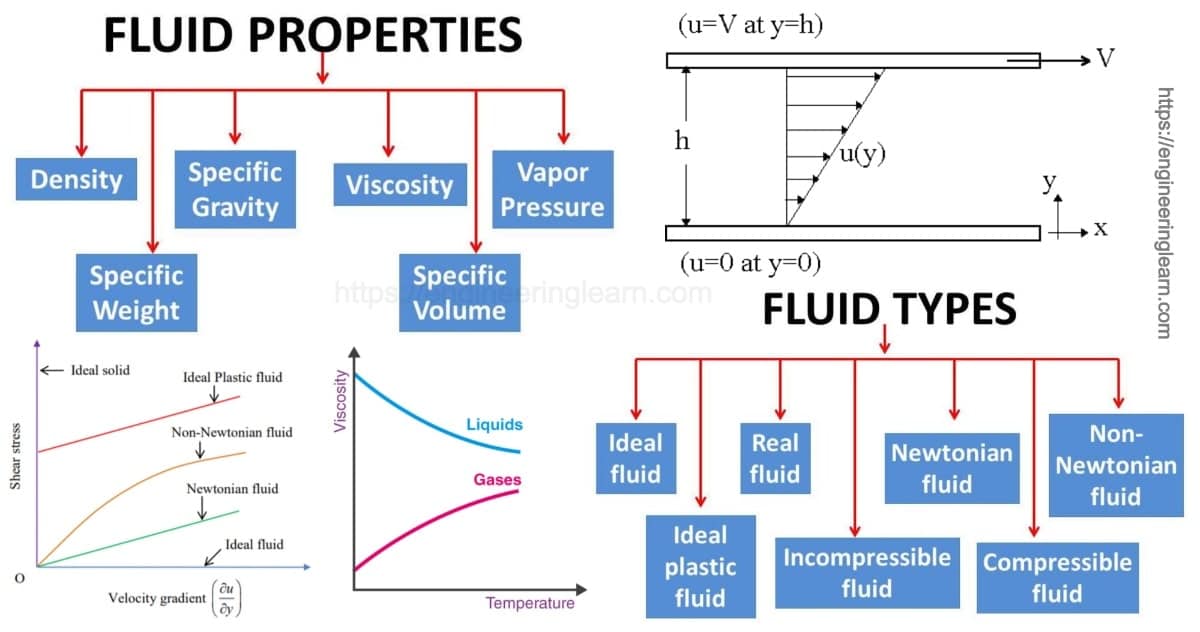
The relationships between these properties are summarized in this chart.
Test your understanding!
The specific gravity of Jet A-1 fuel, a common aviation turbine fuel, is approximately 0.8. Assume the density of water is 1000 kg/m³ and m/s².
- Calculate the density of Jet A-1 fuel in kg/m³.
- Calculate the specific weight of the fuel in N/m³.
- If an aircraft's wing tank has a volume of 5 m³, what is the mass of the fuel it can hold?
Show answer
-
Density:
We use the definition of specific gravity: . -
Specific Weight:
We use the relationship between specific weight and density: . -
Mass of Fuel:
From the definition of density, .
The tank can hold 4000 kg (4 tonnes) of fuel. This simple calculation is fundamental in aircraft weight and balance management.
2. The "Thickness" of a Fluid: Viscosity
While density describes a fluid's mass, it doesn't tell us how it flows. Honey and water have similar densities, but they flow very differently. This resistance to flow, or internal friction, is called viscosity. It's one of the most important properties in fluid mechanics, governing everything from the drag on an airplane to the pressure loss in a fuel line.
The following video provides an excellent conceptual and mathematical introduction to viscosity.
This video from 'The Efficient Engineer' brilliantly explains what viscosity is, where it comes from, and how we model it mathematically.
Please watch from 00:28 to 05:10 and from 06:21 to 07:38. Focus on: The concept of shear stress between fluid layers. The definition of Newton's Law of Viscosity. The difference between dynamic and kinematic viscosity. How temperature affects viscosity in liquids and gases.
As the video explained, viscosity links the shear stress within a fluid to its rate of deformation. This is analogous to how Young's Modulus in solids (from our Mechanics of Materials module) links stress to strain.
Let's formalize the concepts:
-
Newton's Law of Viscosity: For most common fluids, called Newtonian fluids, the shear stress () is directly proportional to the rate of shear strain. This rate is represented by the velocity gradient (), which is the slope of the velocity profile.
Here, is the constant of proportionality. -
Dynamic Viscosity (): This is the property in the equation above, also known as absolute viscosity. It represents the fluid's intrinsic resistance to shearing flows. Its SI unit is Pa·s (Pascal-second) or N·s/m².
-
Kinematic Viscosity (): In many fluid dynamics problems, the ratio of dynamic viscosity to density appears. We define this ratio as the kinematic viscosity.
Physically, kinematic viscosity represents how quickly momentum diffuses in a fluid. Its SI unit is m²/s. -
Effect of Temperature: As you saw, temperature has opposite effects on liquids and gases.
- Liquids: Viscosity decreases as temperature increases. Higher thermal energy allows molecules to overcome the cohesive forces binding them together more easily. (e.g., engine oil is thicker when cold).
- Gases: Viscosity increases as temperature increases. In gases, viscosity arises from molecular collisions and momentum exchange between layers. Higher temperature means more molecular motion and thus more collisions. This is a key consideration in high-speed aerodynamics.
Test your understanding!
Consider two large, parallel plates separated by a 2 mm gap, filled with an oil that has a dynamic viscosity Pa·s. The bottom plate is stationary, and the top plate is pulled at a constant velocity of 1.5 m/s.
- Assuming a linear velocity profile in the gap, calculate the velocity gradient ().
- Calculate the shear stress () in the oil.
- If the top plate has an area of 0.5 m², what force is required to keep it moving at 1.5 m/s?
Show answer
-
Velocity Gradient:
For a linear profile, the gradient is the change in velocity over the change in distance. The velocity changes from 0 at the bottom plate to 1.5 m/s at the top plate, over a distance of 2 mm (0.002 m). -
Shear Stress:
Using Newton's Law of Viscosity: -
Force:
Shear stress is force per unit area (). Therefore, .
A force of 26.25 N is required to maintain the plate's motion. This force is needed to overcome the viscous friction in the oil.
Conclusion
In this lesson, we have defined and learned to calculate the fundamental properties that characterize a fluid. These properties are the building blocks for all subsequent analysis in fluid mechanics.
Key Takeaways:
- Density () and Specific Weight () describe a fluid's mass and weight per unit volume, respectively. They are related by .
- Specific Gravity (SG) provides a convenient, dimensionless measure of a fluid's density relative to water.
- Viscosity is a measure of a fluid's resistance to flow and is described by Newton's Law of Viscosity, .
- Dynamic viscosity () is the fluid's intrinsic resistance to shear, while kinematic viscosity () relates to how momentum diffuses through the fluid.
- Temperature has a significant—and opposite—effect on the viscosity of liquids and gases.
Next Steps:
Now that we have a grasp of these basic properties, we can begin to analyze how fluids behave. In the next lesson, we will focus on hydrostatics—the study of fluids at rest. We will learn how to apply the hydrostatic pressure equation to determine the pressure at any depth within a static fluid, a foundational skill for analyzing everything from fuel tanks to hydraulic systems.
Can't find a good explanation? Sign up and we'll make it for you
Sign up