Hello! Welcome to the first lesson of your course on using game theory for business decisions.
The main goal of this course is to equip you with a new way of thinking strategically about your woodworking business. We'll move beyond simple business planning and into the realm of interactive decision-making, where your best move depends on the moves of others.
In this introductory lesson, we will focus on the first, most fundamental step of strategic analysis: identifying the key players who can affect your business's success. By the end of our session, you'll be able to map out the customers, suppliers, competitors, and other key parties in your specific market. This map will serve as the foundation for all the strategic frameworks we'll build in later lessons.
The Building Blocks of a Strategic Game
Before we dive in, it's helpful to understand the basic components of any strategic interaction, or "game." In game theory, every situation can be broken down into four key elements:

- Players: The decision-makers in the game.
- Rules: The laws, customs, contracts, and practical constraints that govern how the players can behave.
- Actions/Consequences: The moves each player can make and the outcomes that result from those moves.
- Payoffs: The value (positive or negative) that each player receives from a particular outcome.
Today, our entire focus is on that first, crucial element: the Players.
Introducing the Value Net: A Map of Your Business World
To identify the players relevant to your business, we'll use a powerful framework called the Value Net. It was developed to help business leaders see beyond just their direct competitors and understand the full landscape of relationships that determine a company's success.
The Value Net organizes all the key players into four main categories.
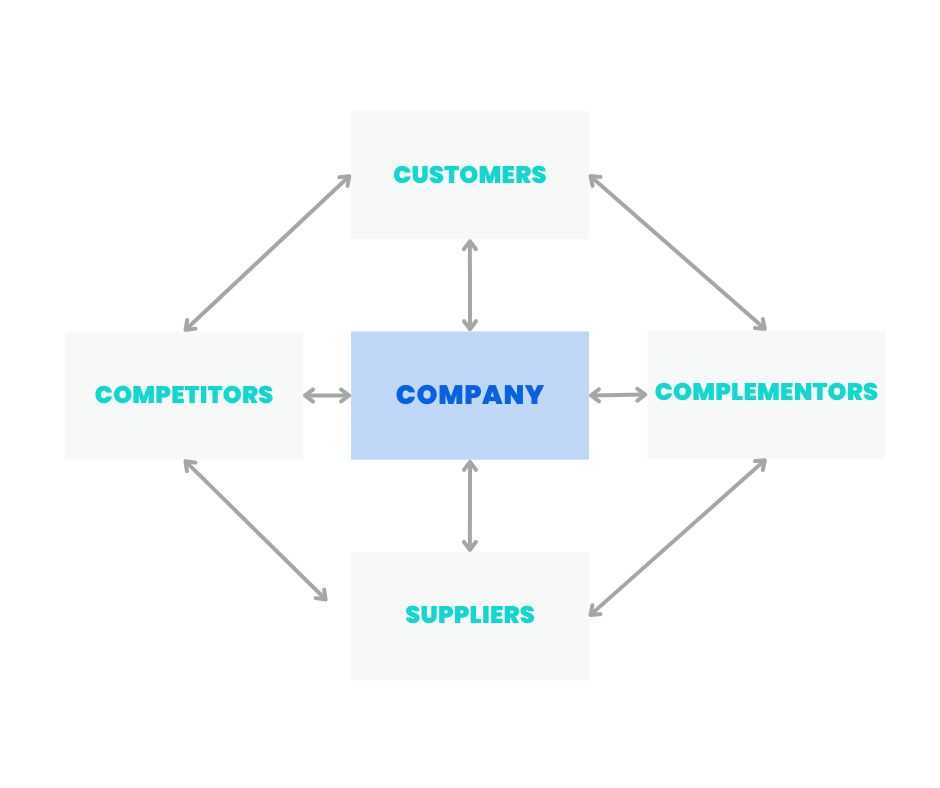
To get a clear definition of each of these player types, please read the following short sections from the article "The Value Net Framework".
This reading will introduce you to the four core player types in the Value Net. It provides clear, business-focused definitions for each one.
Please read the subsections under 'Now let’s go over the components of this framework:'. Focus on the definitions for 'Customers', 'Competitors', 'Suppliers', and 'Complementors'.
Deep Dive: The Four Player Types in Your Woodworking Business
As you just read, the Value Net identifies four key roles. Let's translate these general definitions into the specific context of your new premium woodworking venture.
1. Customers
This seems obvious, but it's worth being specific. Your customers are the people or entities who pay you for your products. For your business, this could include:
- End-consumers: Homeowners commissioning a new set of kitchen cabinets or a custom front door.
- Intermediaries: General contractors, interior designers, or architects who specify your products for their projects.
The strategies you use to appeal to a homeowner might be very different from how you build relationships with a contractor. Identifying them separately is a critical first step.
2. Suppliers
These are the businesses you pay. They provide the necessary inputs for you to create your products.
- Material Suppliers: Lumber yards, veneer specialists, suppliers of high-quality plywood.
- Hardware Suppliers: Companies that provide hinges, handles, drawer slides, and other fittings.
- Equipment Suppliers: The company you buy your CNC machine from is a key supplier. Their support, training, and reliability directly impact your business.
- Service Suppliers: The software company for your CNC machine, your accountant, or even the company that hosts your website.
Your relationships with suppliers determine your costs, your quality, and sometimes even your production capacity.
3. Competitors
These are the other players your customers might turn to for a solution. It's crucial to think broadly here.
- Direct Competitors: Other local custom woodworking shops that produce high-end doors and cabinets.
- Indirect Competitors:
- Large-scale manufacturers (like KraftMaid or even high-end IKEA lines) that offer a different value proposition (lower cost, less customization).
- Cabinet refacing companies that offer a cheaper alternative to full replacement.
- Even a homeowner's decision to simply repaint their existing cabinets instead of replacing them represents competition for their budget.
The article you read used the great example of a gas station competing not just with another gas station, but with the city's transit system. For you, any alternative that solves the customer's "need for a new kitchen" is a form of competition.
4. Complementors
This is often the most overlooked but most powerful category. A complementor is any player whose products or services make yours more valuable to the customer.
- If you make premium kitchen cabinets, a manufacturer of high-end stoves and refrigerators (like Sub-Zero or Wolf) is a complementor. A customer is more likely to want your premium cabinets if they are also buying premium appliances.
- If you make custom entry doors, an architect specializing in luxury homes is a complementor. Their designs create the need for your product.
- Other complementors could include:
- High-end countertop suppliers (granite, quartz).
- Luxury lighting fixture companies.
- Interior designers who serve your target clientele.
Working with complementors can be a powerful way to grow your business, a topic we'll explore in depth in a future lesson.
Test your understanding!
Imagine you're running your woodworking business. Categorize each of the following as a Customer, Supplier, Competitor, or Complementor.
- A local construction firm that builds luxury homes.
- A company that sells premium German-made drawer slides.
- A large, well-known cabinet shop in a neighboring city that also targets high-end clients.
- A manufacturer of high-end faucets and sinks.
Show answer
- Customer: The construction firm buys your cabinets to install in the homes they build. They could also potentially be a Complementor if you work together to win projects, but their primary role is that of a buyer.
- Supplier: They provide a key component for your cabinets.
- Competitor: They are targeting the same customers with a similar product.
- Complementor: Their premium faucets make your premium cabinets and the entire kitchen project more attractive to the end customer.
Your Turn: Map the Players in Your Value Net
Now it's time to apply this framework directly to your business. This exercise is the core takeaway for today's lesson. Creating this map will give you a clear, strategic picture of your business environment.
The following resource provides a concise, step-by-step guide to applying the Value Net. We'll focus on the first part of this process.
Value Net - Strategy Frameworks
This guide offers a practical, step-by-step method for using the Value Net. We will focus on the step that involves identifying and listing the players.
Please read section 5, 'How to Apply the Value Net: Step-by-Step'. Focus your attention on Step 2, 'Map the players and alternatives'. This will guide your thinking for the activity below.
Activity (15 minutes):
Take a piece of paper or open a new document. Based on the reading and our discussion, create your own Value Net. For each of the four categories, list at least 2-3 specific names or types of businesses.
- My Customers:
- (Who are your ideal first customers? e.g., "Homeowners in [Your Town] with home values over $X", "Boutique contracting firm 'XYZ Construction'").
- My Suppliers:
- (Who will you rely on? e.g., "The CNC machine vendor [Brand Name]", "Local lumber yard [Name]", "Blum for hardware").
- My Competitors:
- (Who are you up against, directly and indirectly? e.g., "Custom shop 'ABC Woodworks'", "Home Depot's design service").
- My Complementors:
- (Whose success helps you? e.g., "Sarah Jones Interior Design", "The local Ferguson appliance showroom").
Don't worry about getting it perfect. This is a living document that you will refine as you learn more about your market. The goal is to start thinking strategically about these relationships.
Conclusion
In this lesson, we took the first essential step in applying game theory to your business. You learned that strategic thinking begins with identifying the key Players in your environment.
Key Takeaways:
- Any strategic interaction involves Players, Rules, Actions, and Payoffs.
- The Value Net is a framework for mapping the four key player types: Customers, Suppliers, Competitors, and Complementors.
- It's crucial to think broadly about competition and to actively identify Complementors, as they represent opportunities for collaboration and mutual gain.
By creating a preliminary map of your own Value Net, you've already moved from a simple business idea to a strategic view of your market.
Preview of the Next Lesson:
Now that we have identified who the players are, our next lesson will focus on the nature of the game itself. We'll explore the fundamental difference between competitive and cooperative situations, and you'll learn to recognize when you're in a situation where you need to fight for a bigger slice of the pie versus one where you can work with others to make the entire pie bigger.