
Hello! Welcome to the first lesson in our module on Multi-Touch Attribution and Customer Journey Intelligence.
In our previous lesson, we established a holistic measurement framework, positioning attribution as the "microscope view" used for granular, in-channel tactical optimization. Now, we're going to adjust the lenses on that microscope. Your teams on the ground use these models daily, and your ability to guide their strategy depends on understanding the strengths, weaknesses, and inherent biases of each one.
Today's learning outcome is to compare the strategic implications of different attribution models (e.g., last-click, linear, data-driven). We won't be looking for a single "best" model. Instead, your goal as a leader is to understand which model provides the most useful lens for a given business objective and to recognize the strategic blind spots each one creates.
1. The Attribution Challenge: Dividing the Credit
The modern customer journey is rarely a straight line. A user might see a social media ad, later search for your brand on Google, read a blog post, receive an email, and finally click a retargeting ad before converting. The core challenge of attribution is to assign credit for that conversion back to these various touchpoints.
The model you choose to do this is not just a technical setting in an analytics platform; it is a strategic decision that will directly influence which marketing activities are perceived as valuable and, consequently, where your budget flows.
Let's begin by visualizing the most common models.
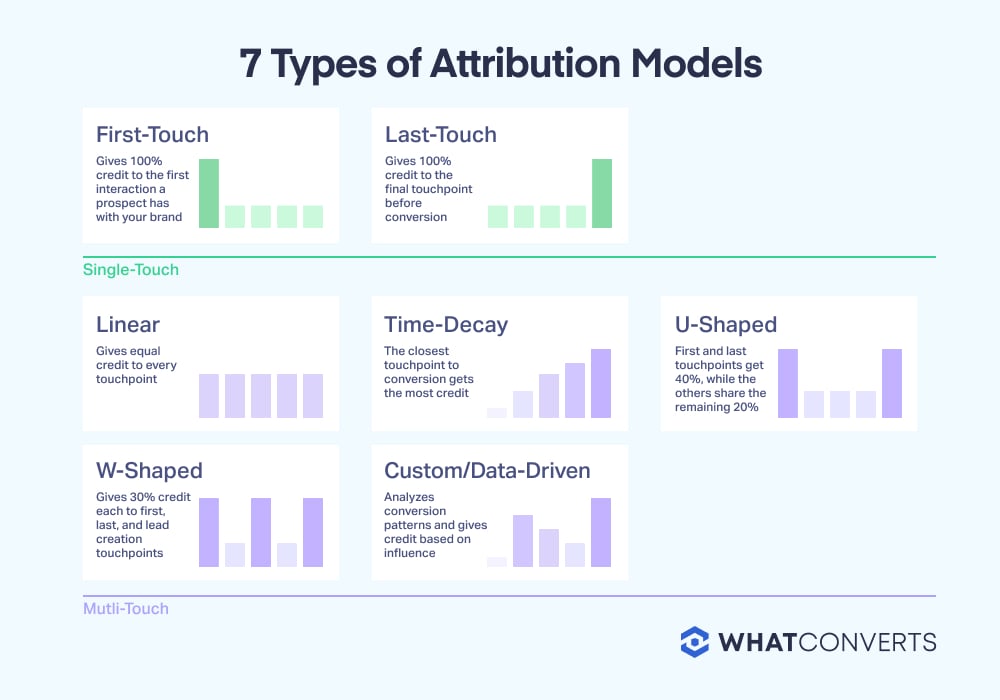
As you can see, these models can be broadly grouped into two families:
- Rule-Based (or Heuristic) Models: These assign credit using simple, predefined rules. They are transparent and easy to understand. This category includes all the single-touch and multi-touch models shown, except for the last one.
- Data-Driven (or Algorithmic) Models: These use your historical data and machine learning to calculate the actual influence of each touchpoint, creating a custom model tailored to your business.
We will now explore the strategic implications of each.
2. Rule-Based Models: Simplicity and Its Biases
Rule-based models are the most common starting point for attribution. They are built into most marketing and analytics platforms (like Google Analytics and the ads platforms you're familiar with), making them accessible and easy to implement. However, their simplicity comes with significant trade-offs.
The Power of Attribution Models in Data-Driven Decisions
To understand these models in detail, please read the following sections from the article 'The Power of Attribution Models in Data-Driven Decisions' by Concord. It provides a clear breakdown of each rule-based model.
Please read the sections on 'Single Touch Attribution Business Logic' (covering First Touch and Last Touch) and 'Multi-Touch Attribution Business Logic' (covering Linear, Time Decay, U-Shaped, and W-Shaped). For each model, focus on the 'Benefits and Drawbacks' and 'When to Use'/'When to Avoid' subsections.
Let's synthesize what you've just read and frame it from a leadership perspective.
Single-Touch Models: A Narrow Focus
-
Last-Touch Attribution: This is often the default. It gives 100% of the credit to the final touchpoint.
- Strategic Implication: It heavily favors bottom-of-funnel, "closing" channels like branded search and retargeting ads.
- Leadership Risk: You risk systematically under-investing in upper-funnel activities that create initial demand (e.g., social media awareness campaigns, content marketing). Your teams will be incentivized to "harvest" existing demand rather than create it.
-
First-Touch Attribution: This gives 100% of the credit to the first recorded interaction.
- Strategic Implication: It highlights top-of-funnel, "opening" channels that introduce new users to your brand. It's useful if your primary goal is new customer acquisition and lead generation.
- Leadership Risk: It ignores the entire middle and bottom of the funnel. You'll have no insight into which touchpoints effectively nurture leads and drive them toward conversion.
Multi-Touch Models: A Broader, but Still Arbitrary, View
These models attempt to provide a more balanced picture by distributing credit across multiple touchpoints.
-
Linear Attribution: Gives equal credit to every touchpoint.
- Strategic Implication: A "democratic" model that acknowledges all interactions have some value. It prevents the extreme bias of single-touch models.
- Leadership Risk: It assumes all touchpoints are equally valuable, which is almost never true. A view of a display ad is treated the same as an in-depth product demo. It can lead to mediocrity by not highlighting the truly impactful moments.
-
Time-Decay Attribution: Gives more credit to touchpoints closer to the time of conversion.
- Strategic Implication: A more nuanced version of last-touch, useful for businesses with longer consideration cycles where recent interactions (like a final promotional email) are more influential.
- Leadership Risk: Similar to last-touch, it still undervalues the critical first touchpoints that initiated the journey.
-
Position-Based (U-Shaped & W-Shaped): These give more weight to specific "key" moments—typically the first and last touches (U-Shaped), with the W-Shaped model adding a third key moment for lead creation.
- Strategic Implication: This is often a good strategic compromise, as it values both starting the conversation (acquisition) and closing the deal (conversion). The W-shaped model is particularly relevant for businesses with a distinct lead qualification step (e.g., a SaaS trial signup).
- Leadership Risk: The weights (e.g., 40% first, 40% last, 20% middle) are still arbitrary. They represent a hypothesis about what's important, not a data-backed conclusion.
Test your understanding!
Imagine a customer journey for an e-commerce purchase:
- Sees a TikTok ad (Awareness)
- A week later, searches on Google and clicks an organic link to a blog post (Consideration)
- Signs up for the newsletter from the blog post (Lead Creation)
- Two days later, clicks a link in a promotional email (Nurturing)
- Clicks a Facebook retargeting ad and makes a purchase (Conversion)
How would a Last-Touch model and a W-Shaped model assign credit? What different strategic conclusions might a marketing leader draw from each?
Show answer
-
Last-Touch Model: 100% of the credit goes to the Facebook retargeting ad.
- Strategic Conclusion: "Our retargeting ads are incredibly effective. We should increase our Facebook budget, specifically for retargeting campaigns." This view completely ignores the roles TikTok, SEO, and email played in making the sale possible.
-
W-Shaped Model: Credit is split, with the majority going to the first touch (TikTok), lead creation (Newsletter Signup), and last touch (Facebook ad). The touches in between get a small share. For example, 30% to TikTok, 30% to the Newsletter Signup event, and 30% to the Facebook ad, with the remaining 10% split between the organic search click and the email click.
- Strategic Conclusion: "Our success depends on a combination of awareness (TikTok), lead capture (our blog/newsletter), and closing (Facebook retargeting). We need to ensure we are funding and optimizing all three of these key stages, not just the final click." This provides a much more holistic and strategically sound view of the funnel.
3. Data-Driven Attribution: The Algorithmic Approach
While rule-based models are a good start, their fundamental weakness is that the "rules" are based on human assumptions. Data-Driven Attribution (DDA) flips this by letting the data create the rules.
Data-Driven Attribution vs Rule-Based: Which Fits Your ...
The article 'Data-Driven Attribution vs Rule-Based' provides an excellent comparison focused on the strategic choice between these two families of models. Let's explore the data-driven approach first.
Please read the sections 'Data-Driven Attribution Models: Precision Through Machine Learning' and 'Data-Driven vs Rule-Based Attribution: Side-by-Side Comparison'. Focus on how DDA works, its benefits, its challenges, and how it impacts marketing strategy differently than rule-based models.
As you read, DDA uses algorithms to analyze all converting and non-converting paths. By comparing these paths, it calculates the actual probability of conversion added by each touchpoint.
-
Strategic Implication: DDA provides the most accurate and unbiased view of how your marketing channels work together. It often uncovers the hidden value of upper-funnel "assist" channels that rule-based models miss. This allows you to allocate your budget with much greater confidence, moving funds to channels that have a proven influence, not just those that happen to be the last click. The article mentions this can lead to a 6% increase in conversions—a direct result of smarter budget allocation.
-
Leadership Risk & Challenges:
- Data Hungriness: DDA requires a large volume of high-quality data to be effective. It's not a viable option for small businesses or those with low conversion volume.
- Resource Intensity: It requires investment in technology and expertise (data scientists or specialized vendors) to implement and maintain.
- The "Black Box" Problem: Because the model's logic is complex, it can be difficult to explain to non-technical stakeholders (like the CFO) why it's crediting a channel a certain way. Your role as a leader is to build trust in the model's outputs.
4. Making the Strategic Choice
As a marketing leader, your job isn't to be a data scientist, but to be a savvy consumer of these models. The right choice depends entirely on your context.
Data-Driven Attribution vs Rule-Based: Which Fits Your ...
To wrap up, let's review a practical framework for choosing the right model.
Please read the final section, 'How to Choose the Right Attribution Model for Your Business'. Pay close attention to the key factors listed.
The decision boils down to balancing accuracy against complexity, considering these key factors:
- Business Goals: Are you focused on pure acquisition (favoring First-Touch), direct sales with a short cycle (favoring Last-Touch or Time-Decay), or a balanced view of a complex funnel (favoring Position-Based or DDA)?
- Customer Journey Complexity: The more channels and touchpoints involved, the less reliable simple rule-based models become and the stronger the case for DDA.
- Data Maturity and Resources: Do you have the data volume, technical team, and budget to support a DDA model? If not, a Position-Based model is often the most pragmatic and strategically sound rule-based option.
Your role is to guide the organization's evolution. A startup might rightly begin with Last-Touch. As it grows, you might champion a move to a Position-Based model. As the company matures and invests in its data infrastructure, you can then build the business case for a DDA project.
Conclusion
Today, we've dissected the most common attribution models, focusing not on their technical mechanics but on their strategic impact.
Key Takeaways:
- Attribution models are not neutral; they are biased lenses that shape how you value your marketing efforts and allocate your budget.
- Rule-based models (First-Touch, Last-Touch, Linear, etc.) are simple and transparent but rely on arbitrary assumptions that can lead to poor strategic decisions.
- Data-driven models offer a more accurate, nuanced, and dynamic view by learning from your actual customer data, but they require significant investment in data and resources.
- Choosing an attribution model is a strategic decision that must align with your business goals, customer journey complexity, and organizational maturity.
Preview of the Next Lesson:
Now that you understand the what and why of different models, our next lesson will focus on the when. We will explore how to evaluate when to use heuristic (rule-based) vs. algorithmic (data-driven) models for tactical optimization. This will equip you to provide clear guidance to your teams on which tool to use for which job.