Hello! Welcome to the third lesson in our special topic module on AI startup diligence.
In our last lesson, we learned how to spot "AI washing" by looking for tell-tale signs like vague technical claims, a lack of deep AI expertise on the team, and most importantly, a failure to demonstrate real customer traction. We concluded that a key differentiator for a genuine AI company is often a defensible moat, frequently built on proprietary data.
This lesson directly builds on that idea and addresses the learning outcome: Analyze the components of a startup's data acquisition and annotation strategy.
As you prepare to invest in and mentor AI-focused startups, your ability to dissect and evaluate their data strategy will be one of your most critical skills. A strong, defensible data strategy is a leading indicator of a durable business. A weak one, no matter how much data is collected, often leads to a company with no competitive advantage. We will explore the "why," "what," and "how" of data strategies so you can confidently ask founders the right questions.
1. Why Data Strategy Matters: The Foundation of a Moat
In the age of powerful open-source models and accessible APIs, a startup's AI model itself is rarely a long-term defensible moat. The enduring advantage often comes from a unique, compounding data asset that is difficult for competitors to replicate. The process of acquiring and refining this data is what creates the moat.
Let's hear from the experts at Y Combinator on how data contributes to two of the most powerful moats for AI startups.
The 7 Most Powerful Moats For AI Startups
This video from Y Combinator, 'The 7 Most Powerful Moats For AI Startups,' discusses how data creates defensibility. We'll focus on the concepts of cornered resources and network economies.
Please watch two key segments: Cornered Resources (14:26 - 17:50): Focus on how startups can gain a 'cornered resource' by getting access to real data and real workflows through deep customer integration. This is a crucial data acquisition strategy. Network Economies (37:25 - 40:05): Pay attention to how the classic network effect is reshaped in AI. The flywheel of 'more users → more data → better model → more users' is a core principle of data-driven defensibility.
As the video highlights, the goal isn't just to have data; it's to have data that gets better and more proprietary over time, creating a virtuous cycle that competitors struggle to enter.
2. A Framework for Evaluating Data Moats
To systematically analyze a startup's data strategy, we need an investor's framework. The central question you should always ask is: How hard would it be for a well-funded competitor to replicate this dataset?
This short but insightful post from an investor provides a perfect lens for this evaluation.
Evaluating Data Moats for AI-Enabled Startups
This LinkedIn post, 'Evaluating Data Moats for AI-Enabled Startups,' provides a concise, powerful framework for assessing the defensibility of a data strategy.
Read the entire post. It's very short. Internalize the five key dimensions the author lays out for evaluating a data moat. We will use these as our analytical toolkit for the rest of the lesson.
Let's summarize the excellent framework from the post. When a founder describes their data strategy, you should be evaluating it along these five dimensions:
- Ease of Aggregation: Is the data publicly available (e.g., via web scraping, public APIs) or from proprietary sources?
- Time & Cost to Recreate: Could a competitor reproduce it in months, or would it take years of historical data collection?
- Refresh Rate & Exclusivity: Is the data static, or does it update frequently? Crucially, are the rights to this data stream exclusive?
- Proprietary Labeling & Enrichment: Is the value in the raw data, or in the unique, expert-driven annotations layered on top?
- Regulatory & Contractual Protection: Do legal barriers like HIPAA or long-term exclusivity contracts protect the data?
With this framework in mind, let's explore the common strategies for data acquisition and annotation.
3. Data Acquisition: From Puddles to Moats
Data acquisition is the process of gathering the raw information that will fuel the AI model. The method a startup chooses places it somewhere on the "data moat spectrum," from a shallow, easily evaporated "puddle" to a deep, defensible moat.
This excellent article from Air Street Press provides a comprehensive overview of modern data strategies. We will use it to explore the most common acquisition methods.
Data acquisition strategies for AI-first start-ups - Air Street Press
The article 'Data acquisition strategies for AI-first start-ups' details the modern playbook for getting data. We'll read about several distinct methods.
Please read the following sections: Large generative models: Focus on 'LLMs and LMMs as synthetic data generators'. Open datasets Simulated environments Scraping the web, books, and other materials As you read, think about where each strategy fits within the evaluation framework we just discussed.
Let's categorize these strategies using our framework:
| Strategy | Description | Moat Analysis (using our framework) |
|---|---|---|
| Open Datasets | Using publicly available datasets (e.g., from Hugging Face, Kaggle). | Very Weak Moat. Easy to aggregate, zero exclusivity. Useful for initial model training or benchmarking, but never a source of long-term advantage. |
| Web Scraping | Systematically extracting data from public websites. | Weak Moat. The data is public, so aggregation is relatively easy for any competitor with engineering resources. The only defense is the sheer scale and complexity of the scraping operation, but this is a "speed bump," not a wall. |
| Synthetic Data | Using an AI model (often a large one) to generate new training data. | Variable Moat. If a startup is just using a generic model to create simple data, the moat is weak. However, if they have a sophisticated, proprietary process for generating high-quality, complex data that reflects unique edge cases, it can be a defensible asset. The "know-how" of generation becomes the moat. |
| Simulated Environments | Creating virtual worlds to generate data, common in robotics and autonomous vehicles. | Strong Moat. Building a high-fidelity simulator is extremely difficult, costly, and time-consuming. This makes the data generated from it very hard to recreate. |
| Proprietary Workflows | Sourcing data through exclusive partnerships or by integrating deeply into a customer's unique operational workflow. | Very Strong Moat. This is the "cornered resource" from the YC video. The data is exclusive, often protected by contract, and enriched by the context of the real-world process it comes from. This is the gold standard for a data moat. |
4. Data Annotation: Creating Value from Raw Material
Raw data is often just the starting point. To be useful for most machine learning tasks, it needs to be labeled or "annotated." This process—tagging images, categorizing text, identifying entities—is where immense value can be created. A startup's annotation strategy is a critical component of its data moat.
The annotation process itself can be quite structured.
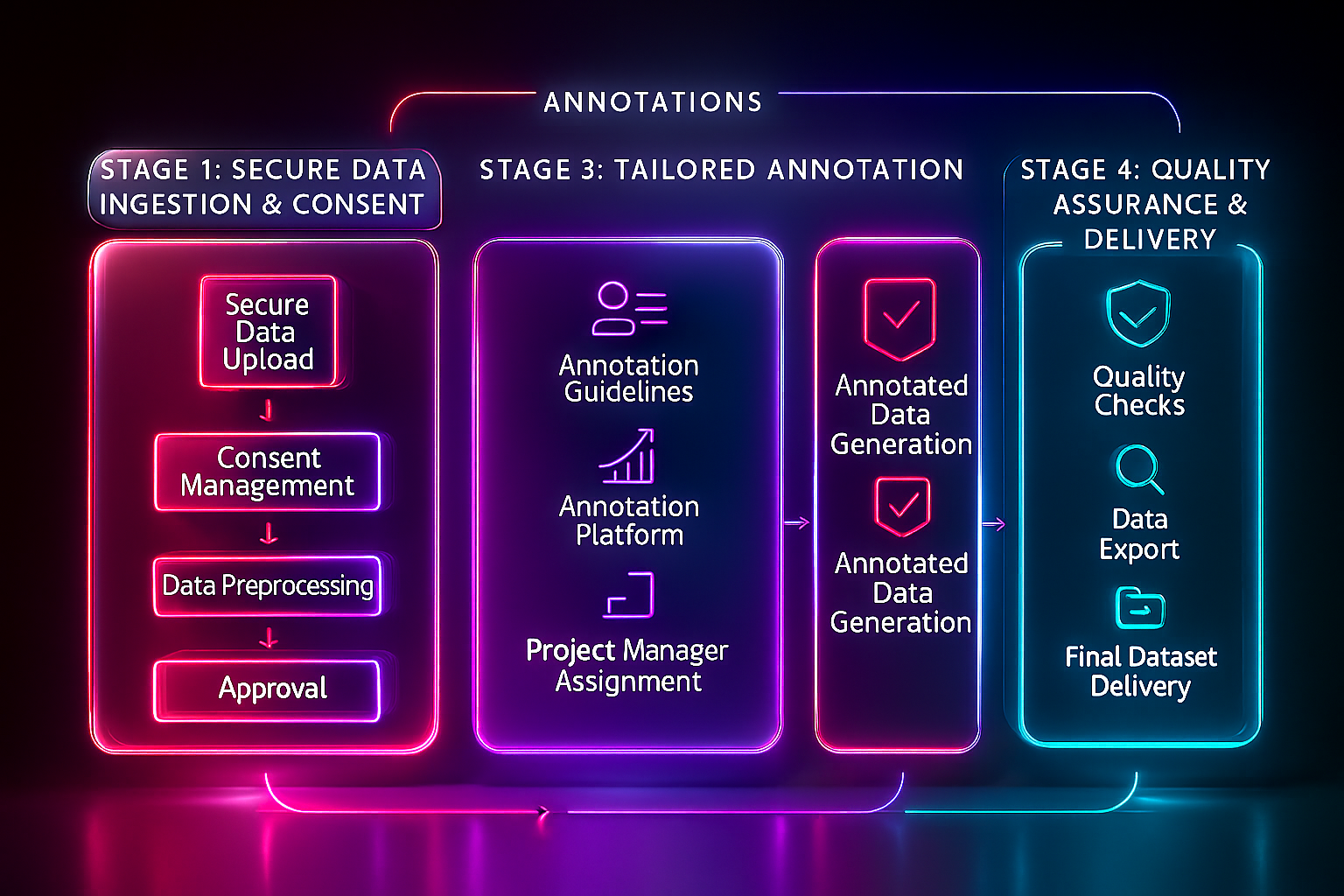
Just as with acquisition, the how of annotation matters. Let's return to the Air Street Press article to explore the different approaches.
Data acquisition strategies for AI-first start-ups - Air Street Press
Let's revisit 'Data acquisition strategies for AI-first start-ups' to understand how annotation happens, from human-powered platforms to AI-driven methods.
Please read these sections: Start with Data labeling: people and platforms to understand the landscape of human annotation services. Then, go back to the Large generative models section and read 'LLMs as labellers'. Finally, read 'LLMs as graders' to understand the concept of RLAIF.
The key takeaway is that the annotation process itself can be a proprietary asset.
- Commodity Annotation: Using generalist crowdsourcing platforms (like Amazon Mechanical Turk) for simple tasks. This is fast and cheap but offers no real moat.
- Expert Annotation: Using specialized platforms (like Scale AI, V7) or, even better, an in-house team of domain experts (e.g., doctors labeling medical scans, lawyers reviewing contracts). This "Proprietary Labeling & Enrichment" is extremely difficult and expensive for competitors to replicate. The quality and consistency of these expert labels become a powerful moat.
- AI-driven Annotation: Using powerful models (like GPT-4) to label data automatically (LLMs as labellers) or to grade the output of other models (RLAIF). This is a newer, powerful technique that can create a moat through speed, scale, and cost-effectiveness, especially if the company develops a superior process for prompting and quality control.
When you diligence a startup, you should ask not just "Do you label your data?" but "What is your annotation pipeline, who does the labeling, and how do you ensure quality?"
Test your understanding!
You are pitched by two startups aiming to disrupt the commercial real estate market with AI.
-
Startup A ("MarketPrice AI"): They scrape public real estate listings from sites like Zillow and LoopNet daily. They use a standard open-source ML model to predict property valuation trends. Their annotation is done automatically by parsing listing details.
-
Startup B ("SmartBuild AI"): They have exclusive partnerships with three large commercial property management firms. They get access to proprietary, real-time data streams including tenant maintenance requests, energy usage from building sensors, and security incident logs. They have an in-house team of five former building managers who label and categorize this data to train a model that predicts major capital expenditures (e.g., "this HVAC unit has an 80% chance of failing in the next 6 months").
Using the 5-point framework, which startup has a more defensible data strategy, and why?
Show answer
SmartBuild AI has a vastly more defensible data strategy. Here's the analysis using the framework:
-
Ease of Aggregation:
- MarketPrice AI: Very easy. The data is public. A competitor can replicate their data sources immediately.
- SmartBuild AI: Very difficult. The data comes from proprietary, exclusive partnerships.
-
Time & Cost to Recreate:
- MarketPrice AI: Low. A competitor could build a similar scraper and dataset in weeks or months.
- SmartBuild AI: High. A competitor would need to negotiate similar exclusive partnerships, which could take years, if it's even possible.
-
Refresh Rate & Exclusivity:
- MarketPrice AI: High refresh rate, but zero exclusivity.
- SmartBuild AI: High refresh rate (real-time data) and high exclusivity due to contracts. This is a huge advantage.
-
Proprietary Labeling & Enrichment:
- MarketPrice AI: None. They use automated parsing of public data.
- SmartBuild AI: This is their core strength. The in-house team of domain experts provides proprietary enrichment that is extremely difficult to replicate. The value is in their unique labels ("predicts HVAC failure"), not just the raw data.
-
Regulatory & Contractual Protection:
- MarketPrice AI: None.
- SmartBuild AI: Strong contractual protection through their exclusive partnership agreements.
Conclusion: MarketPrice AI has a "puddle" that will evaporate under competitive heat. SmartBuild AI is building a deep, defensible "moat" based on an exclusive, expertly-enriched dataset.
Conclusion
You now have a comprehensive toolkit to analyze an AI startup's data acquisition and annotation strategy. By moving beyond surface-level questions and using a structured evaluation framework, you can discern which companies are building truly defensible assets versus those that are simply repackaging public data.
Key Takeaways:
- A data moat is defined by its defensibility. Use the five-point framework (Ease of Aggregation, Time/Cost to Recreate, Exclusivity, Proprietary Enrichment, Protection) to assess it.
- Data acquisition strategies range from weak (public data, web scraping) to strong (synthetic data, simulations) to strongest (proprietary workflows and exclusive partnerships).
- Data annotation is a critical value-creation step. Annotation by domain experts is a powerful source of competitive advantage that is very difficult to replicate.
- Your job as an investor is to ask the tough questions: Where does your data come from? Is it exclusive? Who labels it? How do you ensure quality?
Preview of the Next Lesson
We have now established how to analyze the strategy and process for building a data asset. But how do you evaluate the quality of the resulting asset itself? In our next lesson, we will address the learning outcome: Evaluate the quality, relevance, and defensibility of a startup's dataset. We will explore how to spot biases, assess data freshness, and determine if the dataset is truly fit for the problem it aims to solve.