Hello! Welcome to the second lesson in our special topic module on AI startup diligence.
In our last lesson, we focused on what makes a strong AI business, exploring the concepts of technical feasibility and defensibility. You learned to assess if a team can actually build their claimed solution and, if so, whether they can protect it from competition using moats like process power, data network effects, and counter-positioning.
This lesson tackles the flip side of that coin and addresses the learning outcome: Distinguish between genuine AI innovation and superficial 'AI-washing'.
AI washing is the practice of overstating or fabricating the use of AI to capitalize on the hype. As you prepare to launch an AI-focused incubator, the ability to quickly and accurately identify these superficial claims is a fundamental screening skill. It will save you immense time and, more importantly, prevent you from investing in businesses built on a fragile foundation of marketing buzz rather than genuine innovation.
1. What is AI Washing?
Just as "greenwashing" emerged to describe false environmental claims, "AI washing" has become the term for exaggerated or misleading claims about a company's use of artificial intelligence.
To ground our understanding, let's start with a formal definition and context.
AI Washing: Signs, Symptoms, and Suggested Solutions
The CFA Institute has published a report on this very topic within the investment industry. Please read the introductory sections to get a clear definition of AI washing and the motivations behind it.
Read the sections 'What is AI Washing?', 'The Motivations Behind AIW', and the brief example contrasting a 'genuine AI application' with a superficial one. Focus on understanding the definition, the commercial pressures that lead to this behavior, and the fundamental tension between the desire to appear cutting-edge and the difficulty of genuine implementation.
As the report highlights, AI washing can range from using buzzwords without substance to making outright false claims about a product's capabilities. A study cited by Mercanis found that 40% of European startups presenting themselves as "AI startups" didn't actually use real AI in a meaningful way.
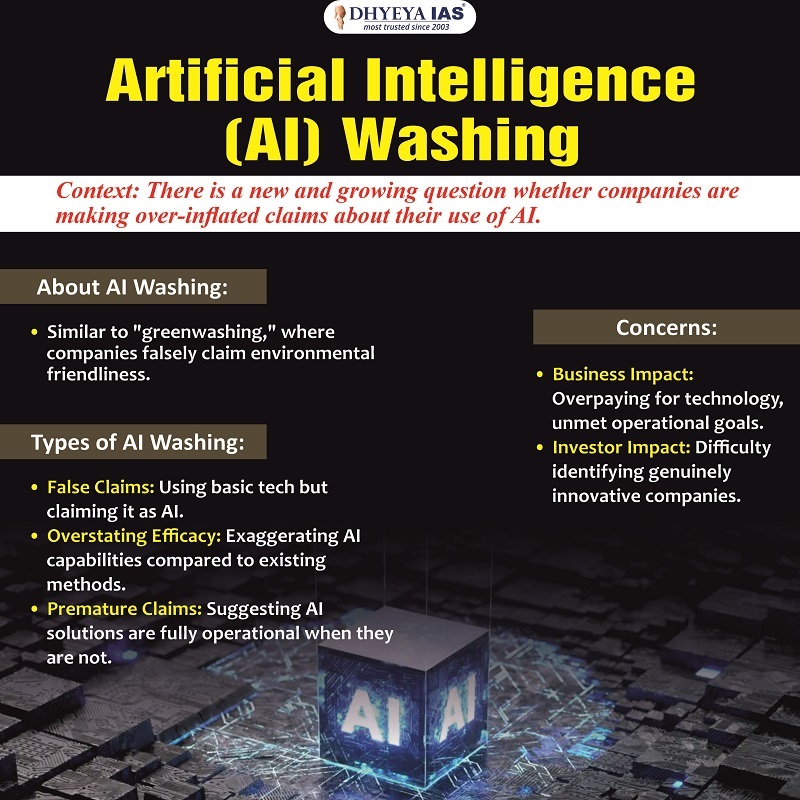
The most common form of AI washing today involves building a thin "wrapper" around a publicly available large language model (LLM) from a provider like OpenAI or Anthropic. The startup's product is often just a user interface that passes prompts to the underlying model's API. While these can be built quickly and look impressive, they often represent weak and unsustainable businesses.
2. The "AI Wrapper" and its Unsustainable Economics
A key indicator of potential AI washing is a business model that lacks a path to profitability. Many simple "AI wrappers" fall into this category. Unlike traditional Software-as-a-Service (SaaS), where the cost to serve an additional customer is near zero, AI-native products have a real, ongoing computational cost for every user action (inference). This fundamentally changes the unit economics.
This video provides an excellent, numbers-focused breakdown of why many of these businesses are economically unviable.
Why Most AI Startups Are Bad Businesses
In this video, 'Why Most AI Startups Are Bad Businesses', the creator breaks down the challenging economics of AI-native products, especially 'LLM wrappers'.
Please watch two key sections: The introduction (00:00 - 02:31), which contrasts the high margins of traditional SaaS with the much lower margins of AI-native products. The section on identifying sustainable models (13:14 - 17:42), which presents a 'litmus test' for a good AI business. Focus on the idea that a valuable product should solve a real problem even without AI.
The video makes a critical point that serves as a powerful first-pass filter: Would this product solve a real problem without AI? If the answer is no, and the entire value proposition is "we use AI," you should be highly skeptical. A genuine innovation uses AI to solve an existing problem 10x better, faster, or cheaper, rather than using AI for its own sake.
3. A Practical Framework for Spotting AI Washing
As an investor, you need a systematic way to probe a startup's claims. Your due diligence process should be designed to separate hype from reality. Here is a framework combining key signals.
Signal 1: Scrutinize the Claims and the Team
Genuine AI companies are typically transparent about their technology. Vague, evasive language is a major red flag.
The Mercanis blog provides a clear, actionable checklist for this.
AI washing: How to distinguish genuine AI from marketing ...
This blog post, 'AI washing: How to distinguish genuine AI from marketing...', offers a practical, step-by-step guide.
Read the section '5 practical steps: Distinguishing real AI from AI washing'. Pay attention to the key questions under each step, such as 'Does the system learn from new data?' and the emphasis on demanding measurable results.
Going a step further, the CFA Institute report suggests that one of the easiest ways to verify a firm's AI claims is to investigate the people behind them.
AI Washing: Signs, Symptoms, and Suggested Solutions
Let's revisit the CFA report to focus on its advice for uncovering AI washing through personnel analysis.
Read the section 'Uncovering Potential AIW'. The core takeaway is to investigate the leadership of the technical teams. A lack of deep, relevant experience in AI/ML roles is a strong negative signal.
A startup claiming to build a novel AI system should have founders or key technical leaders with demonstrable experience in machine learning, data science, or a related field. If the "Head of AI" is a long-time marketing executive with a recently completed online certificate, it's a sign that the company's AI efforts may be more for show than for substance.
Signal 2: Demand Proof of Value (Traction)
In the current environment, a slick demo is easy to create. An investor's most reliable signal against AI washing is not the demo, but customer validation. A startup that has convinced a customer to pay for their product, even an early version, has demonstrated it solves a real problem worth solving.
This concept is brilliantly illustrated in the following pitch deck review, which analyzes a startup that is successfully securing VC meetings precisely because it has this proof.
This Pitch Deck is (Almost) PERFECT & Getting VC Meetings! (AI Agent Startup)
In this video, 'This Pitch Deck is (Almost) PERFECT', investor Ed Kang critiques the deck of a real AI startup. He highlights why having a paying customer is the ultimate antidote to AI washing.
Watch the sections analyzing the Problem/Solution (02:46), How it Works (08:40), and especially Traction (15:49). Notice how the solution directly and quantifiably solves the stated problem. In the 'How it works' section, note the emphasis on being an 'agent, not another tool', indicating a deeper integration than a simple wrapper. Most importantly, focus on the 'Traction' analysis. Understand why Kang states that 'getting the first paying customer says a lot these days' and how this is a more powerful signal to investors than a perfect demo.
As Kang emphasizes, development is now the easier half of the equation; distribution and proving value are what investors are looking for. Your diligence process should prioritize evidence of market pull—letters of intent, pilot customers, and especially paying customers—over technical wizardry alone.
Signal 3: Ask the Tough Technical Questions
Finally, for startups that pass the initial screens, your CS background allows you to go deeper. You don't need to be a research scientist, but you should be comfortable asking pointed questions to test the depth of their technical claims. The goal is to see if they can move beyond buzzwords to specifics.
The CFA Institute report provides an excellent list of such questions. For an early-stage investor, the most relevant ones are those that probe the core of their claimed innovation.
Here is a curated set of questions, adapted from the CFA report and tailored for pre-seed AI diligence:
- Model & Data:
- "Can you specify what type of model you're using? Are you fine-tuning a base model or building from scratch?"
- "What data sources are you using to train or fine-tune your model? Is this data proprietary?" (We will dive much deeper into this in the next lesson).
- "How does your AI-driven model outperform simpler, non-AI heuristics? Can you show a comparison?"
- Robustness & Overfitting:
- "What precautions are you taking to guard against overfitting?"
- "How do you validate the model's performance? Can you walk me through your evaluation framework?" (This connects back to our previous lesson).
- Interpretability:
- "Can you provide an example of a recent decision influenced by the model’s output? How was the rationale explained to the team?"
A team with genuine expertise will welcome these questions and provide specific, confident answers. A team engaged in AI washing will likely respond with vague marketing-speak.
Test your understanding!
You are evaluating a startup called "MarketAI". Their pitch is to "use the power of generative AI to create high-conversion marketing copy for e-commerce stores."
Here's what you learn during diligence:
- Product: The product is a web app where users input a product description, and it generates ad copy, emails, and social media posts.
- Technology: When asked about their model, the CEO says they use "a proprietary blend of advanced intelligent algorithms, including GPT-4." They refuse to give more detail, citing their "secret sauce."
- Team: The founding team consists of two experienced marketing executives. Their CTO is a recent computer science graduate whose main experience is in web development.
- Traction: They have a beautiful, functional demo. They have 1,000 free-trial sign-ups but have not yet converted any to a paid plan. They say they are "focused on growth before monetization."
Based on the framework from this lesson, identify at least three red flags that suggest MarketAI might be an example of AI washing.
Show answer
Here are several red flags indicating AI washing:
- Vague Technical Claims & "Secret Sauce" Defense: Their response about using a "proprietary blend of advanced intelligent algorithms" is a classic example of vague marketing-speak. A genuine team would be able to articulate their specific approach (e.g., fine-tuning, retrieval-augmented generation, prompt engineering chains) without giving away proprietary code. Hiding behind the "secret sauce" defense for high-level architectural questions is a major red flag.
- Lack of Deep Technical Expertise on the Team: While the marketing experience is relevant, the lack of a seasoned AI/ML leader is concerning. A CTO with only web development experience is likely not equipped to build a defensible, novel AI system beyond a simple API wrapper around GPT-4.
- No Customer Validation (No Paying Customers): 1,000 free-trial users demonstrate good top-of-funnel marketing, but the inability to convert any to paid customers is a critical failure. It suggests the product is a "nice-to-have" toy, not a must-have tool that solves a real business problem. They haven't proven value.
- Likely a Thin "Wrapper" with Poor Economics: The description strongly suggests the product is a simple interface for the GPT-4 API. This means they have no technical moat (anyone can build this) and are subject to OpenAI's pricing, likely resulting in very thin or negative margins, especially if they offer a low-priced subscription.
Conclusion
You now have a robust framework for looking past the hype and identifying superficial AI claims. Your ability to apply this filter will be invaluable as you build your deal flow and reputation as a savvy AI investor.
Key Takeaways:
- AI Washing is Widespread: Be skeptical by default. Many companies claiming to use AI are simply leveraging buzzwords for marketing.
- Follow the Economics: A thin "AI wrapper" is often an unsustainable business with no moat and poor margins. Ask if the product would be valuable even without AI.
- The Ultimate Test is Traction: A slick demo is not enough. The most powerful signal against AI washing is evidence that a customer finds the product valuable enough to pay for it.
- Trust, but Verify: Scrutinize the team's expertise and don't be afraid to ask specific technical questions. Evasiveness is a clear red flag.
Preview of the Next Lesson
In this lesson, we identified "proprietary data" as a key differentiator between a genuine AI innovation and a simple wrapper. But what makes a data strategy strong and defensible? In our next lesson, we will dive deep into this topic to address the learning outcome: Analyze the components of a startup's data acquisition and annotation strategy. You will learn how to evaluate the quality, defensibility, and strategic value of a startup's most critical asset: its data.