
Welcome back. You have already defined the roles worth targeting: enterprise Technology COO and VP Technology Strategy & Operations positions with a real mandate, executive sponsorship, meaningful operating complexity, and defined transformation scope.
The next question a recruiter, CIO, or hiring executive will ask—implicitly or explicitly—is: Where is the evidence that you have handled comparable problems at meaningful scale? This lesson gives you a disciplined way to answer that question without turning broad responsibilities into unsupported achievements.
Your aim is to create an evidence map: a working document that connects each target-role accountability to a specific example, a precise description of your role, verified scope, and—where available—a measured outcome. This will become the factual source for your résumé, LinkedIn profile, networking conversations, and interview stories later in the course.
The difference between experience and evidence
A senior-level résumé or interview answer cannot rely on a list such as:
- budget management;
- vendor management;
- operating-model design;
- executive stakeholder engagement.
Those are experience categories, not yet proof of readiness. Evidence makes them credible by answering five questions:
- What business or operating problem was involved?
- What did you personally own, lead, recommend, or influence?
- What was the relevant scale or complexity?
- What changed, and how do you know?
- What could verify the claim if an executive asked?
For example, “managed infrastructure budget” is a responsibility. “Managed a 150 million dollar budget for a global Enterprise IT Infrastructure function” establishes meaningful scope, but it still does not establish a financial result. It becomes an outcome claim only if you can substantiate a result—for example, an approved forecast improvement, avoided cost, investment reallocation, or performance improvement associated with your actions.
That distinction protects your credibility. At VP level, hiring executives will usually detect when a candidate is presenting organizational activity as personal impact, or describing scale as though it were a result.
A useful structure is:
Not every example will contain all four elements. That is acceptable. The discipline is to be explicit about what you do know, what you can verify, and what you should not claim.
Writing Impactful Resume Bullets – Office of Career Strategy – Yale University
Read “Writing Impactful Resume Bullets” from Yale’s Office of Career Strategy. Although it is written for a broad audience, its core distinction between responsibilities and accomplishment statements is directly useful for building executive evidence.
In the opening “Resume Accomplishment Statements” section, read the rationale for accomplishment statements. Then, in “Guidelines for Creating Impactful Resume Accomplishment Statements,” read the reflection prompts and the two writing frameworks. Focus especially on the action, project, and result structure. Use it as an evidence-capture method for now; you will turn the strongest evidence into résumé bullets in Module 3.
Build evidence before writing positioning language
You will eventually tailor language to individual job postings. But first, build a factual evidence base that remains stable across applications.
The most useful unit is an evidence card. Create one for each major accountability on your target-role scorecard.
| Field | What to capture | Example prompt |
|---|---|---|
| Target accountability | The job requirement you are seeking to demonstrate. | Financial stewardship; operating-model governance; vendor value. |
| Business context | The problem, opportunity, risk, or decision at stake. | What had to improve, be decided, or be controlled? |
| Your role | Your exact level of ownership. | Did you own, lead, design, recommend, influence, administer, or support? |
| Specific action | The mechanism you used. | Established a governance forum; renegotiated a contract; redesigned a planning process. |
| Scope | Size, reach, complexity, or authority. | Budget, geography, services, stakeholders, suppliers, team, duration, or decision rights. |
| Outcome | A verified measurable or observable result. | Cost, forecast accuracy, service performance, time, risk, delivery, adoption, or decision speed. |
| Proof source | What substantiates the claim. | Approved budget, performance dashboard, contract record, steering material, sponsor, performance review. |
| Positioning note | Why this example matters for the target role. | Demonstrates commercial governance across a global technology environment. |
The card should be written in plain language first. Do not optimize wording yet. A good first draft may look like this:
Target accountability: vendor and commercial stewardship
Context: [specific supplier, contract cycle, cost or service issue]
Role: [owned / led / influenced—select only the accurate verb]
Action: [specific governance, negotiation, sourcing, or performance mechanism]
Scope: [supplier spend, contract value, regions, services, stakeholders]
Outcome: [verified result or “outcome not yet verified”]
Proof: [contract, QBR, financial report, executive sponsor]
This format makes missing information visible. That is a feature, not a failure. You are building a reliable executive case, not trying to make every box look complete.
Separate scope from impact
Scope answers: “How large or complex was the work?”
Impact answers: “What improved because of the work?”
For your background, several valuable scope facts are already clear:
- You managed a 150 million dollar budget for a global Enterprise IT Infrastructure function.
- You have led teams ranging from zero to 20 people.
- Your experience includes operating-model design, strategic alignment, contracts and vendor management, and budget and investment management.
- You have interacted primarily with VP-level stakeholders.
These are substantial facts. But they should be presented accurately:
| Strong, evidence-safe statement | Claim to avoid unless verified |
|---|---|
| Managed a 150 million dollar budget for global Enterprise IT Infrastructure. | Delivered major savings from a 150 million dollar budget. |
| Led teams of up to 20 people. | Led a large global organization. |
| Designed or contributed to operating-model work. | Transformed the enterprise operating model. |
| Worked with VP stakeholders on strategy and operations. | Advised the C-suite on enterprise strategy. |
| Managed vendor and contract activity. | Delivered superior vendor value realization. |
The right-hand claims may eventually be true. They simply require evidence: a baseline, a result, and clarity about your authority and contribution.
Organize operating-model evidence across actors, assets, and approach
Technology Strategy & Operations roles are often difficult to describe because they sit between organizational design, financial management, governance, delivery, suppliers, and executive decision-making. Gartner’s operating-model framework is a useful way to make that work concrete.
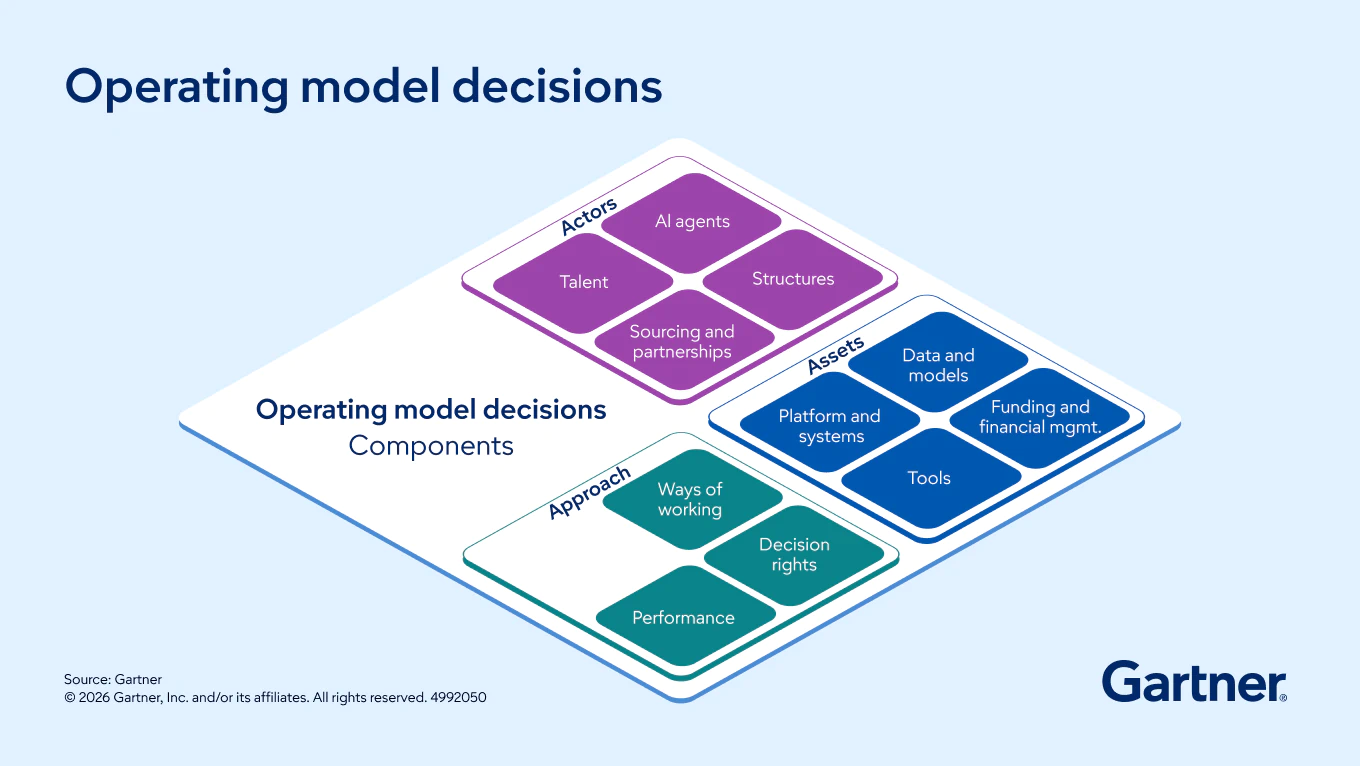
Use these three categories to unpack a vague statement such as “operating-model design.”
| Operating-model area | What it includes | Evidence you might seek |
|---|---|---|
| Actors | Structures, talent, sourcing, partnerships, accountabilities. | Team or supplier model, role design, RACI, workforce plan, new leadership forums. |
| Assets | Funding, platforms, systems, tools, data, and models. | Investment mechanisms, planning tools, reporting architecture, financial controls, vendor platforms. |
| Approach | Decision rights, performance measures, governance cadence, and ways of working. | Decision log, governance charter, performance scorecard, escalation path, operating rhythm. |
This creates a much stronger account of your operating-model work. Instead of saying:
“Led operating-model design.”
you should be able to say something closer to:
“Led [or contributed to] the redesign of [specific operating-model component], clarifying [decision rights / organizational responsibilities / supplier roles / performance mechanisms] across [scope]. The change was adopted through [governance, process, or executive approval], with [verified outcome, if available].”
The bracketed material matters. It forces you to distinguish between:
- developing a proposed model;
- gaining stakeholder agreement;
- implementing the change;
- measuring whether it worked.
All four can be valuable. They are not interchangeable.
Use an evidence hierarchy: direct, adjacent, and unproven
Not every scorecard criterion requires identical depth. A VP Strategy & Operations candidate can have strong direct evidence in financial stewardship and vendor governance while having adjacent evidence in enterprise portfolio governance or C-suite influence.
Classify each example honestly.
| Evidence level | Meaning | How to position it |
|---|---|---|
| Demonstrated | You had direct responsibility and can show verified scope plus a result, decision, or durable change. | “Led,” “owned,” “established,” or “directed,” when accurate. |
| Credible bridge | You performed closely related work at meaningful scale, but lack one part of the target mandate, formal authority, or a quantified result. | “Applied experience in…,” “brought relevant experience from…,” or “partnered to…” |
| Adjacent exposure | You participated in or supported the work but did not lead it. | “Contributed to,” “supported,” “provided analysis for,” or “influenced.” |
| Unproven | You cannot identify a specific example or substantiate it. | Do not imply prior experience; treat it as a development area. |
The verbs are not cosmetic. They signal decision authority.
- Use owned only if you had accountable responsibility for the outcome.
- Use led if you directed the work and its participants, even if a more senior executive retained final approval.
- Use designed if you created the mechanism, structure, or recommendation.
- Use influenced if your analysis, relationship, or recommendation shaped a decision controlled by others.
- Use supported only where your contribution genuinely was supportive. It is preferable to overstating authority.
Ex-Google Recruiter Explains: 6 Résumé Secrets That Get You Hired
Watch selected segments from “Ex-Google Recruiter Explains: 6 Résumé Secrets That Get You Hired” by Farah Sharghi. The useful message for this stage is not résumé styling; it is that senior candidates need clear, relevant evidence that reduces a hiring manager’s perceived risk.
Watch result evidence for the distinction between vague duties and a specific, measured result. Then watch role translation on connecting prior work to the target organization’s commercial priorities. Finish with balanced profile, which explains why a senior profile should demonstrate operational, commercial, technical, and leadership evidence rather than only one strength.
Create your initial Technology COO / VP Strategy & Operations evidence map
Below is a provisional map based only on the facts currently known about your background. It is deliberately conservative. Complete the verification column before using any row as an executive claim.
| Target-role accountability | Current evidence | Initial assessment | What to verify or add |
|---|---|---|---|
| Financial stewardship and investment discipline | Managed a 150 million dollar budget for a global Enterprise IT Infrastructure function; experience in budget and investment management. | Credible bridge with substantial scale. | Budget period; degree of accountability; planning and forecast responsibilities; investment decisions; verified cost, forecast, or allocation outcomes. |
| Vendor and commercial value | Experience in contracts and vendor management. | Credible bridge. | Supplier scope; contract or spend scale; commercial mechanisms used; service, cost, risk, or performance outcomes. |
| Technology operating-model design | Experience in operating-model design. | Credible bridge; likely differentiated if made specific. | Which actor, asset, or approach changed; your ownership; executive sponsorship; adoption; measurable operational effect. |
| Operational performance and service management | Global Enterprise IT Infrastructure context. | Relevant context, but insufficient outcome evidence yet. | Critical services; performance metrics; resilience, incident, delivery, productivity, or service-level outcomes. |
| Strategy and enterprise alignment | Director of Technology Strategy; strategic-alignment experience. | Relevant, but needs decision-level examples. | Strategic planning cycle; business problem; stakeholders; recommendations; resulting investment, priority, or roadmap decision. |
| Portfolio governance | Budget and investment-management experience may be relevant. | Potential bridge, not yet demonstrated as formal portfolio governance. | Governance forums, prioritization mechanisms, decision rights, demand management, benefits tracking, or cross-portfolio trade-offs. |
| Executive influence | Primarily interacted with VPs. | Meaningful senior exposure; needs a decision story. | A specific executive decision, your recommendation, conflicting priorities, and the resulting action. |
| People and matrix leadership | Led teams ranging from zero to 20 people. | Direct people-leadership scope is established. | Team composition, talent outcomes, operating rhythm, performance improvement, and matrix leadership beyond direct reports. |
| Transformation execution | Operating-model work may support this area. | Do not claim broad transformation leadership without a defined example. | Transformation objective, scope, sponsorship, governance, milestones, benefits, and your accountable role. |
Notice what this table does not do: it does not conclude that you lack portfolio governance, executive influence, or transformation evidence. It identifies the evidence you need to retrieve and verify.
Your strongest starting anchors are likely:
- Financial and operational scale through the global infrastructure budget.
- Commercial and supplier management through contracts and vendor work.
- Operating-model expertise through specific design and governance work.
- Direct people leadership through teams of up to 20.
- Senior stakeholder exposure through VP interactions.
The differentiator will be how well you connect these anchors. A hiring executive should see not five disconnected skills, but a leader who can improve the technology operating system: allocate resources, govern suppliers, clarify decisions, improve performance visibility, and help senior leaders make trade-offs.
Verify outcomes without inventing them
The evidence map should include a verification pass. For every high-value example, ask:
- What was the baseline before the intervention?
- What was the outcome afterward?
- Was the outcome measured, approved, or visible in a regular scorecard?
- What part of the result can I reasonably attribute to my work?
- What source, document, or senior stakeholder could confirm the claim?
Useful proof sources include:
- approved budget and forecast materials;
- business cases and investment approvals;
- service-performance dashboards;
- supplier scorecards or quarterly business reviews;
- signed contracts, sourcing decisions, or commercial governance records;
- operating-model charters, decision-rights documents, or governance terms of reference;
- transformation plans, milestone reports, and benefits tracking;
- performance reviews or a former executive sponsor’s corroboration.
Do not take confidential documents into an interview process. The purpose is to refresh and validate your own recall, not to disclose internal information. Use rounded, non-sensitive numbers externally when appropriate, and omit details subject to confidentiality.
Be especially careful about causation. If a cost reduction occurred during a broader transformation, do not say you “delivered” the entire reduction unless you owned the initiative and can support that claim. More accurate alternatives may be:
- “Led the supplier-governance workstream supporting…”
- “Developed the investment analysis that informed…”
- “Partnered with finance and procurement to…”
- “Established the performance mechanism used to track…”
This is not weaker language when it is true. It is executive-grade precision.
A 35-minute working method
Use the following workflow to produce the first version of your evidence map.
1. Reopen the target-role scorecard — 3 minutes
List the eight or so accountabilities that recur most often across your primary-target roles. Keep them at the level of outcomes and operating mechanisms, not job-title language.
For example:
- investment and portfolio governance;
- financial and capacity stewardship;
- operating-model effectiveness;
- operational performance;
- vendor and commercial value;
- transformation execution;
- executive decision support;
- people and matrix leadership.
2. Generate one candidate example per accountability — 10 minutes
For each row, write one specific situation. If several examples exist, select the one with the greatest combination of relevance, scale, and result.
Do not begin with “What did I do for years?” Begin with: “What material decision, problem, or change can I describe precisely?”
3. Add scope in at least two dimensions — 8 minutes
Use relevant dimensions such as:
- budget or investment value;
- geographical footprint;
- number or criticality of services;
- supplier or contract scope;
- organization or team size;
- executive stakeholder level;
- time frame;
- number of business units;
- level of decision authority.
A global remit and a 150 million dollar budget are already valuable scale indicators. Add only facts you can validate.
4. Separate result from activity — 8 minutes
For every candidate example, complete one of these statements:
- “The verified outcome was…”
- “The decision or durable change was…”
- “The scope is verified, but I still need to confirm the outcome.”
- “I contributed to the work, but another leader owned the result.”
This step prevents inflated claims while showing you exactly where follow-up is needed.
5. Classify the evidence — 6 minutes
Mark each scorecard row as:
- Demonstrated
- Credible bridge
- Adjacent exposure
- Unproven
Do not average the labels into a single score. A weak area in a core requirement—such as formal portfolio governance—matters more than several strengths in secondary areas. The next lesson will turn those findings into a focused three-gap candidacy plan.
Key takeaways
A credible transition from Director to VP Strategy & Operations or Technology COO is built on an evidence map, not broad claims of readiness.
- Convert responsibilities into evidence by naming the context, your role, specific action, scale, outcome, and proof source.
- Keep scope and impact separate. Managing a 150 million dollar global infrastructure budget is strong scope; it becomes a financial achievement only when linked to a verified outcome.
- Describe operating-model work through concrete changes to actors, assets, and approach—for example, sourcing structures, funding mechanisms, decision rights, or performance cadence.
- Use precise ownership language: owned, led, designed, influenced, contributed, and supported are materially different claims.
- Treat incomplete evidence as a discovery task, not something to conceal or fill with assumptions.
Next, you will use this map to create a three-gap candidacy plan: deciding which gaps require stronger positioning, targeted development, or a deliberate choice of roles where your current evidence is already compelling.
Can't find a good explanation? Sign up and we'll make it for you
Sign up