
You now have an evidence map: a factual view of where your experience directly matches Technology COO and VP Strategy & Operations requirements, where it provides a credible bridge, and where the proof is still thin. The next step is strategic: decide which differences from the target role actually matter, how you will speak about them honestly, and what you will do about them.
A candidacy plan is not a confession of shortcomings and not a generic development wish list. It is a risk-reduction plan for the hiring executive. It should show that you understand the mandate, can transfer relevant experience, and are deliberate about building the few capabilities that need broader exposure or stronger proof.
By the end of this lesson, you will have a three-gap plan tailored to your move from Director of Technology Strategy toward enterprise Technology COO or VP Technology Strategy & Operations roles.
Turn the evidence map into a focused decision
The prior lesson classified your evidence as demonstrated, credible bridge, adjacent exposure, or unproven. Do not turn every “credible bridge” into a gap. At senior level, no candidate will perfectly match every criterion, especially across industries. The question is whether the difference creates a material hiring risk for the specific role.
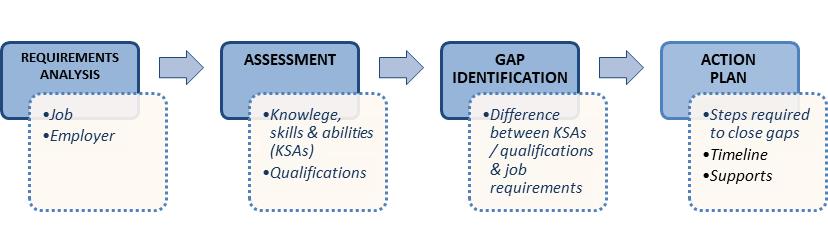
A useful definition is:
That definition is deliberately narrower than “something I have not done.” For example, you may not have held the formal title “Technology COO,” but that is not itself a useful gap. The relevant question is whether you can demonstrate the underlying work: operating cadence, financial stewardship, supplier performance, governance, executive decision support, organizational effectiveness, and transformation execution.
Before selecting your three gaps, apply four filters.
| Filter | Question to ask | Implication |
|---|---|---|
| Role criticality | Is this central to the mandate, or merely preferred? | Prioritize recurring, core requirements. |
| Evidence distance | Is this a proof problem, a scope problem, or a genuine capability gap? | Use the lightest credible remedy. |
| Time to improve | Can you create meaningful evidence within the job-search period or through a near-term assignment? | Avoid plans dependent on years of experience. |
| Search impact | Can role targeting and careful positioning reduce the risk now? | Do not pursue roles whose non-negotiables you cannot meet. |
The plan should contain only three gaps. More than three usually becomes an unfocused list of aspirations; fewer may overlook an important concern. For each gap, write a clear boundary around what you can claim today, then pair it with one or more of three responses:
- Positioning: explain the transferable experience you genuinely have.
- Mitigation: target roles, sponsors, or role designs that reduce the immediate hiring risk.
- Development: take an action that produces new, observable evidence.
The strongest plans use all three—but do not pretend that a course or certification alone closes a senior-executive gap. A credible development action produces a decision, artifact, operating mechanism, stakeholder endorsement, or measurable result.
Identifying Your Transferable Skills - The Human Reach
Read “Identifying Your Transferable Skills” from The Human Reach for a concise framework on turning a skills-gap diagnosis into targeted development and evidence.
In the section “How Do Transferable Skills Bridge the Executive Skills Gap?”, read the opening explanation. Then read the full subsection “What Are Effective Strategies to Close Skills Gaps for Senior Professionals?”, beginning with the practical strategies. Focus on the distinction between learning activity and evidence-producing action: stretch work, sponsorship, and coaching matter because they create visible proof.
Diagnose the type of gap before choosing a remedy
A weak candidacy plan treats every gap as a training problem. That is expensive, slow, and often unnecessary. First identify its type.
1. Evidence-retrieval gap
You may already have performed relevant work but have not yet reconstructed the example with sufficient specifics, scope, outcome, and proof.
For instance, “I have experience with investment management” may conceal a strong portfolio-governance example if you can identify:
- the investment or demand decision;
- the alternatives and trade-offs considered;
- your role in the analysis or recommendation;
- the decision forum and senior stakeholders;
- the resulting allocation, deferral, risk reduction, or operating change.
Primary response: verify the story and position it accurately. Do not create an unnecessary development plan before you have investigated your own record.
2. Scope or authority gap
You have done comparable work, but at a narrower level or without formal ownership of the enterprise outcome.
For example, you may have managed a million dollar global Enterprise IT Infrastructure budget and contributed to investment decisions, but not formally owned an enterprise-wide technology portfolio governance function.
Primary response: use a credible bridge statement, target mandates where the next level of scope is a logical step, and gain an adjacent stretch assignment where possible.
3. Capability or experience gap
You do not yet have a concrete example demonstrating the criterion, or your existing experience is too distant to support it.
For example, if you cannot identify a senior-stakeholder decision in which your recommendation influenced the outcome, then “C-suite influence” is not merely a résumé wording issue. You need an experience-building move.
Primary response: seek a focused assignment, sponsorship, feedback, or exposure that can generate evidence. Meanwhile, do not imply that you already possess the missing experience.
This distinction protects you from two opposite errors:
- under-selling: treating a verified, transferable strength as if it were a deficiency;
- over-selling: calling exposure or participation a demonstrated executive capability.
The central principle is that a transition need not begin from zero. As the Harvard Business Review discussion on skill gaps notes, underlying capabilities can transfer; the work is to build a coherent narrative and obtain the exposure that makes the next move credible.
Are You Underqualified for the Job You Want?
Read this Harvard Business Review discussion for a pragmatic view of skill transitions: transferable capabilities need a narrative, while projects and exposure create credibility for the next move.
In the opening portion, find the exchange on the common mistake people make when facing a skills gap; focus on the idea that relevant underlying capabilities do not disappear simply because the new title is different. Then, in the section discussing lateral moves and exposure, read the discussion of lateral moves. Treat “lateral” here as a principle rather than a prescription: the useful move is one that adds a missing kind of exposure without discarding the scale and credibility you have already built.
Select your three priority gaps
Based only on the current evidence map and your stated development priorities, the following are sensible draft gaps. They must be validated against your actual examples and against the individual job postings you target.
They are not judgments that you lack these capabilities. They are the areas where a hiring executive is most likely to ask for more specific proof when considering a Director for a VP Strategy & Operations or Technology COO role.
Gap 1: Formal enterprise technology portfolio governance
Why it matters: Technology COO and VP Strategy & Operations roles commonly require a repeatable mechanism for comparing technology demand, allocating investment and capacity, making trade-offs, monitoring benefits, and escalating decisions.
Your current evidence is promising: you have managed a million dollar budget for global Enterprise IT Infrastructure and have budget and investment-management experience. However, unless you can document formal decision forums, prioritization methods, cross-portfolio trade-offs, and benefits tracking, you should not represent this as already having led enterprise portfolio governance.
| Plan element | Draft content |
|---|---|
| Honest current position | “I have led financial stewardship for a global Enterprise IT Infrastructure environment, including a million dollar budget, and have experience in budget and investment management. I am extending that foundation into more explicit enterprise portfolio-governance practice.” |
| Do not claim | “I led enterprise-wide portfolio governance” unless you can identify the governance mechanism, decision authority, scope, and outcome. |
| Positioning bridge | Frame financial discipline, capacity trade-offs, investment analysis, and governance design as the underlying capabilities. Use precise verbs such as “managed,” “developed analysis for,” “recommended,” or “designed,” according to your authority. |
| Search mitigation | Favor roles where the mandate is to establish, mature, or improve portfolio governance under a CIO or Technology COO. Be cautious with roles requiring a proven record of already running a mature, enterprise-wide investment portfolio. |
| Development action | Seek a defined opportunity to support or lead an investment-review cycle, demand-intake mechanism, prioritization exercise, or benefits-review process. If this is possible in your current organization, agree in advance on scope, decision rights, and what success evidence will be available. |
| Evidence to produce | A sanitized prioritization approach, a decision forum or cadence, documented trade-offs, an approved recommendation, and sponsor confirmation of your contribution. |
| Near-term milestone | Within two weeks, identify one past investment decision that may already be usable and one current or prospective stretch opportunity that would strengthen formal governance evidence. |
This is a good example of a scope-and-proof gap, not necessarily a capability gap. The aim is not to reinvent your background. It is to connect existing financial and investment experience to a recognizable executive operating mechanism.
Gap 2: C-suite influence and executive decision support
Why it matters: In the target roles, strategy and operations leaders must help senior executives make decisions involving cost, risk, service performance, transformation priorities, vendors, and organization design. The capability is not simply “presenting well.” It is framing a decision, surfacing trade-offs, aligning distinct stakeholders, and moving the organization toward a practical next step.
Your known background includes substantial interaction with VP-level stakeholders. That is meaningful senior exposure. Yet you have identified a desire to strengthen readiness for more senior executive engagement, and the current evidence map does not yet show a verified CIO-, CFO-, CEO-, or executive-committee-level decision story.
| Plan element | Draft content |
|---|---|
| Honest current position | “I have worked with VP stakeholders on technology strategy and operations decisions. My next step is expanding the breadth and visibility of executive decision support, particularly where financial, operational, and business priorities must be reconciled.” |
| Do not claim | “I advised the C-suite on enterprise strategy” merely because senior leaders were informed of work you performed. |
| Positioning bridge | Emphasize the decisions you helped frame: budget choices, vendor issues, operating-model options, risks, and strategic alignment. The evidence must state what recommendation you made, who decided, and how your work affected the path chosen. |
| Search mitigation | Target roles reporting to, or closely sponsored by, a CIO, CTO, or Technology COO where executive partnership is part of the design of the role. Avoid positions requiring an already-established record of direct board or CEO engagement unless you can demonstrate it. |
| Development action | Identify one decision forum where you can author or co-author an executive brief, present a recommendation, and receive feedback from a senior sponsor. The topic can be a budget trade-off, vendor-performance decision, service-risk issue, or operating-model choice. |
| Evidence to produce | A decision brief; a clear record of the recommendation and decision; senior-stakeholder feedback; and a concise story about competing interests and how you helped resolve them. |
| Near-term milestone | Within two weeks, select one past VP-level decision story and verify the details. In parallel, identify one current executive-facing forum or sponsor through which you can gain more direct exposure. |
An executive narrative should show, rather than merely tell, leadership qualities.

For this gap, “I am a strong executive communicator” is telling. A stronger, evidence-safe statement is:
“I prepared the options and recommendation for a VP-level decision on [topic], making the cost, service, and delivery trade-offs explicit. The group chose [decision], and my role was [accurate contribution].”
The next module will help you convert this factual material into a concise executive value proposition and career narrative. For now, capture the proof rather than polishing the language.
Gap 3: End-to-end transformation execution with verified outcomes
Why it matters: Many Technology COO and Strategy & Operations postings use “transformation” broadly. In practice, hiring executives often want evidence that a leader can move from diagnosis through design, approval, implementation, adoption, performance tracking, and course correction.
Your operating-model design experience is highly relevant. However, “operating-model design” and “transformation execution” are not interchangeable. A proposed model, an approved model, an implemented model, and a model with measured outcomes represent four different levels of evidence.
| Plan element | Draft content |
|---|---|
| Honest current position | “My experience includes operating-model design and strategic alignment in a global Enterprise IT Infrastructure context. I am strengthening evidence of end-to-end implementation, adoption, and measurable operational outcomes.” |
| Do not claim | “Led enterprise transformation” without being able to define the transformation objective, accountable role, implementation scope, adoption mechanism, and result. |
| Positioning bridge | Describe the concrete operating-model component you changed or influenced: decision rights, team structure, sourcing model, funding process, performance cadence, supplier governance, or escalation path. |
| Search mitigation | Prioritize roles with a defined transformation mandate, executive sponsorship, and authority to establish operating mechanisms. Be cautious about turnaround roles demanding an externally proven record of delivering large, quantified enterprise transformations from start to finish. |
| Development action | Lead or co-lead one bounded implementation workstream—not only a design exercise—with named measures of adoption or operating effectiveness. Examples might include implementing a governance cadence, supplier-performance mechanism, planning process, or accountability model. |
| Evidence to produce | Baseline problem; implementation plan; stakeholder approvals; adoption evidence; performance measures; and a clear statement of your personal ownership. |
| Near-term milestone | Within two weeks, choose the operating-model example with the most potential, identify whether it reached adoption, and retrieve evidence of its lasting operational effect. If it did not, describe it as design or contribution rather than implementation. |
This gap should not lead you to undersell operating-model work. It should lead you to make it concrete. A credible sentence might be:
“I designed and helped implement [specific governance or operating-model mechanism] across [scope], clarifying [decision rights, supplier responsibilities, funding controls, or performance cadence].”
Only add an outcome after verification:
“The mechanism was adopted through [forum or sponsor] and resulted in [verified operational change].”
Write the plan in one page
Your final candidacy plan should be short enough to use during role selection, recruiter conversations, and interview preparation. Use this structure.
| Priority gap | Evidence boundary today | Positioning and search mitigation | Development action | Proof of progress |
|---|---|---|---|---|
| Portfolio governance | Managed a million dollar global infrastructure budget and worked in investment management; formal enterprise portfolio-governance ownership still to be verified. | Position financial stewardship, investment analysis, and trade-off experience. Target mandates to mature governance, not only roles demanding a fully established portfolio-governance record. | Lead or support a defined prioritization, investment-review, or benefits-tracking mechanism. | Decision forum, prioritization criteria, approved recommendation, sponsor corroboration. |
| Executive decision support | Worked primarily with VPs; direct C-suite decision stories require verification or further exposure. | Position credible VP-level decision support without inflating seniority. Target CIO- or COO-sponsored roles with direct executive partnership. | Author and present a decision brief; obtain senior feedback. | Brief, decision outcome, stakeholder feedback, interview-ready story. |
| Transformation execution | Operating-model design experience is established; end-to-end implementation and outcome evidence must be made specific. | Position concrete design and adoption work; favor sponsored transformation mandates with clear authority. | Own an implementation workstream with adoption and performance measures. | Baseline, implementation record, adoption measure, operating result, sponsor validation. |
Three quality checks will keep this plan honest and usable.
Check 1: Could you say it in an interview without qualifiers?
If the statement needs several verbal caveats, it is too broad. Replace it with a more precise claim. For example:
- Too broad: “I ran global portfolio governance.”
- More precise: “I managed financial planning for a global infrastructure budget and contributed analysis to investment decisions; I am now broadening that into formal portfolio-governance leadership.”
The second statement is more credible because it separates demonstrated experience from the next development step.
Check 2: Does each action create evidence, not just knowledge?
“Take a course on executive presence” may help, but it does not by itself make an interviewer confident you can frame a difficult decision for a CIO and CFO. Pair learning with an observable application:
- prepare a decision brief;
- present a recommendation;
- lead a review forum;
- facilitate a prioritization decision;
- establish a performance mechanism;
- collect sponsor feedback.
Check 3: Does the target role allow the bridge?
A candidacy plan also guides what not to pursue. If a posting requires an established record of direct board engagement, enterprise P&L ownership, or multiple completed company-wide turnarounds—and you do not have that evidence—it may not be the right first VP move.
That does not shrink your ambition. It concentrates it on roles where your global infrastructure scale, million dollar financial stewardship, vendor and contract experience, operating-model capability, and leadership of teams up to can credibly support the next level of accountability.
A practical two-week cadence
Because your course and job-search preparation are moving quickly, do not wait for all gaps to be fully closed before engaging the market. Run the plan on two tracks: reduce uncertainty now and build stronger proof over time.
| Timing | Focus | Output |
|---|---|---|
| Days 1–3 | Validate the three gaps against your evidence cards and two or three target postings. | Final three-gap plan with exact boundaries on what you can claim. |
| Days 4–7 | Retrieve evidence from past work: documents, metrics, decisions, and former sponsors’ recollections. | One usable example for each gap, even if it is positioned as a bridge rather than full proof. |
| Days 8–10 | Identify a current stretch opportunity or exposure path for each gap. | Specific sponsor, forum, project, or assignment; do not settle for vague intentions. |
| Days 11–14 | Apply the plan to your target-role filters and initial outreach. | A clearer list of roles to pursue, roles to approach selectively, and roles to defer. |
Keep the plan private and factual. It is a decision tool, not language to send to recruiters. Recruiters and hiring executives should hear the positioning and see the evidence; you use the full plan to ensure that your claims remain accurate and that your career actions are focused.
Key takeaways
A three-gap candidacy plan turns your evidence map into a practical job-landing strategy.
- A priority gap is a material hiring risk, not simply an experience you have not had.
- Diagnose whether the issue is missing proof, narrower scope or authority, or a genuine capability gap; each requires a different response.
- Pair every gap with an honest current position, a careful positioning bridge, search mitigation, a development action, and a concrete form of proof.
- For your transition, the strongest draft priorities are likely: formal portfolio governance, executive decision support, and end-to-end transformation execution.
- Avoid inflated claims. Specific boundaries—what you managed, influenced, designed, or implemented—make the transition case more credible, not less.
Next, you will move from candidacy strategy into executive positioning: building a verified impact inventory from your global infrastructure scope, million dollar budget, operating-model work, and vendor-management experience.
Can't find a good explanation? Sign up and we'll make it for you
Sign up