
Hello! Welcome to the first lesson of your second module, Strategic Measurement Frameworks.
In the previous module, we built a solid statistical foundation, culminating in our last lesson on how to frame a business problem as a testable hypothesis. That entire process was focused on answering one crucial type of question: "Did my action cause this result?"
This lesson will zoom out and place that skill into a broader strategic context. As a marketing leader, you'll face a variety of business questions, and not all of them are about causation. Your effectiveness will depend on your ability to identify the type of question you're asking and to direct your analytics resources accordingly.
Today, we'll focus on learning to distinguish between descriptive, predictive, and causal questions in marketing analytics. Understanding this framework will help you clarify your objectives, ask for the right kind of analysis, and interpret the results with the appropriate level of confidence.
1. The Analytics Maturity Framework: A Leader's Map
A helpful way to think about different types of analytical questions is through a maturity framework. This model organizes analytics from the simplest to the most complex, showing how each level builds upon the last to deliver increasing business value.
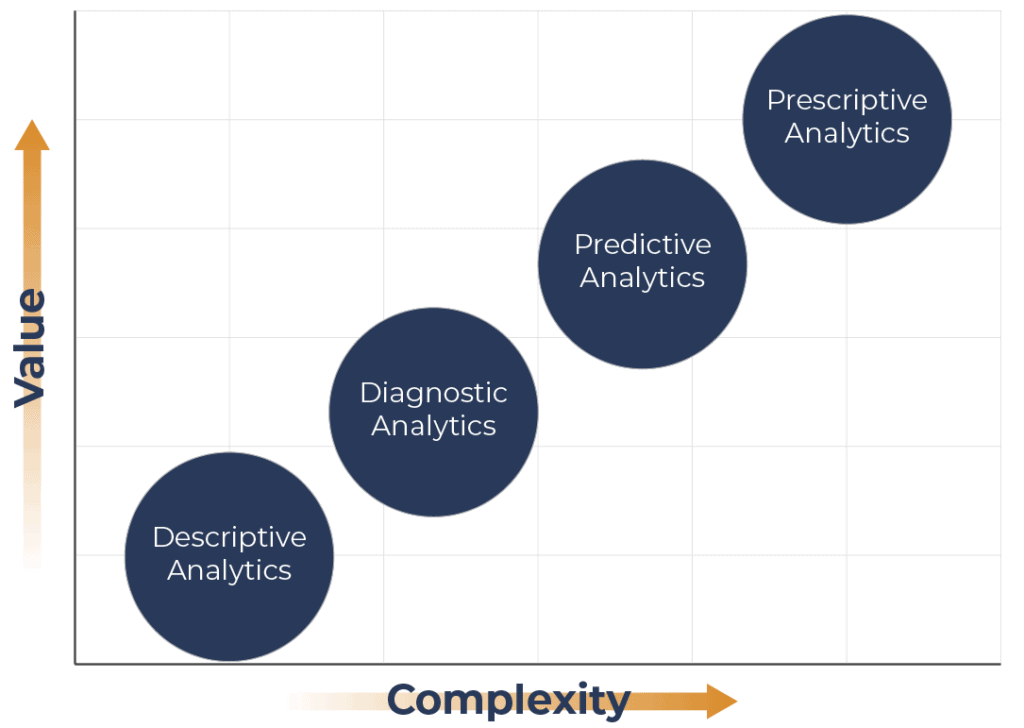
The four key questions this framework helps us answer are:
- Descriptive: What happened?
- Diagnostic/Causal: Why did it happen?
- Predictive: What will happen?
- Prescriptive: What should we do about it?
For this lesson, we will focus on the first three, as they represent the most common categories of questions you'll encounter and need to distinguish between.
2. Descriptive Analytics: "What happened?"
Descriptive analytics is the foundation of all marketing reporting. It involves summarizing historical data to provide a clear picture of past performance. This is the realm of dashboards, KPIs, and standard business reports.
Key Characteristics:
- Focus: The past.
- Purpose: To monitor and report.
- Typical Questions:
- "What was our revenue last quarter?"
- "How many leads did our Meta ads generate in July?"
- "What is the click-through rate of our latest email campaign?"
- Tools: Google Analytics, Adobe Analytics, ad platform dashboards (Google/Meta), BI tools (Tableau, Power BI).
With your extensive background in SEO and paid advertising, you are already an expert user of descriptive analytics. You live in these reports daily.
To solidify this concept, let's explore a clear definition and example.
4 Types of Data Analytics to Improve Decision-Making
The article '4 Types of Data Analytics to Improve Decision-Making' from Harvard Business School Online clearly defines each analytics type. We'll start with their section on Descriptive Analytics.
Please read the section titled '1. Descriptive Analytics'. Note how it focuses entirely on summarizing what has already occurred.
Descriptive analytics tells you the "what" but not the "why." It can tell you that sales are down, but it can't tell you if your competitor's recent campaign is the cause. That's where we need to ask a different kind of question.
3. Causal (Diagnostic) Analytics: "Why did it happen?"
Causal analytics seeks to understand the drivers behind the numbers. It moves beyond correlation to determine cause-and-effect relationships. This is the domain of experimentation and rigorous analysis, and it's where you'll find the most reliable answers for making strategic decisions.
This directly builds on our previous lessons about correlation vs. causation and hypothesis testing. When you run an A/B test, you are asking a causal question.
Key Characteristics:
- Focus: The relationship between actions and outcomes.
- Purpose: To explain, diagnose, and prove impact.
- Typical Questions:
- "Did our new ad creative cause the increase in conversion rate?"
- "What is the true incremental revenue generated by our retargeting campaign?"
- "Why did churn rate increase after we changed our pricing?"
- Tools: A/B testing platforms (e.g., Optimizely), incrementality studies (geo-lift, conversion lift), statistical analysis.
A perfect example of the strategic importance of causal questions comes from contrasting attribution with incrementality—a critical topic for any performance marketing leader.
- Attribution is largely descriptive. A last-click model tells you "what happened"—the last touchpoint a user clicked.
- Incrementality is causal. It tells you "why it happened"—whether that touchpoint actually caused the conversion or if the user would have converted anyway.
.png)
Let's explore this distinction further.
Marketing Incrementality Testing: Measure True Campaign Impact Beyond Last-Click
This article, 'Marketing Incrementality Testing', does an excellent job of distinguishing attribution from incrementality, framing it as the difference between a descriptive and a causal question.
Please read the subsection titled 'The Critical Difference: Attribution vs. Incrementality'. Pay close attention to how it defines attribution as answering 'what happened' and incrementality as answering 'why it happened'.
As a leader, knowing when to ask for an attribution report (descriptive) versus an incrementality test (causal) is key to effective budget allocation.
4. Predictive Analytics: "What will happen?"
Predictive analytics uses historical data, statistical algorithms, and machine learning techniques to identify the likelihood of future outcomes. Instead of looking backward, it looks forward.
Your computer science background gives you a head start in understanding the principles here, even if you're not building the models yourself. Your role is to define the business problem that prediction can solve and to interpret the model's output to guide strategy.
Key Characteristics:
- Focus: The future.
- Purpose: To forecast and anticipate.
- Typical Questions:
- "Which of our current customers are most likely to churn in the next 90 days?"
- "What is the predicted lifetime value (pLTV) of a customer acquired from our new campaign?"
- "What is our expected sales volume for the upcoming holiday season?"
- Tools: Machine learning models (e.g., regression, classification), forecasting algorithms, predictive scoring tools.
Let's return to the HBS Online article for a clear definition.
4 Types of Data Analytics to Improve Decision-Making
Now, let's look at the HBS Online article's take on Predictive Analytics.
Please read the section '3. Predictive Analytics'. Notice its forward-looking nature and reliance on historical data to make forecasts.
Test your understanding!
Your team manages a large e-commerce site. They present you with the following questions. Classify each as Descriptive, Causal, or Predictive.
- How much revenue did we generate from the top 10% of our customers last year?
- Will offering free shipping on orders over $50 cause a profitable increase in average order value?
- Which visitors currently on our site are most likely to make a purchase before they leave?
Show answer
- Descriptive. This question asks for a summary of past data (revenue from a specific segment last year).
- Causal. The keyword "cause" signals that this requires an experiment (like an A/B test) to determine the true effect of free shipping, separate from other factors.
- Predictive. This question asks to forecast a future event (making a purchase) for a specific group (current visitors) based on their behavior.
5. Bringing It All Together
These analytical categories are not mutually exclusive; they work together to provide a comprehensive view of the business. You start by describing what happened, diagnose why it happened, predict what will happen next, and finally, decide what to do.
To see how these concepts connect, let's watch two short video clips.
Descriptive vs Diagnostic vs Predictive vs Prescriptive Analytics: What's the Difference?
First, this video from Maven Analytics uses a simple, non-marketing analogy to explain the four types of analytics and makes a crucial point that they are often used in tandem, not in a rigid linear sequence.
Please watch from the beginning to 2:52. Pay attention to the medical analogy and the clarification that these analytics types are complementary.
Now, let's see this framework applied directly to marketing.
What is marketing analytics?! | Unlock growth by understanding data and analytics
This video from Funnel applies the same 'maturity framework' specifically to marketing analytics, giving you concrete examples relevant to your work.
Please watch from 2:12 to 4:14. Notice how the example flows from understanding spend and clicks (descriptive) to predicting the effects of future spend (predictive) and taking action (prescriptive).
As these videos illustrate, a mature data strategy involves using all these approaches. You might start with a descriptive dashboard showing a drop in conversion rate. This leads you to a causal question: you run an A/B test and discover a broken button on iOS devices was the cause. You then build a predictive model to forecast revenue loss from similar bugs in the future, and finally, a prescriptive alert system is built to notify engineers immediately when key conversion funnels break.
Conclusion
In this lesson, we've mapped out the landscape of marketing analytics questions. By understanding this framework, you can now provide much clearer direction to your teams and stakeholders.
Key Takeaways:
- Descriptive Analytics ("What happened?"): The foundation for all reporting, summarizing past data. Your dashboards live here.
- Causal Analytics ("Why did it happen?"): The key to understanding true impact through experiments and incrementality tests. This is where you prove ROI.
- Predictive Analytics ("What will happen?"): The use of models to forecast future behavior, such as customer churn or lifetime value. This informs proactive strategy.
- As a leader, your role is not just to consume data, but to formulate the right type of question to drive meaningful action and business growth.
Preview of the Next Lesson:
Now that we know what kinds of questions to ask, we need to ensure we can trust the answers. A brilliant analysis is worthless if it's based on bad data. In our next lesson, we will focus on how to develop a framework for evaluating marketing data quality, focusing on the crucial dimensions of accuracy, completeness, timeliness, and consistency.