
Hello! Welcome to your next lesson in the Strategic Measurement Frameworks module.
In our last session, we distinguished between descriptive, predictive, and causal questions. This gave you a mental model for clarifying the type of analytical question you need to ask. Now, we turn to a prerequisite for answering any of those questions reliably: the quality of the data itself. A sophisticated causal analysis or a predictive model is useless—or even dangerous—if it's built on a foundation of flawed data. The principle of "garbage in, garbage out" is a fundamental truth in analytics.
Today's lesson addresses this head-on. We will develop a framework for evaluating marketing data quality, focusing on accuracy, completeness, timeliness, and consistency. As a leader, you won't be the one manually cleaning databases. However, you are accountable for the decisions that come from that data. Your ability to question data quality, understand its limitations, and champion a culture of data integrity is a critical leadership skill that protects the business from costly errors and unlocks more reliable growth.
1. Data Quality: More Than Just "Correct" Data
Let's start with a simple but powerful analogy to frame the concept of data quality.
This short clip from IBM Technology uses a great analogy of a chef with poor-quality ingredients to illustrate the business impact of bad data. It then introduces some of the core concepts we'll be discussing today.
Please watch from the beginning to 1:04. Pay attention to the chef analogy and the four qualities of data the speaker introduces.
The video highlights that data quality isn't a single thing; it's a combination of several characteristics. A common mistake is to use "data quality" and "data accuracy" interchangeably. For a strategic leader, understanding the difference is key.
- Data Accuracy asks: "Is this information correct at this moment?"
- Data Quality asks: "Is this data fit for our purpose?" It's a broader, more strategic assessment.
An accurate piece of data might still be poor quality if it's incomplete, inconsistent with other systems, or out of date.
Data Quality vs Data Accuracy - Integrate
This article from Integrate, a company focused on B2B marketing data, provides excellent, marketing-specific examples that clarify the distinction between accuracy and overall quality.
Please read the sections 'Differences Between Data Quality and Data Accuracy', 'Examples of Data Quality vs Data Accuracy in Use', and 'Why the Difference Matters to Marketing Ops'. Notice how a lead record can be technically accurate but still be low-quality and unusable for your marketing automation.
Think about your experience with Google or Meta Ads. If you upload a customer list to create a lookalike audience, you need high-quality data. If the list is full of duplicates (uniqueness issue), missing key firmographic data (completeness issue), or contains old job titles (timeliness issue), the platform's algorithm receives poor signals, resulting in inefficient targeting and wasted ad spend.
2. The Core Dimensions of a Data Quality Framework
To evaluate data quality systematically, we need a framework based on its core dimensions. The learning outcome highlights four, but we'll touch on a few others as well. The table below provides a fantastic overview of how to think about each dimension—not just its definition, but its strategic relevance, common challenges, and potential solutions.

Let's briefly define the four key dimensions with marketing examples:
-
Accuracy: Does the data reflect reality?
- Example: A contact's email address is
john.doe@company.com, and this is their real, active email. The data is accurate. If the email bounces, it's inaccurate.
- Example: A contact's email address is
-
Completeness: Are all the required data fields populated?
- Example: You want to segment your leads by company size to send targeted content. If 40% of your lead records are missing the "Company Size" field, your data is incomplete for this purpose.
-
Consistency: Is the same data represented uniformly across different systems?
- Example: Your CRM stores country data as "USA," while your ad platform uses "United States." This inconsistency can break integrations and lead to fragmented customer views.
-
Timeliness: Is the data recent enough to be useful?
- Example: You have an accurate lead record for someone listed as "Marketing Manager." However, the data was collected three years ago, and they have since been promoted to "VP of Marketing." The data is accurate in the past, but not timely, making it poor quality for a campaign targeting VPs.
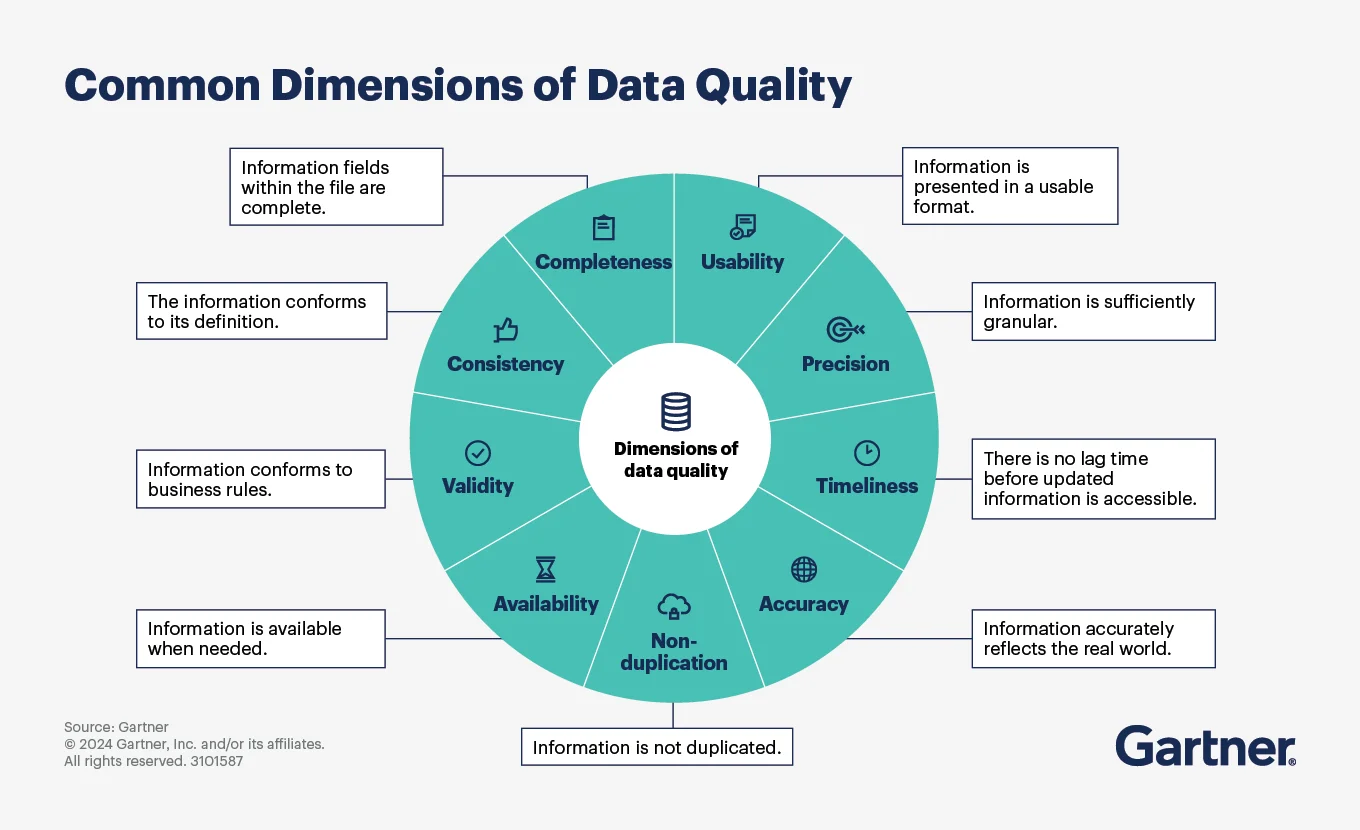
Other important dimensions, as shown in the Gartner diagram below, include Uniqueness (no duplicates), Validity (conforms to a defined format, e.g., a phone number has the correct number of digits), and Compliance (meets legal standards like GDPR/CCPA).
Test your understanding!
Your team is preparing a list for a new campaign targeting VPs of Marketing in the software industry in Germany. They encounter the following issues. Match each issue to the primary data quality dimension it violates.
- The 'Industry' field is blank for 30% of the contacts.
- The contact list contains 500 duplicate entries for the same people.
- Country is listed as 'Germany', 'DE', and 'Deutschland' in different records.
- A spot check reveals that 15% of the contacts listed as VPs changed jobs over a year ago.
Show answer
- Completeness: Critical information needed for segmentation ('Industry') is missing.
- Uniqueness: The list is inflated with duplicate records.
- Consistency: The same piece of information ('Germany') is stored in different formats.
- Timeliness: The job title information is outdated and no longer relevant for targeting.
3. How to Develop and Implement a Data Quality Framework
Knowing the dimensions is the first step. Implementing a Data Quality Framework (DQF) is how you translate that knowledge into action. A DQF is a formal process and set of policies your organization uses to measure, manage, and improve data quality. As a leader, your role is to sponsor this initiative and hold your teams accountable to it.
Here are the essential components and steps for establishing a DQF.
Establishing a Data Quality Framework: A Comprehensive ...
Now, let's move from theory to practice. This comprehensive guide from Zendata outlines the key components of a Data Quality Framework and provides a step-by-step plan for implementation. This is the strategic blueprint you would use to guide your team.
Please read the sections titled 'Components of a Data Quality Framework' and '5 Steps to Establish a Data Quality Framework'. Focus on understanding the pillars of a DQF (Standards, Governance, Tools, Monitoring) and the actionable sequence for putting one in place.
Based on the reading, a robust DQF consists of two main parts: the core components and the implementation plan.
Key Components of the Framework:
- Data Quality Standards & Metrics: You must first define what "good" looks like. This involves setting specific, measurable thresholds.
- Example Standard: "All lead records must have a valid email and country field."
- Example Metric: "Achieve and maintain <2% bounce rate on marketing emails" (measures accuracy) or "95% completeness for 'Job Title' field in the CRM."
- Data Governance: This defines ownership and accountability. It answers the question, "Who is responsible for data quality?" This includes appointing roles like Data Stewards who are accountable for ensuring policies are followed.
- Tools and Technology: This involves using software for automated data profiling (to assess quality), cleansing (to fix errors), and enrichment (to add missing information).
- Continuous Monitoring and Improvement: Data quality is not a one-time project; it's an ongoing process. You need regular audits and feedback loops.
A 5-Step Implementation Plan:
As a leader, you would direct your team to follow a process like this:
- Assess Current Data Quality: First, benchmark your current state. Profile your key databases (e.g., your CRM) to understand where the biggest problems lie.
- Set Objectives and Standards: Based on the assessment, define clear, prioritized goals (e.g., "Reduce duplicate customer records by 50% in Q3").
- Design and Implement Policies: Create clear rules for data entry, management, and usage. This includes training staff and integrating quality checks into daily workflows.
- Select and Deploy Tools: Choose the right technology to automate validation, cleaning, and monitoring.
- Monitor and Continuously Improve: Establish dashboards to track your data quality metrics over time and regularly review progress against your objectives.
Your role isn't to execute these five steps, but to ensure this strategic process exists, is resourced, and is treated as a business priority.
Conclusion
Today we've moved from simply acknowledging that data can be "bad" to creating a structured, professional framework for evaluating and managing its quality. This is a cornerstone of a mature data-driven marketing organization.
Key Takeaways:
- Data quality is about "fitness for purpose," a concept much broader than just accuracy.
- Your evaluation framework should be built around key dimensions like Accuracy, Completeness, Consistency, and Timeliness.
- Developing a Data Quality Framework (DQF) is a formal process involving:
- Setting clear standards and metrics.
- Establishing governance and ownership.
- Leveraging tools for automation.
- Committing to continuous monitoring.
- As a marketing leader, your responsibility is to champion the need for high-quality data, ask probing questions about it, and sponsor the framework that ensures its integrity.
Preview of the Next Lesson:
With a solid understanding of data quality, we are now better prepared to use that data to calculate and interpret the metrics that truly matter. In our next lesson, we will focus on how to interpret advanced performance metrics in a strategic context, focusing on the crucial trio of LTV/CAC ratio, payback period, and unit economics. These are the metrics that connect your marketing activities directly to the company's financial health and long-term profitability.