
Good to see you again. In the previous lesson, we used Soros’s reflexivity to show how a favourable valuation can become an input into a startup’s future: it improves financing access, hiring, customer confidence, and time available for experimentation. That left an important question. If financing conditions can reinforce themselves, does every venture boom follow a Minsky pattern?
Not quite. Minsky’s financial-instability hypothesis is fundamentally a theory of debt commitments, leverage, refinancing, and forced deleveraging. Yet some of its most useful insights transfer well to equity-funded VC: prolonged success lowers perceived risk, raises tolerance for fragile financing structures, and makes continued capital inflows seem like evidence of safety. This lesson separates those transferable mechanisms from the debt-specific machinery.
Minsky’s original claim: stability changes financial behaviour
Minsky’s premise is more demanding than the generic observation that investors become optimistic in a boom. He argued that a long period in which borrowers meet obligations, defaults remain low, and asset prices rise alters the financial structure of the economy. Recent tranquillity makes both lenders and borrowers infer that their previous margins of safety were unnecessarily conservative.
The relevant corporate-finance distinction is between cash flows, contractual payment commitments, and the possibility of refinancing.
Minsky described three broad financing postures:
| Financing posture | Operating cash flow relative to debt commitments | Dependence on refinancing or asset appreciation |
|---|---|---|
| Hedge finance | Can service both interest and principal from expected cash flows | Low |
| Speculative finance | Can service interest, but must roll over or refinance principal | Material |
| Ponzi finance | Cannot meet even interest commitments from cash flow | Critical; survival depends on new borrowing or rising asset prices |
“Ponzi finance” here is a technical term, not an allegation of fraud. It describes an entity whose contractual debt burden can be sustained only through continued refinancing or asset-price appreciation.
The destabilising sequence is therefore financial as well as psychological:
- A cautious post-crisis period creates conservative borrower and lender behaviour.
- The resulting projects tend to perform well, partly because they were selected with wide safety margins.
- Success is interpreted as proof that risk has fallen.
- Lending standards loosen, leverage rises, and more marginal projects obtain finance.
- Asset prices and activity may rise further, validating the optimism for a time.
- Eventually, a decline in asset values or a failure of refinancing exposes the fragility created during the apparently stable period.
The decisive problem is that debt creates fixed claims. A shareholder can suffer a markdown and remain a shareholder. A leveraged borrower may have to sell, inject collateral, or default at precisely the moment prices are falling.
Minsky's Financial Instability Hypothesis I A Level and IB Economics
Watch “Minsky's Financial Instability Hypothesis” from tutor2u for a concise baseline model of why prolonged prosperity can produce financial fragility. It is useful here chiefly as a benchmark: we will then ask which elements survive when the financed asset is a venture portfolio rather than a debt-funded credit market.
Watch the core premise for the hypothesis that calm growth encourages hazardous finance. Continue with the boom mechanism, focusing on the loosening of lending standards and the rise in leverage. Then watch the contraction, paying particular attention to how falling asset values, lender caution, and debt losses reinforce one another.
In the classic version, the “Minsky moment” is not simply the peak of optimism. It is the point at which the system’s ability to refinance weakens, the need to sell becomes widespread, and falling asset prices damage balance sheets enough to cause more selling. Debt turns a revision of belief into a potentially compulsory liquidation process.
Why the label needs care in venture capital
The supplied Minsky graphic captures a stylised debt-driven boom: credit rises increasingly rapidly, real activity rises for a while, and a reversal in credit coincides with downturn.
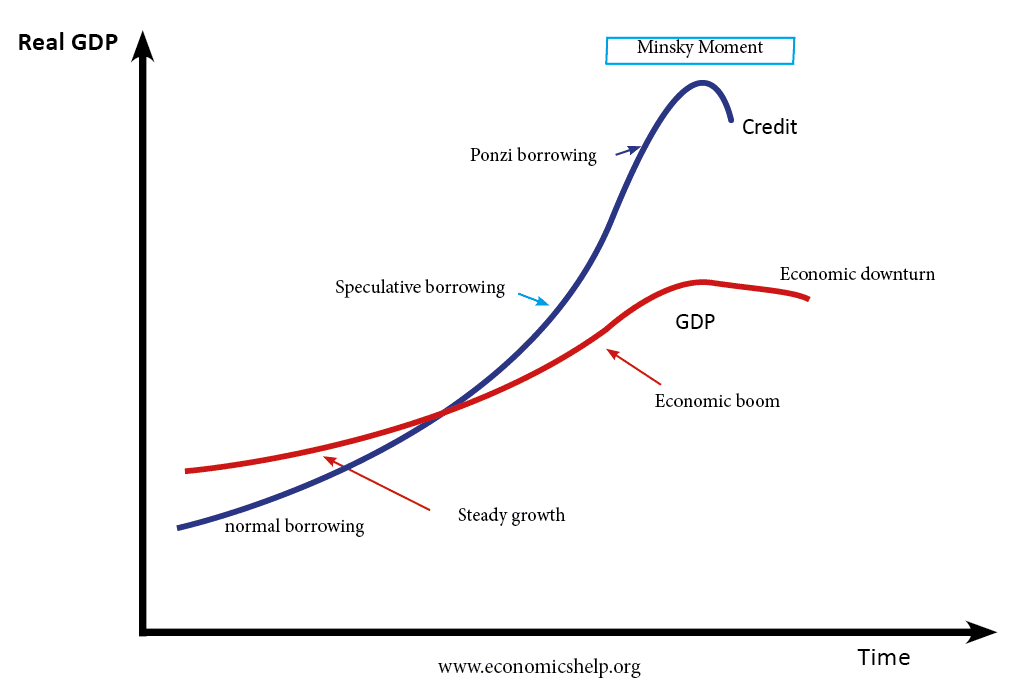
The figure is helpful only if we do not make a false substitution:
Equity financing is not debt financing with a different name.
In traditional venture capital, several stabilisers distinguish the system from a leveraged credit market:
- VC funds are typically closed-end vehicles. LPs commit capital for a fixed period and ordinarily cannot demand redemption after a disappointing quarter.
- Standard VC funds generally do not borrow to buy portfolio-company equity.
- Startup equity has no contractual coupon or principal repayment schedule.
- Private-company marks are periodic and discretionary enough that a valuation decline does not automatically trigger a margin call.
- A startup can often cut burn, raise an insider bridge, sell assets, or continue at a lower valuation without becoming legally insolvent.
This means that a company whose runway is short should not automatically be called a “Ponzi” company in Minsky’s technical sense. Many pre-revenue companies have negative operating cash flow by design. If negative free cash flow financed by equity qualified as Ponzi finance, almost every pre-seed biotech, laboratory platform, and infrastructure startup would fit the definition, making the term analytically useless.
The better language is financing dependence:
- A startup is milestone-funded when its existing cash and credible operating plan can reach a value-creating milestone without assuming unusually favourable market conditions.
- It is rollover-dependent when it needs a further financing, but can plausibly obtain one at a realistic valuation if it executes.
- It is valuation-dependent when its strategy, hiring plan, employee incentives, and investor base all require another large round at a price near or above the previous round.
The third posture can resemble Minsky’s speculative or Ponzi finance in one narrow respect: continuation depends on external finance being available on favourable terms. But it lacks the original debt mechanism of fixed interest, principal, collateral calls, and lender-driven foreclosure.
What does transfer cleanly from Minsky to VC?
The most valuable transferable idea is:
Stability can reduce perceived risk without reducing underlying risk.
In a venture boom, the relevant apparent evidence of safety is often not a tight credit spread. It is a sequence of rapid financings, up rounds, increasing portfolio marks, and compressed time between seed, Series A, and Series B.
A quick set of follow-on rounds can make a fund look safer than the underlying distribution of terminal company outcomes has become. The visible portfolio has fewer apparent failures; unrealised value rises; early fund performance improves; LP interest strengthens; and more capital becomes available to deploy. Yet the true risks may remain stubbornly unchanged: product-market fit, technical feasibility, retention, regulatory risk, competitive intensity, and eventual exit demand.
Minsky Moments in Venture Capital - by Abraham Thomas
Read Abraham Thomas’s “Minsky Moments in Venture Capital” for the central attempt to translate Minsky into a VC setting. Its most useful contribution is the distinction between a real reduction in terminal failure risk and a reduction in risk that is merely inferred from faster marks and financing cycles.
Start with the section “Is Venture Immune?” and its short account of why closed-end, unlevered VC funds lack the ordinary margin and redemption spirals. Then read the sections “I Have Confidence … In Confidence Alone” and “In Search of Shortened Time.” In particular, follow the perceived-risk argument: accelerated rounds and markups can make a portfolio look less risky even if the distribution of ultimate outcomes has not changed. Next, in “True Risk and Measured Risk,” read the distinction between true and measured risk. Finish with “Reasons For Momentary Lapses,” reading the down-round mechanism as a venture-specific reversal story.
This adaptation of Minsky is persuasive in four respects.
1. Apparent success can compress risk perception
An investor may reasonably read a strong Series A as evidence that other investors, customers, and candidates have conducted diligence. But repeated up rounds also reflect the current supply of capital. During a hot period, a markup is simultaneously:
- a signal about company quality;
- a product of abundant investor demand;
- a reference point for the next financing;
- a contributor to the fund manager’s reported performance.
The mistake is to treat it as a clean measurement of reduced failure probability.
2. Long calm periods weaken underwriting discipline
In a debt boom, lenders lower covenants, accept higher loan-to-value ratios, and underprice default risk. The VC analogue is not identical, but it is visible in:
- shorter diligence processes;
- greater willingness to fund unproven teams or unvalidated technical claims;
- higher prices for the same evidence;
- less staged financing;
- lower expectations of early commercial proof;
- a willingness to underwrite business models that require continued abundant funding.
None of these is necessarily irrational in isolation. A genuine technological discontinuity can justify faster decisions and more aggressive funding. The Minsky question is whether the changing terms reflect an improved terminal outcome distribution, or merely a market in which the next financing has become easier.
3. Capital inflow can make measured outcomes look better
This connects directly to the prior lesson on reflexivity. Extra equity can permit a company to hire, survive long procurement cycles, subsidise early adoption, undertake regulatory work, or build product more quickly. Some companies genuinely become stronger as a result.
But the category-level effect may differ. Abundant capital also funds more competitors, bids up technical talent, normalises customer subsidies, and makes early traction less diagnostic. Thus a category can report more rounds, more companies, and more apparent momentum while the expected economics for the median entrant deteriorate.
4. A reduction in financing velocity can reveal fragility
Minsky’s core reversal is debt refinancing failure. In VC, the closest counterpart is a breakdown in the expected cadence of follow-on financing.
If companies expected to raise every 12 to 18 months instead need 24 to 36 months, several structures may fail at once:
- a company cannot achieve the revenue or technical milestone assumed by its previous valuation;
- an insider bridge becomes necessary;
- the next round is delayed or priced lower;
- options become underwater and recruiting becomes harder;
- customers or partners infer elevated continuity risk;
- comparable marks weaken;
- fund-level performance no longer supports rapid fundraising.
This is not a margin spiral. It is a valuation, talent, and financing-availability spiral.
What remains debt-specific?
The distinction is easiest to retain in a direct comparison.
| Minsky mechanism | Does it explain an equity-funded VC boom? | Reasoned assessment |
|---|---|---|
| Stability induces complacency | Yes, strongly | A sequence of up rounds and exits can lower perceived risk and weaken underwriting discipline. |
| Rising asset values attract more capital | Yes, strongly | Higher marks, visible winners, and fast follow-ons draw founders, crossover investors, LP commitments, and category imitators. |
| Capital inflows make risk proxies look safer | Yes, strongly | Faster markups can reduce the apparent severity of the venture J-curve without changing terminal failure risk. |
| Marginal financing structures proliferate late in the boom | Yes, with translation | The venture form is valuation-dependent burn and reliance on future equity rounds, not necessarily excessive corporate debt. |
| Debt-service burden undermines cash flow | Usually no | Equity-backed startups have no compulsory interest or principal payments. The mechanism becomes relevant only where startup or fund leverage is material. |
| Margin calls and collateral liquidation | Usually no | Traditional VC equity is illiquid, infrequently marked, and not ordinarily subject to daily collateral calls. |
| Bank losses contract the supply of money and credit | No, in the standard VC case | Equity write-downs can hurt LP appetite and new commitments, but they do not mechanically impair bank capital in the same way. |
| Investor redemption spiral | Mostly no | Closed-end funds protect managers from immediate LP withdrawals, though future fundraising and secondary-market liquidity can deteriorate. |
| Debt deflation and widespread insolvency | Weakly, if at all | Startups can fail in clusters, but the macroeconomic debt-deflation mechanism is absent unless the ecosystem is heavily leveraged. |
The last three rows explain why a VC correction can be painful without being systemically identical to a credit crisis. Portfolio marks can collapse, companies can close, and an entire category can become unfundable, while no one is forced to liquidate by a broker’s collateral call.
Conversely, the distinction weakens when debt enters the system. Venture debt, revenue-based financing, warehouse facilities, GP-level leverage, subscription lines, and debt-funded growth companies can reintroduce genuine Minsky mechanisms. The analytical question is then concrete: Who owes fixed payments to whom, what collateral secures them, and what happens if the relevant valuation or revenue metric falls?
From boom to bust in an equity-funded category
Consider a hypothetical AI-enabled laboratory category. A few companies show compelling scientific progress and raise prominent rounds. Their valuations are interpreted as evidence that the category has lower technical and commercial risk than previously assumed.
At first, that interpretation may be partly correct. Better models, cheaper automation, or more urgent R&D demand may have improved the opportunity set. The critical issue is whether subsequent capital allocation remains proportionate to that improvement.
A venture-style Minsky progression might look like this:
| Phase | Observable venture-market pattern | What Minsky explains |
|---|---|---|
| Cautious recovery | A few specialist investors fund technically credible companies at modest valuations. | Recent failures still discipline underwriting. |
| Validation | Early winners raise strong rounds; adjacent founders form companies; more funds develop a category thesis. | Success makes prior caution look excessive. |
| Acceleration | Round cadence shortens, prices rise, and private marks improve faster than operating evidence. | Capital inflow lowers measured risk and attracts further capital. |
| Euphoria | Similar companies are funded; customer subsidies and talent costs rise; follow-on availability is embedded in plans. | The system increasingly depends on continuation of the inflow. |
| Recognition shock | A leading company misses technical, commercial, or financing expectations; public comparables fall; a major round fails. | The market reassesses whether apparent safety reflected true de-risking. |
| Reversal | Down rounds, bridges, layoffs, and category stigma reduce company options and reinforce scepticism. | The logic reverses, but through equity-financing conditions rather than forced debt liquidation. |
The transition from acceleration to reversal need not begin with a macro shock. It may be initiated by a mundane failure of recognition: a flagship company cannot raise, a much-cited customer deployment does not renew, unit economics reveal unexpected services intensity, or a model’s technical edge turns out to be replicable.
The category becomes especially fragile when participants treat the continuation of financing as if it were an operating fundamental. In that environment, “we can grow into the valuation” is not simply an optimistic forecast. It is an assumption that the market will keep validating the financing path long enough for the forecast to become true.
Venture overshooting: more money, less effective capital
Minsky helps explain the financial side of a boom. To understand why a real technological opportunity can still become overfunded, add the organisational and competitive side of venture cycles.
Gompers and Lerner’s historical analysis is useful here. They emphasise that the supply of venture capital adjusts slowly and unevenly; once it does react, it can overshoot. That oversupply funds duplicative companies, inflates the cost of scarce talent, and reduces the efficacy of each incremental dollar.
[PDF] Short-Term America Revisited? Boom and Bust in the Venture ...
Read the selected portions of this NBER chapter by Paul Gompers and Josh Lerner to connect financial enthusiasm with the real-economy consequences of excess venture funding. The analysis is historical, but its account of delayed capital supply, overshooting, and duplicative startup formation remains highly relevant to category booms.
In the section “Why Does the Venture Market Overreact?” on the PDF’s chapter pages 11–15, read the account of overshooting. Focus on why an increase in genuine opportunities does not imply that every subsequent increase in VC supply is well allocated. Then move to “The Impact of Market Cycles” on pages 20–22. Read the evidence on overheated periods, especially the mechanisms of duplicative research, talent bidding, and lower effectiveness of venture funding at the peak.
This lets us make a more precise contrarian claim than “hot categories are bad.” A category may be genuinely important while still becoming a poor setting for incremental capital at prevailing prices.
For the AI-lab example, the relevant question is not whether automated experimentation matters. It is whether the marginal dollar funds a defensible scientific, regulatory, data, or workflow advantage—or whether it mostly finances another expensive competitor pursuing the same customer budgets and talent pool.
A practical diagnostic: is this truly Minsky-like?
When assessing a hot or newly cold VC category, ask six questions.
-
What is the risk proxy currently declining?
It may be rapid follow-on financing, higher marks, lower observed mortality, improving public comparables, or growing fund DPI expectations. Name the proxy rather than calling the category “de-risked.” -
Why has the proxy improved?
Separate genuine changes in technology, customer economics, or regulation from improvements caused by abundant capital and social validation. -
Has the terminal outcome distribution changed?
Ask whether more companies can plausibly reach durable cash generation, strategic value, or venture-scale exits—not merely whether more companies can raise a Series A. -
Where is the financing dependency?
Identify the next required capital event, the milestone needed to support it, and whether the company can survive a six- to twelve-month delay. A high burn rate is not automatically dangerous; an inflexible burn rate combined with a valuation-dependent next round is. -
Is there a debt amplifier?
Look for venture debt, facilities, contractual purchase commitments, personal guarantees, fund leverage, or collateral-sensitive structures. If these are absent, resist importing the full debt-crisis analogy. -
How would pessimism become self-validating?
Specify the transmission channel: down round, weaker recruiting, customer continuity concerns, loss of a strategic partner, lower comparable marks, delayed fundraises, or reduced new-company formation.
A useful investment memo can state the conclusion in one of three forms:
- Not Minsky-like: the category’s higher valuations reflect a demonstrable improvement in terminal economics, while companies can survive normal financing delays.
- Equity-Minsky-like: apparent risk has fallen largely because financing has become abundant and fast, while companies increasingly require favourable future rounds.
- Debt-Minsky-like: the category also relies on fixed debt claims, collateral, or refinancing structures that can force liquidation when valuations or cash flows weaken.
That last case deserves the strongest caution. The middle case is often the core venture contrarian setup: an overheated category where the technology is real, but the market has mistaken plentiful financing for permanently lower risk.
Key takeaways
Minsky’s original hypothesis is not merely a theory of crowd psychology. It is a theory of how successful periods encourage increasingly fragile debt-financed balance sheets, until refinancing and asset-price support fail.
For equity-funded venture capital, the strongest transferable mechanisms are:
- stability and rapid markups can lower perceived risk;
- capital inflows can make portfolios and categories look safer before terminal outcomes are known;
- underwriting standards, round cadence, and valuation-dependent business plans can become progressively more fragile;
- a slowdown in follow-on financing can generate down-round, talent, customer-confidence, and valuation spirals.
The mechanisms that depend on margin calls, debt service, bank losses, forced liquidation, and redemption runs do not generally describe a conventional closed-end VC fund or an equity-financed startup. They become relevant only where material leverage or fixed financing obligations have entered the system.
In the next lesson, we will compare Minsky with the other frameworks developed so far—Keynesian higher-order beliefs, Girardian mimesis, information cascades, and Sorosian reflexivity—and ask what each predicts we should observe in the same venture boom.