
Good to see you again. In the previous lesson, we separated Minsky’s debt-centred financial-instability hypothesis from its more limited VC analogue: a category can become fragile through valuation-dependent burn, compressed financing timelines, and dependence on continued follow-on capital even without margin calls or forced liquidation.
This lesson completes the conceptual toolkit of this module. We will use one hypothetical venture boom to compare five explanations—Keynesian higher-order beliefs, Girardian mimesis, information cascades, Sorosian reflexivity, and Minskyan fragility—not by asking which is “right” in the abstract, but by asking what each would lead us to observe. That distinction matters for contrarian work: a category may look crowded for several superficially similar reasons, yet the likely reversal mechanism and the evidence worth seeking differ substantially.
One boom, five possible mechanisms
Consider a hypothetical category of AI-enabled laboratory platforms. Two technically credible companies publish promising results, sign early design partners, and raise seed rounds from respected specialist funds. A well-known generalist VC then leads a large Series A in one company at a striking valuation.
Over the next eighteen months:
- new companies form around adjacent versions of the thesis;
- investors begin to describe the category as “inevitable”;
- founder hiring becomes easier, at least initially;
- customers advertise pilots with such companies as innovation signals;
- round sizes and valuations rise faster than revenues or validated deployments;
- operating plans assume a substantial next round within 12 to 18 months.
Then a leading company delays its next financing. It has not necessarily disproved the technology, but its commercial conversion is slower than expected. Soon, several companies reduce hiring, insiders provide bridge rounds, and the category acquires a reputation for being capital-intensive and difficult to monetize.
The chronology is deliberately compatible with all five theories. The analytical task is to identify what additional traces each mechanism should leave behind.
A useful first distinction is the primary object of explanation:
| Framework | Central question | Primary mechanism |
|---|---|---|
| Keynes | What does each investor think other investors will value later? | Higher-order expectations and market conventions |
| Girard | Whose desire, prestige, or identity is being imitated? | Status-mediated desire and rivalry |
| Information cascade | Have visible actions overwhelmed private information? | Sequential social learning |
| Soros | Have beliefs and valuations changed the underlying situation? | Feedback between perceptions, actions, and fundamentals |
| Minsky | Has apparent stability produced increasingly fragile financing structures? | Reduced risk perception and financing dependence |
The theories overlap, but they are not interchangeable. A prestigious VC can be a Keynesian signal of what the next investor may value, a Girardian model of what others want to emulate, the public action that starts an information cascade, a catalyst in a reflexive loop, and part of the apparent stability that permits Minsky-like financing fragility. The investor’s job is to disaggregate these channels rather than treat “brand-name validation” as a complete explanation.
Watch the Financial Times video, “A Keynesian beauty contest,” for a concise reminder of why market participants may price an asset according to expected collective opinion rather than their own estimate of intrinsic worth.
Watch the beauty contest. Focus on the shift from “what I think is valuable” to “what I expect the majority to judge valuable.” In venture markets, substitute “the investor who must price the next round” for “the majority of judges.”
Keynes: a boom in higher-order beliefs
Keynes’s beauty-contest logic starts from a difficult fact of early-stage investing: there is no stable, observable intrinsic value against which a pre-revenue company can simply be marked. Investors therefore care partly about the likely beliefs of other investors, acquirers, employees, customers, and future funders.
In the laboratory-platform boom, a Keynesian explanation says:
Investors fund the company not only because they expect laboratory automation to matter, but because they expect other investors to regard the category as fundable at the next financing.
This can be individually rational even when the investor has reservations about current economics. A seed investor may reason that a Series A market is forming. A Series A investor may reason that strategic buyers and later-stage funds will treat the company as a scarce category leader. Each is calculating partly on the anticipated judgments of others.
What should be observable?
A predominantly Keynesian boom should show:
- Explicit references to consensus and future sponsorship. Investors discuss whether “the market will support this,” whether a category is “institutionally investable,” or whether the company can command a strong syndicate at the next stage.
- Price movement before corresponding fundamental change. Valuations, round sizes, and competitive term sheets rise on the expectation that collective opinion will remain favourable.
- Private doubt alongside public participation. Participants may privately regard a valuation as aggressive but still invest because they expect a liquid or well-funded next buyer.
- Sharp changes when convention changes. A failed flagship financing can matter disproportionately because it revises expectations about the future market’s view, not just that company’s technical prospects.
The key Keynesian indicator is not mere optimism. It is second- and third-order language: “What will the next investor believe that other investors believe?” The market convention can hold even when many participants recognize its thin evidentiary basis, because deviating too early may be professionally costly or financially premature.
A Keynesian account does not require investors to lack private information, to worship a particular model, or to change company fundamentals. It can explain a valuation boom through coordinated expectations alone.
Girard: a boom in prestige, identity, and imitation
Girard shifts attention from what people expect others to price to what people come to desire through others. The relevant structure is triangular: a subject desires an object partly because a model confers value on it.
In venture capital, the object may be a company, a category, access to a founder, a board seat, or the identity of being associated with “the defining technology of the decade.” The model may be a prestigious firm, a famous founder, a technically revered scientist, or an investor whose judgment is treated as a marker of discernment.
The key point is more specific than ordinary social proof:
A Girardian mechanism predicts that the desired investment carries prestige because valued people or institutions visibly desire it.
The category may therefore become an arena for rivalry. Firms do not merely conclude that AI-enabled laboratories have attractive expected returns; they compete to demonstrate that they can recognize and win the same scarce opportunities as admired peers.
Introduction to Mimetic Theory | René Girard
Watch the selected part of Jonathan Bi’s “Introduction to Mimetic Theory | René Girard” for a clear explanation of triangular desire, prestige, and the way imitation can shape both conformity and ostensible independence.
Watch mimetic desire for the distinction between an object’s practical utility and its identity or prestige value. Then watch mimetic rebellion, which is useful for contrarian investing: distancing oneself from a hot category can itself be a socially conditioned status move rather than independent judgment.
What should be observable?
A strongly Girardian boom should leave evidence of model-centred attention:
- Particular investors, founders, universities, or laboratories function as prestige magnets; their involvement changes perceived desirability far more than a comparable but lower-status participant’s involvement.
- Deal competition is intense around socially visible companies, while technically similar but less prestigious companies receive markedly less interest.
- Participants adopt an identity-laden vocabulary: “category-defining,” “generational founder,” “frontier,” “the company everyone wants to work for.”
- Scarcity and exclusion heighten desire. The fact that a round is difficult to access becomes part of its attraction.
- Competitive behaviour spreads beyond the original business proposition: hiring practices, founder backgrounds, laboratory aesthetics, company narratives, and even diligence styles become copied.
The theory also gives a warning about contrarian identity. A decision to reject the fashionable AI-lab category can be as mimetic as a decision to fund it if the real aim is to display superiority over the crowd. Genuine contrarian analysis must ultimately rest on causal evidence, not on the satisfactions of being early, unusual, or disdainful.
[PDF] Mimesis, scapegoating and financial crises: a critical evaluation of ...
Read the sections on mimetic desire and the connection between Girardian mimesis and Keynesian financial conventions. The paper is academically critical rather than a simple endorsement of Girard, which is useful when translating a philosophical framework into an investment diagnostic.
Begin in Section 2.1, “Mimetic Desire,” with the triadic structure. Focus on the distinction between a mediator, a desiring subject, and the desired object. Then move to Section 5, “Mimetic Theory, Crisis Sites, and Financial Crisis.” Read from the Keynes and Girard comparison. Notice the authors’ distinction between imitating a particular person and conforming to a supra-individual market convention; that distinction prevents a simplistic collapse of Girard into Keynes.
Information cascades: a boom in socially amplified inference
An information cascade is narrower than either Keynesian higher-order beliefs or Girardian mimesis. It concerns how people learn when actions are visible but underlying information is not.
Suppose early specialist investors fund two laboratory companies. Later investors observe those investments but cannot fully observe the private diligence, technical validation, or reservations behind them. If the visible actions look sufficiently informative, later investors may rationally give them more weight than their own weaker or ambiguous signals. Once this happens repeatedly, the market can produce correlated investment decisions even if some participants privately see reasons for caution.
The important claim is not “people copy each other.” It is:
In a cascade, public actions become so informative that later decision makers rationally suppress their own private signals.
What should be observable?
Look for the following:
- Sequential sensitivity. The earliest visible financings have unusually large effects on subsequent investor behaviour, company formation, and media attention.
- Convergence despite heterogeneous private evidence. Different investors reach similar decisions even when their direct diligence, technical expertise, or commercial access differ.
- Thin-information repetition. Later entrants cite prior rounds, investor rosters, or category momentum more often than independent technical or customer evidence.
- Fragility at the margin. A sufficiently salient contrary event can interrupt the process rapidly because it changes the inferred content of prior actions.
- Stronger effects where private verification is costly. Cascades should be more likely in domains where outsiders cannot easily assess scientific, regulatory, or technical claims.
The cascade diagnosis is strengthened if post-mortems reveal that investors assumed earlier backers possessed better information, while those earlier backers had themselves acted partly on signals from others. In contrast, if every investor had independently validated the underlying technology and customer economics, correlated investment may be rational aggregation of evidence, not a cascade.
A cascade can coexist with Girardian mimesis, but its predicted evidence differs. The former centres on inference from actions; the latter centres on prestige-mediated desire and rivalry.
Soros: a boom in which belief changes the facts
Soros’s reflexivity adds a crucial step absent from the three accounts above. In Keynes, Girard, and cascade models, beliefs chiefly explain why people coordinate around an investment. In reflexivity, beliefs and prices also alter the venture’s future conditions of operation.
A high valuation is not only an opinion about a laboratory company. It can enable the company to hire better computational biologists, buy automation equipment, survive long validation cycles, attract partners, reassure customers about continuity, and establish a data advantage. The initial belief may therefore help make the company better.
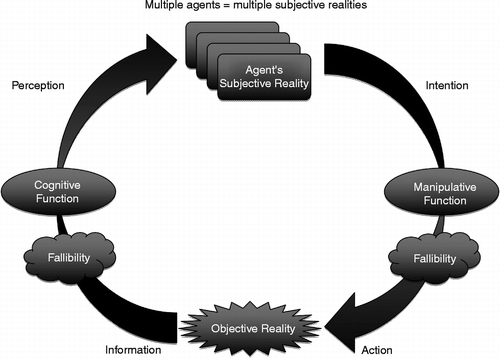
This does not mean the original valuation was correct. A valuation can be excessive while still producing temporarily favourable real effects. Nor does it mean capital always helps. In a category boom, the same money that strengthens a leading company can also fund too many rivals, inflate scientist salaries, normalize customer subsidies, and erode the informational value of early traction.
Fallibility, Reflexivity, and the Human Uncertainty Principle
Read George Soros’s account of how fallible perceptions and intentional actions form feedback loops, then his description of positive feedback and boom–bust processes. This is the conceptual basis for distinguishing a change in valuation from a valuation-driven change in venture fundamentals.
In the subsection “Reflexivity,” begin with the two functions. Focus on the cognitive function, which takes facts into beliefs, and the manipulative function, which takes beliefs into actions. Next, in “Negative versus positive feedback loops,” read from positive feedback. Finally, in “Boom–bust processes,” read from the bubble anatomy. Translate “underlying trend” into a genuine technological or market advance, and “misconception” into an exaggerated claim about its speed, breadth, or economic capture.
What should be observable?
A reflexive account predicts an identifiable bridge from financing conditions to operating outcomes:
| Belief or market event | Venture-world transmission channel | Observable operating consequence |
|---|---|---|
| High valuation or marquee round | More cash, credibility, and option value | Faster hiring, larger experiments, longer runway |
| Category legitimacy | Customers and partners expect continuity | More pilots, partnerships, and recruiting interest |
| Rising comparable financings | More founders and investors enter | Greater startup formation and competition |
| Financing slowdown | Cash preservation and continuity concerns | Hiring freezes, bridges, reduced experimentation, delayed customer commitments |
The most discriminating evidence is not that valuations rose. It is that financing access changed variables that later showed up in the business: time to technical milestone, customer conversion, recruitment quality, purchasing power, or competitive intensity.
This produces a practical counterfactual question: Would the company’s operating trajectory have differed materially if it had raised the same capital at a much lower valuation, or if the category had not become fashionable? If the answer is no, reflexivity is likely secondary. If the answer is yes, it is central.
Minsky: a boom in financing fragility
The Minsky lens begins later in the causal chain. It asks whether a period of success, rapid funding, and low visible failure has caused investors and companies to treat continuation finance as more dependable than it truly is.
For conventional VC, we must retain the qualification from the previous lesson: this is usually an equity-Minsky pattern, not a debt crisis. A startup may have negative cash flow by design; that alone does not make it Minskyan. The relevant issue is whether the company’s strategy becomes unviable when financing cadence slows or valuation expectations reset.
What should be observable?
An equity-Minsky interpretation expects:
- Compressed financing time. Companies reach successive rounds faster, and rapid markups are treated as evidence of reduced business risk.
- Weaker underwriting discipline. Less validated evidence is needed for a larger round; milestones shift from commercial proof toward narrative or category leadership.
- Growing valuation dependence. Hiring plans, option expectations, cap-table structures, and planned spend presume an up round or at least a large flat round.
- Reduced buffers. Companies may have cash, but insufficient flexibility to absorb a delayed financing without painful retrenchment.
- A reversal centred on financing availability. When round velocity slows, bridges, down rounds, layoffs, and delayed milestones become mutually reinforcing.
Minsky does not, by itself, explain why this particular category became glamorous. It does not require celebrity investors, cascading inferences, or higher-order beliefs. It explains why a boom that has already emerged becomes fragile as its apparent stability produces looser standards and greater dependence on continuation.
In the hypothetical laboratory boom, the decisive Minsky evidence would be the late-cycle operating plans: how many companies need a new round before generating enough technical validation or commercial revenue to justify their prior valuation? A category can be technologically important and still be financially fragile.
Comparing the reversal
The clearest way to distinguish the theories is to examine what each says about the same negative event: a marquee laboratory company fails to raise a planned round.
| Framework | Why does the failed round matter? | What should follow first? |
|---|---|---|
| Keynes | It changes beliefs about what future investors will value and fund. | Repricing of expectations, reduced willingness to pay, caution in new rounds |
| Girard | A prestige model loses aura; imitation and rivalry lose their focal point. | Attention shifts away from the category; formerly desirable affiliations become less status-enhancing |
| Information cascade | The event is a negative public signal that may outweigh prior visible actions. | A sharp halt in imitation, especially among actors with weak private information |
| Reflexivity | Less funding impairs hiring, experimentation, customer confidence, and execution, validating pessimism. | Operating deterioration follows the financing shock and further strengthens negative beliefs |
| Minsky | It reveals reliance on favourable continuation finance and exposes fragile funding structures. | Bridges, burn cuts, down rounds, missed milestones, and category-wide financing stress |
Notice the difference in timing. A cascade or Keynesian convention may break very quickly at the level of investor behaviour. Reflexivity predicts subsequent effects on company fundamentals. Minsky predicts that firms most dependent on a timely, favourable financing will suffer most severely.
This is why a falling valuation is not enough to diagnose any of these mechanisms. The investor should ask: Who changes behaviour? What information have they received? Which companies become operationally weaker? Who must finance or refinance soon?
A disciplined way to use the five lenses
The frameworks are best treated as rival causal claims, not as colourful labels. For a live category, create a short chronology with dated entries in five columns:
- Private evidence: technical milestones, customer retention, regulatory results, unit economics.
- Public signals: high-profile rounds, investor announcements, press narratives, comparables.
- Prestige structure: whose endorsement changes behaviour disproportionately?
- Financing conditions: round cadence, valuation steps, insider bridges, burn assumptions.
- Operating consequences: hiring, customer adoption, product velocity, competition, supplier or talent costs.
Then test three questions.
1. What moved first?
If public investment decisions precede widespread underlying validation, the cascade and Keynesian lenses deserve attention. If a few prestigious actors precede the movement, Girard may add explanatory power. If financing changes precede operational outcomes, reflexivity is likely active. If financing dependence accumulates over a period of apparent stability, the Minsky lens becomes stronger.
2. Who is most affected?
Prestige-sensitive companies and investors should respond most to Girardian dynamics. Actors with limited ability to conduct independent diligence should be more cascade-prone. Companies with high burn and an imminent financing requirement should be most exposed to Minsky-like reversal. Companies whose commercial performance depends on perceived continuity should show reflexive vulnerability.
3. Is the category’s problem informational, social, operational, or financial?
These are not the same diagnosis:
- Informational: investors inferred too much from prior visible actions.
- Social: prestige and rivalry concentrated attention beyond the object’s standalone merits.
- Expectational: participants priced what they expected the next market to reward.
- Operational: belief and capital changed the businesses themselves.
- Financial: companies became unable to tolerate a normal deterioration in financing conditions.
A contrarian opportunity often appears after these mechanisms have been conflated. For example, the market may conclude that an entire category is “broken” after a financing reversal. Yet the actual damage may be concentrated in valuation-dependent companies, while technically capable firms with sufficient runway, differentiated customer access, and lower capital requirements are being priced as if the stigma applied equally to all.
Key takeaways
The five frameworks can describe the same venture boom, but they predict different observable traces:
- Keynes directs attention to higher-order beliefs and market conventions: participants invest because they expect others to value the opportunity later.
- Girard directs attention to models of prestige, identity, and rivalry: an investment becomes desirable because admired actors visibly desire it.
- Information cascades direct attention to sequential learning: visible decisions overwhelm private signals, making coordinated behaviour fragile.
- Soros directs attention to feedback from belief and valuation into real venture fundamentals: capital and legitimacy can change what companies can achieve.
- Minsky directs attention to late-cycle fragility: apparent stability weakens discipline and makes companies dependent on continued favourable financing.
The frameworks can operate together. A prestigious investment may initiate a cascade, establish a Keynesian convention, induce mimetic competition, improve company fundamentals through reflexivity, and eventually support Minsky-like valuation dependence. The important analytical discipline is to specify which link is doing the work, what evidence would support it, and how a reversal would actually propagate.
In the next module, we move from explanation to category dynamics: why a few power-law winners, comparable financings, public marks, and brand-name signals can make a venture category hot—and how salient failures and funding shocks can make it suddenly cold.