
Welcome back. In the last lesson, you used substitution to reduce a system to one equation with one variable and solve for that first value. For example, you might have reached or .
This lesson completes the method. You will back-substitute that known value into an original equation, solve for the remaining variable, and write the system’s solution as an ordered pair . In this module, that is the difference between a partial answer and a complete answer.
From one known value to a complete solution
Suppose substitution has led you to:
This tells you only the -coordinate of the solution. A system needs a value for both variables.
To find , return to one of the original equations. If one equation was already isolated, it is usually the quickest one to use.
For example, consider the system:
In the previous lesson’s substitution step, you would find:
Now back-substitute into the convenient original equation:
Both values are now known:
So the solution is:
The order matters. An ordered pair is always written:
Since and , write , not .
A useful way to organize your work is to label each value before writing the pair:
| Variable | Value |
|---|---|
Then translate the table directly into .
The back-substitution move
Back-substitution is simply substitution with a number instead of an algebraic expression.
If you know:
and an original equation says:
replace with and calculate .
Likewise, if you know:
and an equation says:
replace with and calculate .
The most efficient choice is usually the equation where the unknown variable is already alone. It avoids unnecessary extra equation-solving.
Example 2: Solving systems by substitution | Systems of equations | 8th grade | Khan Academy
Watch “Example 2: Solving systems by substitution” from Khan Academy for a concise demonstration of using a known value of x to find y, then stating both values as the system’s solution.
Watch back substitution. Notice that, once x=4 is known, the presenter returns to the original equation with y isolated. Focus on the distinction between finding a variable value and reporting the final two-coordinate solution.
A full example with a negative value
The substitution diagram below shows the full method. Its lower steps are the focus now: after substitution produces , use that value to determine .
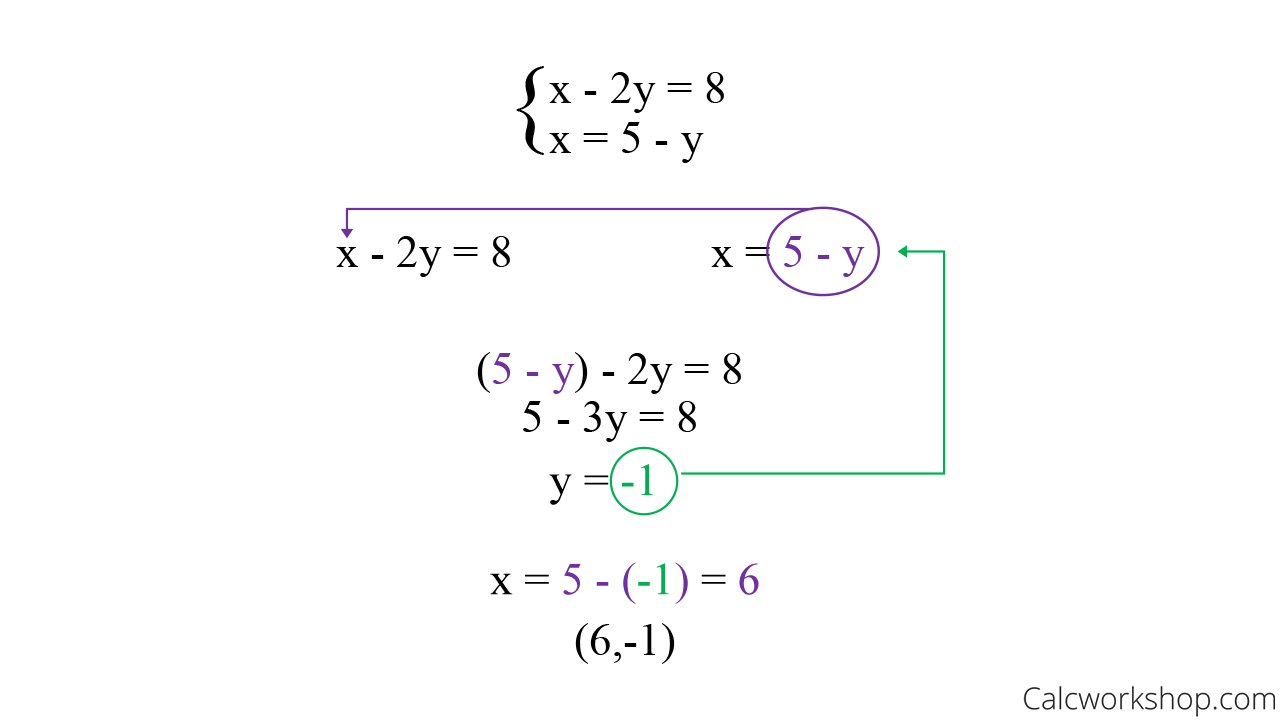
The system is:
After the earlier substitution work, suppose you have found:
Now use the equation that already has isolated:
Substitute for :
The parentheses make the negative value clear. Subtracting a negative is the same as adding:
Now identify each coordinate:
Therefore, the solution is:
Notice an important point: even though was found first, the ordered pair still begins with . The discovery order does not determine the coordinate order.
Choosing an equation for back-substitution
You may substitute the known value into either original equation. Both equations should produce the same missing value. But some choices take less work.
Suppose the original system includes:
and substitution has already given:
Faster choice: use the isolated equation
Because is alone in the first equation, substitute :
The solution is:
Valid but longer choice: use the other original equation
You could instead use:
Substitute :
Add to both sides:
This is correct, but it requires an extra step. When choosing where to back-substitute, look first for an equation where the unknown variable is already isolated.
Write the result in the right form
A complete system solution has three related forms:
The equations identify which value belongs to which variable. The ordered pair gives the final answer in the standard coordinate format.
Be especially careful when you find before . For instance, if your work ends with:
the solution is:
not
The first position always belongs to ; the second always belongs to .
Systems of equations with substitution (article) - Khan Academy
Read Khan Academy’s worked example to see the final stage of substitution in context: once one variable has been found, the remaining value is calculated and the result is written as an ordered pair.
In the first worked example, locate the paragraph that begins after x=8 has been obtained: finding the second value. Follow how the equation y=2x makes back-substitution quick, and note why the final result is written with the x-value first.
Common back-substitution mistakes
At this stage, the algebra is usually short, so small mistakes stand out clearly.
Substituting into the wrong kind of equation
Once you find , do not substitute it into the one-variable equation that helped you find , such as:
That equation has no , so it cannot help find . Return to one of the two original equations that contains both variables.
Losing a negative sign
If:
and:
write:
not:
The value replacing is negative, so parentheses preserve its sign.
Reversing the ordered pair
If:
and:
then the answer is:
The pair represents a different point.
Stopping after one variable
A statement such as
is not yet a complete solution to a two-variable system. Use it to find , then write the pair.
A dependable finish routine
Whenever you finish the first substitution equation, use this short routine:
- Record the known variable value clearly, such as .
- Return to an original equation containing both variables.
- Choose the simplest equation, preferably one with the remaining variable isolated.
- Replace the known variable with its number, using parentheses for negative values.
- Solve for the remaining variable.
- Write the answer as , regardless of which variable you found first.
This routine keeps the end of a substitution problem organized and makes it much harder to reverse coordinates or lose a negative sign.
Key takeaways
Back-substitution turns the first variable value into the second one. Once you know one coordinate, substitute that number into an original equation to find the other coordinate.
Remember:
- A system is not completely solved until you know both and .
- The equation with a variable already isolated is usually the most efficient place to back-substitute.
- Preserve negative values with parentheses.
- Write the final answer in the fixed order , not in the order you happened to find the values.
Next, you will verify an ordered-pair solution by substituting both values into both original equations.
Can't find a good explanation? Sign up and we'll make it for you
Sign up