
Welcome back. In the previous lesson, you finished solving a system by back-substituting to find both variable values and writing the result as an ordered pair . For instance, finding and gives .
Now comes the final safeguard: checking. A candidate pair is a solution only if it makes both original equations true. This lesson shows how to substitute the pair carefully, interpret the true-or-false results, and catch common errors before turning in an answer.
A system requires two successful checks
A linear equation in two variables has many solutions. For example, many points may satisfy:
A system places two equations together. Its solution must satisfy the first equation and the second equation at the same time.
Think of each equation as an independent requirement:
| Requirement | What must happen? |
|---|---|
| First equation | Substitution produces a true statement. |
| Second equation | Substitution produces a true statement. |
| The system | Both statements must be true. |
So there are only two conclusions when checking a proposed ordered pair:
- Both equations are true: the ordered pair is a solution.
- At least one equation is false: the ordered pair is not a solution.
One correct equation is not enough. A point can lie on one line without lying on the other.
The verification routine
Suppose you are asked whether solves a system.
-
Read the ordered pair in its fixed order:
-
Substitute those values into the first original equation.
-
Simplify the left side and decide whether the resulting statement is true or false.
-
Repeat with the second original equation.
-
State a conclusion about the system.
A clear written check usually looks like this:
Then label each result True or False.
When a coordinate is negative, always substitute it with parentheses. If , then becomes:
not .
How to Determine If an Ordered Pair is a Solution to a System of Equations
Watch “How to Determine If an Ordered Pair is a Solution to a System of Equations” from The Organic Chemistry Tutor. It models the exact habit needed here: test the same proposed pair in each original equation, then make one conclusion about the whole system.
Watch a successful check to see a pair that makes both equations true. Then watch a failed check, paying particular attention to the negative y-value and why passing the first equation does not establish that the pair solves the system.
Example: verifying a solution
Consider this system and proposed solution:
First identify the coordinate values:
Now test the first equation.
The first equation is true.
Next, test the second equation.
The second equation is also true. Therefore:
is a solution to the system.
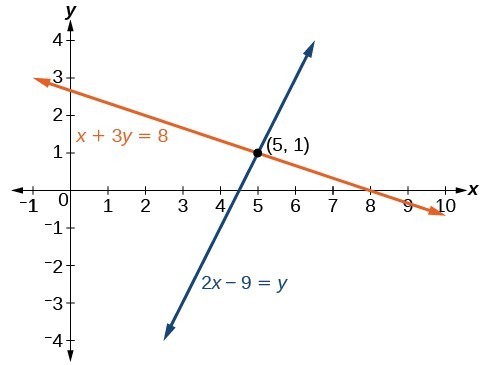
The graph gives a useful interpretation: every point on a line satisfies that line’s equation. Because lies on both lines, it satisfies both equations. The substitution check is the exact algebraic proof.
Example: a point that passes one equation but fails the system
Now consider:
Test the ordered pair:
Here:
Check the first equation
This statement is true.
Check the second equation
This statement is false.
Although works in the first equation, it fails the second. Therefore:
is not a solution to the system.
When you are doing a quick check, one false equation is enough to prove that the pair is not a system solution. But when the instruction says to verify in both equations, write both checks so your work is complete and easy to inspect.
Checking your own substitution answer
Checking is especially useful after you have solved a system by substitution. It can reveal an error in distribution, signs, arithmetic, back-substitution, or coordinate order.
Suppose your substitution work produced:
and your original system was:
Your final check would be:
True.
Then:
True.
Since both original equations check, the solution is confirmed:
Notice that the first coordinate, , always replaces , and the second coordinate, , always replaces . Reversing them would test a different point:
That is why writing the assignments and before beginning is a dependable habit.
Errors that checking is designed to catch
Reversing the coordinates
For the pair :
It does not mean and .
Losing a negative sign
If , preserve the value exactly:
The result is positive:
Parentheses make this much harder to misread.
Checking only one equation
A true result for one equation means only that the point lies on that equation’s line. It does not establish that it solves the system.
Treating a false equation as a calculation error automatically
A false result sometimes means you made arithmetic mistake, so review your work. But it may also mean the proposed pair is genuinely not a solution. Recheck the substitution and arithmetic once; if the statement is still false, conclude that the pair fails the system.
Checking a changed equation instead of the original system
When verifying a solution you found by substitution, return to the two equations you started with. Testing the original equations directly gives the clearest confirmation that the final ordered pair solves the original system.
A compact checklist for quiz work
Before writing your final conclusion, scan your work:
- Did I assign the first coordinate to and the second to ?
- Did I substitute into both original equations?
- Did I use parentheses around negative values?
- Did I simplify each side correctly?
- Are both resulting equations true?
- Did I clearly state whether the ordered pair is or is not a solution?
Key takeaways
To check an ordered pair in a system, substitute its -value and -value into each original equation.
- A system solution makes every equation true.
- One false statement means the ordered pair is not a solution to the system.
- Parentheses protect negative substitutions.
- Checking both original equations is the best final step after solving by substitution.
You have now completed the essential substitution workflow: solve for one variable, back-substitute for the other, write , and verify it. In the next module, you will strengthen the multi-step equation skills that make substitution work when expressions include parentheses and several terms.
Can't find a good explanation? Sign up and we'll make it for you
Sign up