
Hello! Welcome to the first lesson of our new module, "Self-Supervised Speech Representation."
In the previous module, we explored the dominant architectures for supervised Automatic Speech Recognition (ASR), such as Whisper and CTC-based models. A common thread among all of them was their reliance on vast quantities of transcribed audio data for training. While powerful, this dependency creates a significant challenge.
This lesson addresses the learning outcome: Explain the motivation for self-supervised pretraining in speech processing to leverage unlabeled data. We will explore the fundamental limitations of the supervised paradigm and understand why the field has shifted towards self-supervised learning (SSL). This conceptual foundation is crucial for grasping the mechanics of the models we'll study next and is central to your goal of becoming an audio researcher, as SSL is the cornerstone of modern large-scale audio models.
1. The Supervised Learning Bottleneck
State-of-the-art supervised ASR systems, which you've studied, often require thousands, or even tens of thousands, of hours of meticulously transcribed audio to achieve high performance. This presents a major problem.
To begin, let's hear about this challenge directly from the authors of a seminal paper in this field.
Wav2vec2 A Framework for Self-Supervised Learning of Speech Representations - Paper Explained
This video provides a concise introduction to the wav2vec 2.0 paper. The first part clearly articulates the data scarcity problem that self-supervised learning aims to solve.
Watch from 01:38 to 02:30. Pay attention to the statistics mentioned about the data requirements for ASR and the number of languages spoken worldwide.
As the video highlights, creating these large, labeled datasets is:
- Expensive and Time-Consuming: It requires significant manual effort from human transcribers.
- A Scalability Bottleneck: For the vast majority of the world's ~7,000 languages, such datasets simply do not exist and are not feasible to create.
This reliance on annotated data fundamentally limits our ability to build high-quality speech technology for low-resource languages and to continue scaling up model performance.
Self-Supervised Learning for Speech Processing
Dr. Yu-An Chung's PhD thesis from MIT provides an excellent academic framing of this issue. Let's read the introduction to formalize this concept.
Read the first two paragraphs of Chapter 1, 'Introduction' (starting from 'Nowadays, deep neural networks...'). Focus on how it describes the relationship between performance and labeled data size, and the term 'scalability bottleneck'.
In contrast to the scarcity of labeled data, unlabeled audio (raw recordings, podcasts, audiobooks, etc.) is abundant and grows daily. The key question then becomes: How can we leverage this massive, untapped resource?
2. The Self-Supervised Paradigm
Self-supervised learning (SSL) provides the answer. Instead of relying on human-provided labels, SSL creates a "pretext task" where the supervision signal is derived from the input data itself.
The general paradigm for SSL in speech involves two stages:
- Pre-training: A large neural network is trained on thousands of hours of unlabeled audio. The model's objective is a pretext task, such as predicting a masked portion of the audio from its surrounding context.
- Fine-tuning: The pre-trained model, which has now learned rich and general representations of speech, is adapted for a specific downstream task (like ASR) using a very small amount of labeled data.
The power of this approach is staggering. Let's look at a concrete result from the same video.
Wav2vec2 A Framework for Self-Supervised Learning of Speech Representations - Paper Explained
This brief clip quantifies the incredible data efficiency gained through self-supervised pre-training.
Watch from 01:16 to 01:25. Note the amount of labeled data used and the resulting Word Error Rate (WER) after pre-training on a large unlabeled dataset.
The result mentioned—achieving a low WER on the LibriSpeech benchmark with just 10 minutes of labeled data after pre-training on 53,000 hours of unlabeled data—was revolutionary. It demonstrated that pre-training on unlabeled audio could dramatically reduce the need for transcribed data, opening the door to building ASR systems for languages and domains with scarce resources.
3. An Analogy to NLP: Bringing BERT to Speech
Your background with Transformers and models like BERT provides a perfect analogy. The success of BERT in Natural Language Processing (NLP) was a major inspiration for modern speech SSL. BERT is pre-trained on a massive text corpus using a Masked Language Modeling (MLM) task: it learns to predict randomly masked words from their context.
Researchers sought to apply this same powerful idea to speech. However, they faced a fundamental challenge.
An Illustrated Tour of Applying BERT to Speech Data
This article from The Gradient provides a fantastic, illustrated tour of this very problem. It clearly explains the leap from text to speech.
Read the section that begins with the bold question, 'Could we replace the text input in BERT with a speech sequence...'. This section perfectly frames the core technical hurdle.
As the article explains, the central problem is the difference in data modality:
- Text is composed of discrete units (words or sub-words) from a finite vocabulary.
- Speech is a continuous waveform. It has no inherent, discrete units to mask and predict.
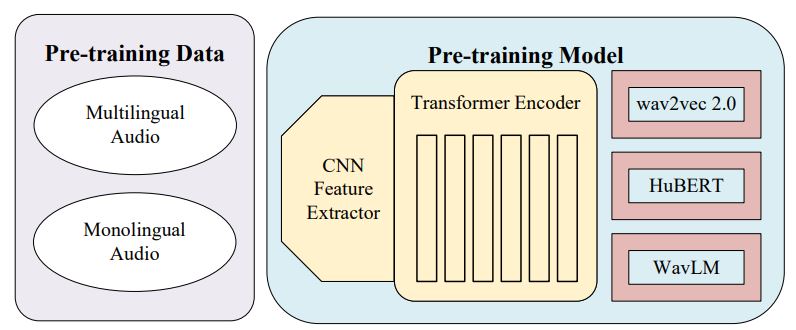
Solving this "discretization problem" is the key technical innovation of models like wav2vec 2.0 and HuBERT. They find a way to learn a set of discrete "speech units" directly from the raw audio during pre-training, enabling a BERT-like masking objective. We will dive into how they do this in the upcoming lessons. For now, the key takeaway is that the core motivation and pretext task design are heavily inspired by the success of self-supervision in NLP.
4. Why are Self-Supervised Representations So Powerful?
You might wonder why we don't just pre-train a model on a supervised task like ASR with a large dataset and then fine-tune it for another. What makes SSL representations special? The difference lies in the information they are forced to retain.
Self-Supervised Learning for Speech Processing
Let's return to the MIT thesis for a nuanced explanation of the difference between supervised and self-supervised pre-training.
Read the subsection '2.3.1 Background'. Focus on the paragraph beginning with 'The key difference between supervised pre-training and self-supervised pre-training...'. This explains what kind of information is retained or discarded by each paradigm.
To summarize this critical point:
- Supervised Pre-training: A model trained on a task like ASR learns to be invariant to factors that don't affect the transcript, such as speaker identity, emotion, or background noise. It is incentivized to discard this information. This makes the learned representations highly specialized but less useful for other tasks (like speaker verification or emotion recognition).
- Self-Supervised Pre-training: A model whose goal is to reconstruct the original input is forced to learn about all aspects of the signal. To predict a masked segment of audio, it must understand the phonetic content, the speaker's vocal characteristics, the prosody, and even the ambient noise. This results in rich, general-purpose representations that are highly effective for a wide range of downstream tasks, not just ASR.
This versatility is why SSL is a foundational pillar for your goal of working on STT, TTS, and STS. All of these tasks benefit from a model that has a deep, holistic understanding of the speech signal.
Conclusion
In this lesson, we've established the crucial "why" behind the shift to self-supervised learning in speech processing.
Key Takeaways:
- Supervised learning is data-hungry: It faces a "scalability bottleneck" due to its reliance on massive, expensive, and often unavailable transcribed datasets.
- SSL leverages unlabeled data: It uses a two-stage pre-training and fine-tuning paradigm, allowing models to learn from abundant unlabeled audio and dramatically reducing the need for labeled data.
- The pretext task is key: Inspired by models like BERT, SSL in speech involves masking parts of the input and training the model to predict the missing information, thus creating its own supervision signal.
- SSL learns rich, general representations: By focusing on reconstructing the input, self-supervised models capture a wide array of speech characteristics, making their learned representations powerful and versatile for many downstream applications.
Preview of the Next Lesson:
Now that you understand the motivation for self-supervised learning, we will begin our deep dive into the mechanics of how these models work. In the next lesson, we will dissect the architecture of one of the most influential self-supervised speech models: wav2vec 2.0. We will focus on its two main components: the CNN feature encoder that processes the raw waveform and the Transformer context network that builds contextualized representations.