
Good to see you again. In the last lesson, you reviewed weather as the condition of the atmosphere at a particular place and time. This final rapid review focuses on the weather hazards most likely to appear on your test: hurricanes, typhoons, tornadoes, blizzards, and droughts.
The central skill is to notice the clue in the question: warm ocean water, funnel cloud, snow and strong wind, or many months with little rain. Those clues point to different hazards.
Plan on about 30 minutes for this lesson.
The five hazards: recognize the defining clue
A hurricane is a huge, organized low-pressure storm that forms over warm tropical or subtropical ocean water. It gets its energy from that warm water. Hurricanes can bring destructive winds, heavy rain, flooding, and storm surge along coasts.
A typhoon is not a different kind of storm. It is the same type of storm as a hurricane, called a tropical cyclone. The name changes based on where it forms:
- HURRICANE: North Atlantic and central/eastern North Pacific
- TYPHOON: western North Pacific, including waters near much of Asia
- CYCLONE: South Pacific and Indian Ocean
Hurricanes | National Oceanic and Atmospheric ...
Read NOAA’s “Hurricanes” overview to lock in the most-tested idea: hurricanes, typhoons, and cyclones are the same type of warm-ocean storm with regional names.
In the “What is a hurricane?” section, read the definition. Focus on the words “low pressure,” “organized thunderstorm activity,” and “warm ocean waters.” Then, in “What’s in a name?”, locate the paragraph beginning “Hurricanes, typhoons, and cyclones are actually all the same type of storm.” Read from the sentence beginning the regional names. Memorize that ASIA is associated with TYPHOONS on a basic geography question.

A tornado is much smaller than a hurricane but can have extremely violent winds. It is a rapidly rotating column of air extending from a thunderstorm cloud to the ground. If the rotating funnel does not reach the ground, it is a funnel cloud; once it touches the ground, it is a tornado.
Tornadoes form in severe thunderstorms when the atmosphere has warm, humid, unstable air and strong wind shear. Wind shear means that wind speed or direction changes at different heights in the atmosphere. On your test, though, the key definition is usually enough:
A powerful funnel-shaped column of air is a TORNADO.
A blizzard is a dangerous winter storm. The school-test definition is usually: a heavy snowstorm with winds of at least 35 miles per hour. More precisely, a blizzard also involves blowing snow and very low visibility for a sustained period. The important distinction is that a blizzard is about snow, strong wind, and reduced visibility, not simply cold temperature.
A drought is a long period with much less precipitation than normal. It can develop over months or longer, damaging crops, lowering water supplies, and increasing wildfire risk. A drought is not one hot day and not just a short stretch without rain.
| Hazard | Main formation or condition | Fast test clue |
|---|---|---|
| Hurricane | Warm tropical ocean water; large rotating low-pressure system | “Storm over warm tropical waters” |
| Typhoon | Same as a hurricane, but in the western North Pacific | “Hurricane in Asia” |
| Tornado | Severe thunderstorm, unstable air, wind shear | “Funnel-shaped rotating column of air” |
| Blizzard | Snow plus strong winds and poor visibility | “Heavy snow and winds over 35 mph” |
| Drought | Long-term lack of rainfall or precipitation | “Months with very little rain” |
Hurricane versus tornado: do not mix them up
Both hurricanes and tornadoes rotate and can cause severe damage, but they are built in very different environments.
A hurricane forms over warm ocean water and can stretch hundreds of miles across. It has a broad circulation, often with a calmer center called the eye. It may last days or even longer as it travels over the ocean and sometimes onto land.
A tornado forms from a severe thunderstorm, usually over land, and is generally far smaller: often hundreds of yards wide, though sizes vary. Many tornadoes last only minutes. Their narrow path does not make them harmless; their winds can be intense.
Hurricane vs. Tornado: What's the difference?
Watch “Hurricane vs. Tornado: What’s the difference?” from Storm Shield App for a fast visual comparison of formation, size, duration, and warning time.
Watch formation and size. Notice the contrast: hurricanes begin over heated seawater, while tornadoes begin within severe thunderstorms. Then watch duration and warnings. The key test point is that hurricanes usually give people much more time to prepare than tornadoes do.
Here is the comparison worth memorizing:
| Feature | Hurricane / Typhoon | Tornado |
|---|---|---|
| Where it forms | Over warm tropical ocean water | In or beneath a severe thunderstorm |
| Typical size | Hundreds of miles wide | Usually much narrower |
| Main appearance | Large spiral storm; may have an eye | Funnel-shaped rotating column |
| Typical duration | Hours to days or longer | Often minutes, sometimes longer |
| Main dangers | Wind, heavy rain, flooding, storm surge | Violent wind and flying debris |
| Warning time | Often days of forecasts and alerts | May be only minutes |
Warning-time question
Your study guide says, “Hurricanes can occur with no warning.” The correct answer is FALSE.
Meteorologists track tropical storms and hurricanes over large ocean areas. Because hurricanes take time to form and travel, people are often warned days before landfall.
Tornadoes are different. Tornadoes can form quickly, so warning time can be short. A tornado watch means conditions are favorable for tornadoes. A tornado warning means a tornado has been seen or detected by radar, and people in the warned area should seek shelter immediately.
Spring Weather Safety Campaign - Tornadoes
Use this National Weather Service page to reinforce the exact tornado definition, why tornadoes can develop rapidly, and why Texas is the expected state answer.
Under “What causes tornadoes?”, read the tornado definition and ingredients. You do not need to memorize every formation detail; retain “thunderstorm,” “hot and humid,” and “wind shear.” Continue in the following “How do tornadoes impact Southeast Texas?” section through the statement that Texas averages the highest number of tornadoes of any U.S. state. Finally, in “National Weather Service Tornado Products,” read watch versus warning. Focus on the fact that a warning covers a smaller area and demands immediate action.
Where do these hazards occur most often?
For your geography test, match the hazard to the correct location or prevalence fact.
Tropical cyclones
Hurricanes, typhoons, and cyclones usually form over warm tropical oceans, not directly on the Equator. The world map shows formation regions in bands north and south of the Equator.
The name depends on the ocean basin:
- Near the Atlantic Ocean, Gulf of Mexico, Caribbean, and eastern Pacific: HURRICANES
- In the western Pacific near East and Southeast Asia: TYPHOONS
- In the Indian Ocean and South Pacific: CYCLONES
Tornadoes
The expected answers are:
- State with the most tornadoes in the United States: TEXAS
- Country with the most tornadoes: UNITED STATES (USA)
Texas’s combination of warm, moist air from the Gulf and clashes with other air masses helps produce frequent severe thunderstorms. The exact yearly totals can change, but Texas is the standard answer to the state question.
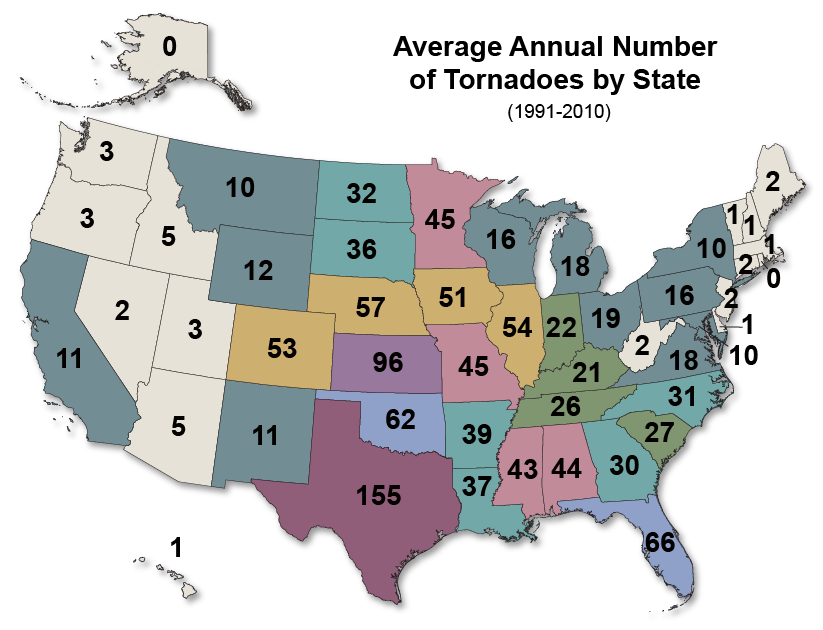
Notice the map’s date range: 1991–2010. It shows a long-term average, not a prediction for this year. On a multiple-choice test asking which state has the most tornadoes, choose TEXAS even if a different source uses a different average period.
Blizzard and drought patterns
Blizzards are most likely in places that can receive snow and strong winter winds, especially northern and central parts of North America. A blizzard can occur wherever the needed winter conditions come together; it is not defined by one particular state.
Droughts can happen in many climates. They are especially common where rainfall is already limited or highly variable, but the definition always focuses on a prolonged precipitation shortage, not the location.
Rapid multiple-choice test drill
Answer each question in your head, then check the answer immediately.
1. A massive storm gains energy from warm tropical ocean water. What is it?
HURRICANE
2. What is a hurricane called in the western North Pacific near Asia?
TYPHOON
3. Hurricanes, typhoons, and cyclones are different names for what general kind of storm?
TROPICAL CYCLONES
4. A violently rotating funnel of air reaches from a thunderstorm to the ground. What is it?
TORNADO
5. Which state has the most tornadoes in the United States?
TEXAS
6. Which country has the most tornadoes?
THE UNITED STATES (USA)
7. “Hurricanes can occur with no warning.” True or false?
FALSE
8. Which hazard commonly provides less time for a warning: a hurricane or a tornado?
TORNADO
9. A snowstorm with winds of at least 35 miles per hour and poor visibility is a what?
BLIZZARD
10. A long period with little or no rain is a what?
DROUGHT
11. Which hazard is most directly connected to strong wind shear inside a severe thunderstorm?
TORNADO
12. Which two hazards are actually the same kind of tropical storm but have different regional names?
HURRICANE AND TYPHOON
Flashcards for a last-minute review
- Storm that forms over warm tropical water — HURRICANE
- Hurricane in Asia / western North Pacific — TYPHOON
- General name for hurricanes, typhoons, and cyclones — TROPICAL CYCLONE
- Powerful funnel-shaped column of air — TORNADO
- State with the most tornadoes — TEXAS
- Country with the most tornadoes — UNITED STATES / USA
- Heavy snowstorm with winds over 35 mph — BLIZZARD
- Long period with little rainfall — DROUGHT
- Hurricanes can occur with no warning — FALSE
- Hazard that may form quickly with little warning time — TORNADO
- Hurricane’s energy source — WARM OCEAN WATER
- Tornado’s parent storm — SEVERE THUNDERSTORM
Key takeaways
Use the defining clue to separate the hazards:
- Warm tropical water means HURRICANE or TYPHOON.
- Funnel-shaped rotating air from a thunderstorm means TORNADO.
- Snow, wind over 35 mph, and low visibility means BLIZZARD.
- A long-term lack of rainfall means DROUGHT.
For the exact study-guide facts, remember: hurricanes do not occur with no warning, a hurricane in Asia is a TYPHOON, TEXAS has the most tornadoes of any U.S. state, and the UNITED STATES has the most tornadoes of any country.
Can't find a good explanation? Sign up and we'll make it for you
Sign up