
Good to see you again. Last lesson focused on the solid Earth: moving tectonic plates can cause earthquakes, volcanoes, and tsunamis. Now shift upward to the atmosphere. For your test, the two essential ideas are:
- Weather is the condition of the atmosphere at a particular place and time.
- Recent global warming is mainly caused by the enhanced greenhouse effect: human activities add extra greenhouse gases that trap more heat.
This is a rapid review lesson; plan for about 25–30 minutes.
Weather: what is happening now?
Weather is the short-term condition of the atmosphere at a particular location and time. It includes things you can observe or measure today, such as:
- temperature
- precipitation, including rain or snow
- wind speed and direction
- humidity
- cloudiness
- air pressure
So if a question says, “It is 45 degrees, cloudy, windy, and raining in Mt. Vernon today,” it is describing WEATHER.
Weather or Climate ... What's the Difference?
Read National Geographic’s short explanation to lock in the difference between weather and climate. This distinction prevents a common test mistake: confusing a daily condition with a long-term pattern.
In the opening section, find the bold heading “Weather Refers to Short-term Conditions.” Read from the definition and examples. Then continue through the paragraph explaining why changing atmospheric conditions mean weather changes. Focus on the words short-term, location, and atmosphere.
A useful comparison:
| If the question asks about... | Choose... |
|---|---|
| Today’s rain, wind, temperature, or clouds | WEATHER |
| Typical conditions measured over many years | CLIMATE |
| A long-term rise in Earth’s average temperature | GLOBAL WARMING |
A cold day, week, or even winter is still weather. It does not disprove a long-term warming trend, because climate describes patterns over many years, usually 30 years or more.
Test-ready definition
The condition of the atmosphere at a particular location and time is WEATHER.
The natural greenhouse effect
Earth receives energy from the Sun. Some sunlight is reflected back into space, but much of it reaches Earth’s surface and warms it. The warm surface then gives off energy as infrared heat.
Certain gases in the atmosphere absorb and re-emit some of that outgoing heat. This process is called the greenhouse effect. It is natural and important: without it, Earth would be much colder and far less suitable for life.
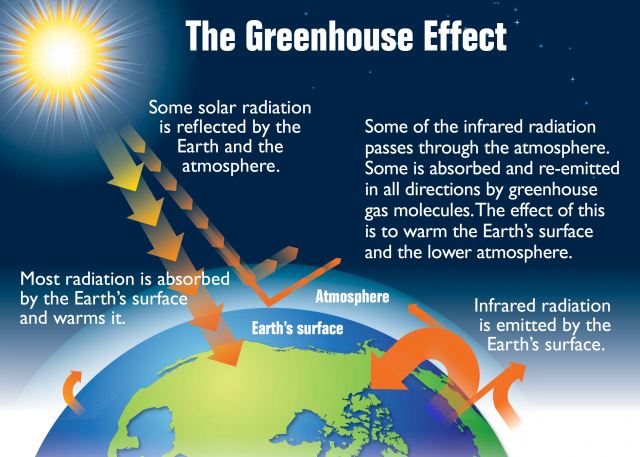
Read the diagram in two parts:
- Yellow arrows represent incoming solar energy. Some is reflected, while much is absorbed by Earth’s surface.
- Orange arrows represent outgoing infrared heat. Some escapes to space, but greenhouse gases absorb and re-emit some in all directions, including back toward the surface.
The diagram is not saying that greenhouse gases create heat from nothing. They slow the loss of heat to space.
What Is the Greenhouse Effect?
Watch NASA Space Place’s “What Is the Greenhouse Effect?” for a quick visual explanation of the natural effect and how human activity strengthens it.
Watch the basic process to see how sunlight warms the ground and the atmosphere holds some outgoing heat. Then watch the gases for examples of greenhouse gases, followed by the human change for the direct connection to fossil fuels and global warming.
Important greenhouse gases include carbon dioxide, methane, nitrous oxide, water vapor, and CFCs. For a basic geography test, the gas most often connected to human-caused warming is carbon dioxide, or .
The enhanced greenhouse effect: the cause of recent warming
The key word is enhanced, meaning made stronger.
Humans burn fossil fuels such as coal, oil, and natural gas for electricity, transportation, heating, and industry. Burning these fuels releases extra carbon dioxide into the atmosphere. Other human activities, including deforestation, agriculture, and some industrial processes, also add greenhouse gases.
With more greenhouse gases in the atmosphere, more outgoing infrared heat is absorbed and re-emitted. Less heat escapes to space as quickly, so Earth’s surface and lower atmosphere warm over time. This human-strengthened warming is the enhanced greenhouse effect.
Read NASA Science’s explanation of the greenhouse effect and the human activities that have increased greenhouse gases. It gives you the exact science behind the short test answer.
First, under “Increasing Greenhouses Gases Are Warming the Planet,” read how the atmosphere traps outgoing heat. Then find the heading “Human Activity Is the Cause of Increased Greenhouse Gas Concentrations” and read from the fossil fuel explanation. Notice that the source identifies human activity, not a recent increase in the Sun’s energy, as the cause of current warming.
Use this test logic:
| Question clue | Best answer |
|---|---|
| “Condition of the atmosphere right now” | WEATHER |
| “Long-term average atmospheric pattern” | CLIMATE |
| “Gases trap more outgoing heat because humans added more of them” | ENHANCED GREENHOUSE EFFECT |
| “Main human activity raising carbon dioxide” | BURNING FOSSIL FUELS |
| “Major greenhouse gas released by burning coal, oil, and gas” | CARBON DIOXIDE |
Be precise with the study-guide wording:
- The greenhouse effect is the natural process that helps keep Earth warm.
- The enhanced greenhouse effect is the extra warming caused by increased greenhouse gases from human activities.
- On a short school question asking for the main cause of recent global warming, GREENHOUSE EFFECT may be the expected answer. The more accurate answer is THE HUMAN-ENHANCED GREENHOUSE EFFECT.
Avoid the common answer traps
Trap 1: “A cold day means global warming is false.”
A cold day is weather, a short-term event. Global warming refers to a long-term increase in average global temperature. Both can exist at the same time.
Trap 2: “The greenhouse effect is always bad.”
No. The natural greenhouse effect is necessary for a livable Earth. The problem is the extra heat trapping caused by higher amounts of human-produced greenhouse gases.
Trap 3: “The Sun is the main cause of current global warming.”
The Sun affects Earth and has influenced climate in the past. However, evidence shows that the modern warming trend cannot be explained by changes in solar energy. The major driver is the human-caused rise in greenhouse gases, especially carbon dioxide.
Trap 4: “Greenhouse gases stop sunlight from entering.”
Not exactly. Most sunlight can pass through the atmosphere and warm the surface. Greenhouse gases mainly slow the escape of outgoing infrared heat.
Flashcard-style final review
- Condition of the atmosphere at a particular place and time — WEATHER
- Rain, wind, clouds, humidity, and temperature today — WEATHER
- Average weather pattern over many years — CLIMATE
- Gas most associated with fossil-fuel warming — CARBON DIOXIDE
- Coal, oil, and natural gas — FOSSIL FUELS
- Natural process in which atmospheric gases absorb and re-emit heat — GREENHOUSE EFFECT
- Human strengthening of that process through extra greenhouse gases — ENHANCED GREENHOUSE EFFECT
- Main cause of recent global warming — HUMAN-CAUSED INCREASES IN GREENHOUSE GASES
- A cold week is an example of — WEATHER
- A decades-long rise in average global temperature is — GLOBAL WARMING
Key takeaways
Memorize this exact definition:
Weather is the condition of the atmosphere at a particular location and time.
For global warming questions, identify the cause-and-effect idea: human activities, especially burning fossil fuels, increase carbon dioxide and other greenhouse gases. Those gases trap more outgoing heat, producing the enhanced greenhouse effect and driving recent global warming.
Next, you will review major weather hazards: hurricanes, typhoons, tornadoes, blizzards, and droughts.
Can't find a good explanation? Sign up and we'll make it for you
Sign up