
Hello. In the previous lesson, you turned the broad theme Natural World into a working investigation: a focused question, a visual intention, and selection criteria. That “project compass” now makes artist research more efficient. You are not looking for a famous photographer to fill a page; you are looking for a photographer whose choices can give your own next images a clearer direction.
This lesson uses Ansel Adams and the supplied landscape photograph as a model. By the end of the session, you will have one source-cited paragraph that does four things: identifies formal choices, places Adams’s work in context, offers a justified interpretation, and states one precise decision for your own project.
An artist study is evidence of development
For AO1, a photographer study needs to show more than biography or admiration. The useful chain is:
- Observe what is visibly present in one photograph.
- Analyse how formal choices such as viewpoint, framing, contrast, tonal range, focus, and composition affect the viewer.
- Contextualise the work with researched facts that are properly cited.
- Connect one specific choice to your own Natural World investigation.
A statement such as “I like Ansel Adams because his photos are dramatic” is a starting reaction, not analysis. It does not explain what creates drama, why it matters, or how it will change your work.
A stronger alternative is:
Adams uses a high viewpoint and a winding river to lead the eye through the landscape, while the contrast between the pale water and dark valley creates a dramatic sense of scale. I will test a similarly controlled tonal contrast in my close-up photographs of natural forms, using a dark background to isolate texture and shape.
That final sentence matters. It converts research into a practical and assessable intention.
How to Analyze Art | Visual and Contextual Analysis
Watch the short “observe, interpret, synthesise” method in How to Analyze Art | Visual and Contextual Analysis by Art History with Alder. It gives you a reliable structure for avoiding vague comments.
Watch the three stages. Use the method while studying Adams’s photograph: first identify visible evidence, then explain possible effects or meanings, and finally connect your observations with researched context and your own project.
Begin with what is actually visible
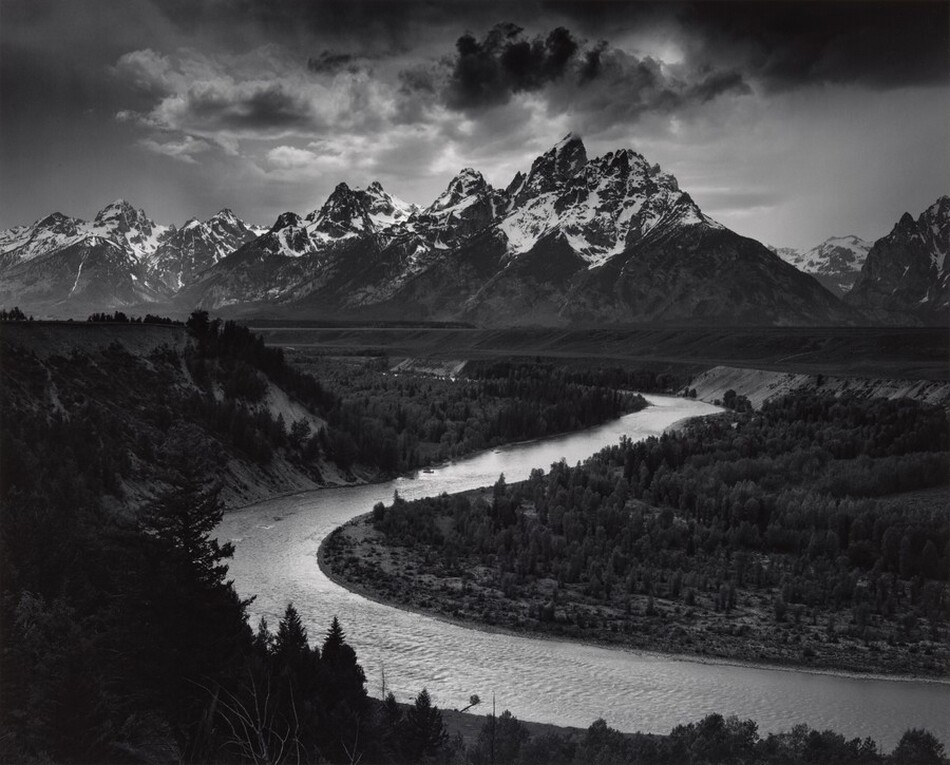
Before researching Adams, spend a few minutes looking closely at the photograph. Treat it as primary visual evidence. Do not begin by assuming what Adams “wanted to say”; begin by describing what he has made visible.
| Visual evidence | Formal choice | Likely effect or interpretation |
|---|---|---|
| The river curves from the foreground into the distance. | A sweeping, curved line leads through the frame. | Your eye travels from the dark foreground towards the mountains, making the landscape feel expansive. |
| The mountains occupy the upper centre of the image. | A wide landscape composition gives the peaks visual dominance. | The mountains appear imposing, while human presence is absent or insignificant. |
| Pale water and snow contrast with dark trees and shadowed land. | Strong black-and-white tonal contrast separates areas of the image. | The scene feels dramatic and carefully ordered rather than like a quick documentary snapshot. |
| Heavy clouds gather above the peaks. | Weather becomes a major visual element, not merely background. | The image suggests change, tension, and the power of a natural world beyond human control. |
| Trees and terrain remain sharply defined. | Detail is retained across foreground, middle distance, and background. | The viewer can explore textures and scale, from individual trees to distant mountains. |
Use precise terms, but only where they genuinely fit the photograph:
- Composition: how visual elements are arranged in the frame.
- Viewpoint: where the camera appears to have been positioned.
- Tonal range: the spread from black through greys to white in a monochrome image.
- Contrast: the difference between light and dark areas.
- Focal point: the area to which the viewer’s attention is drawn.
- Leading line: a line, such as the river, that guides the viewer’s eye.
Your interpretation should follow evidence. For example:
The dark foreground makes the pale river more visually prominent, so the river becomes a route through the image rather than simply part of the scenery.
That is much stronger than simply writing “the river looks nice.”
Add researched context without turning the page into a biography
Context should help explain the photograph’s ideas or methods. For Ansel Adams, the most relevant context is his technical control of black-and-white photography, his focus on the natural environment, and his involvement in conservation.
Ansel Adams | Moonrise, Photos, Biography, Photography, Books, & Facts | Britannica
Read Britannica’s biography of Ansel Adams to find sourceable information about his technical approach, his attention to weather and mood, and his role in conservation. These facts will support your interpretation, rather than replace it.
On the article’s “Ansel Adams” page, begin with the zone system passage. Focus on the idea that exposure and development were controlled in relation to the intended final photograph. Then find the discussion beginning “His work is distinguished” and read Adams’s treatment of weather and mood. This will help you discuss the clouds, light, and atmosphere in the photograph. Finally, under the “Ansel Adams” heading, read the conservation context. Record only the details that help you explain the significance of his landscape work.
Make notes in two columns. This prevents a common mistake: presenting an interpretation as if it were a proven fact.
| What you can state as researched context | What you can state as your interpretation |
|---|---|
| Adams developed the zone system to control the relationship between exposure, development, and negative density. | The wide tonal range in this image makes the landscape feel heightened and theatrical. |
| He was associated with sharply detailed photography through Group f.64. | The detail encourages the viewer to look carefully at the natural environment rather than treating it as distant scenery. |
| He was a Sierra Club director from 1934 to 1971 and used photography to support conservation causes. | The absence of buildings or people can make the landscape seem valuable as wilderness, rather than as a resource to be developed. |
| His work paid attention to transient aspects of nature, especially weather and mood. | The dark clouds make the scene feel unsettled and temporary, despite the apparent permanence of the mountains. |
Use careful language for interpretations:
- “This suggests…”
- “I read this as…”
- “This may imply…”
- “The contrast creates the impression that…”
- “Rather than simply documenting the location, the photograph appears to…”
Avoid presenting an unproven claim as fact. In particular, do not state that this exact photograph was made as an environmental campaign unless you can find a reliable source that confirms it. Adams’s conservation work is relevant context, but it is not automatic proof of the purpose of every individual image.
Build one analytical paragraph
Aim for roughly 150–190 words. A focused paragraph is better than a full page of disconnected notes.
Use this five-part structure:
- Identify the photograph and your first formal observation.
- Analyse composition, viewpoint, contrast, or tonal range using visible evidence.
- Bring in one researched fact about Adams’s methods.
- Explain an idea or meaning, linked carefully to wider context.
- State exactly what you will take into your own project.
Here is a model paragraph. Do not copy it word for word; replace the final sentence with the subject and methods from your own visual intention.
In Figure 1, Ansel Adams uses an elevated viewpoint to organise the Teton mountains, trees, and Snake River into a carefully controlled landscape. The river curves from the foreground towards the distant peaks, creating a leading line that guides the viewer through the image and makes the mountains appear increasingly monumental. The pale water and snow stand out against the dark trees and valley, producing a wide tonal range that gives the scene a dramatic, almost sculptural quality. This visual precision is consistent with Adams’s association with sharply detailed photography and with his zone system, which was designed to help photographers visualise and control the final print (Encyclopaedia Britannica, n.d.). The heavy clouds also make weather an active part of the image, suggesting that nature is not static or easily controlled. This links to Adams’s wider attention to wilderness and conservation (Encyclopaedia Britannica, n.d.). Rather than copying his large-scale landscape, I will test strong tonal contrast and directional composition in photographs of [your specific natural subject] to communicate [your intended idea, such as fragility, decay, resilience, or hidden structure].
Notice the balance:
- The first three sentences are mainly formal analysis.
- The fourth and fifth sentences integrate context and ideas.
- The final sentence makes a testable connection to your own work.
Your connection should name a real next action. Avoid vague endings such as “I will use his style.” Instead, write something like:
I will photograph decaying leaves against a black background, testing whether side lighting can create the same separation between pale veins and dark shadow that makes Adams’s river visually dominant.
Or, if your project is about human impact on nature:
I will use a high viewpoint and a winding compositional line when photographing vegetation beside roads or paths, so that the viewer’s eye encounters human-made intrusion within the natural setting.
Cite sources clearly
You are not expected to use a university-level referencing system perfectly at this stage, but your source use must be visible and consistent.
For this page, use a short citation immediately after the researched claim:
Adams developed the zone system to control exposure and development in relation to the intended final image (Encyclopaedia Britannica, n.d.).
At the bottom of the page, add a small source list:
Sources
Encyclopaedia Britannica (n.d.) Ansel Adams | Moonrise, Photos, Biography, Photography, Books, & Facts. Accessed [insert the date you read it].
Figure 1: Ansel Adams, photograph of the Teton mountain range and Snake River, supplied course image from the National Gallery of Art.
If your school requires a particular citation format for the written investigation, use that format consistently later. For now, the key habits are simple:
- distinguish researched facts from personal interpretation;
- cite factual claims close to where they appear;
- credit reproduced images;
- keep a source record while you work, not at the end of the project.
A focused 55-minute Photography session
Use one school free period to produce a complete AO1 page rather than gathering a large collection of unconnected Adams images.
- First 5 minutes: Print or place the supplied photograph and add a factual caption. Do not add a title or date unless you have verified it from a reliable collection record.
- Next 8 minutes: Watch the short analysis video section and make a visual-evidence table from the photograph.
- Next 10 minutes: Read the Britannica extracts and record three sourceable facts: one technical, one about ideas or weather, and one about conservation.
- Next 17 minutes: Draft your 150–190 word paragraph using the five-part structure.
- Final 15 minutes: Edit for precision. Underline the sentence that connects Adams to your own project, add your citations, and check that your proposed technique is something you can actually test in a later shoot.
Your completed page should contain:
- one credited Adams image;
- three to five short visual annotations or a compact visual-evidence table;
- one source-cited analytical paragraph;
- a source list;
- one specific technique or compositional decision to carry into your own photography.
Key takeaways
- A strong photographer study joins what you see, what you know from research, what you think it means, and what you will do next.
- Formal analysis depends on visible evidence: composition, viewpoint, tonal contrast, detail, weather, and focal movement are all useful in Adams’s photograph.
- Context is useful when it deepens an interpretation; it should not become a disconnected biography.
- Cite researched facts, but signal interpretations with wording such as “suggests,” “may imply,” or “I read this as.”
- Your most important final sentence is the practical connection to your Natural World investigation.
Next, you will use this research-led decision to plan a purposeful primary photoshoot. The shoot should test one or two of the formal choices you identified here, rather than attempting to imitate an entire Ansel Adams landscape.
Can't find a good explanation? Sign up and we'll make it for you
Sign up