
Hello! Last lesson focused on choosing the correct formula and identifying the measurements that belong in it. Now you will use those formulas to calculate volumes accurately, including solids built by joining simpler shapes together.
The main rule remains:
For a single solid, this usually means one calculation. For a composite solid, you split it into non-overlapping simpler solids, calculate each volume, then add them.
Volume answers need cubic units
Volume measures three-dimensional space. If every length is measured in centimetres, the calculation multiplies three centimetres:
So:
- area of a face or cross-section uses square units, such as ;
- volume of a solid uses cubic units, such as .
This is an important test check. An answer such as or cannot be a volume.
Also make sure all dimensions use the same length unit before calculating. Converting between units is the focus of the next module; for now, do not multiply metres and centimetres together as though they match.
Calculating volumes of single solids
A clear working layout reduces mistakes:
- Write the formula.
- Substitute the numbers.
- Calculate.
- Include cubic units.
Rectangular prism
For a rectangular prism:
Suppose a storage box is long, wide, and high.
There is no need to identify one special “base” for a rectangular prism: multiplying any three perpendicular edge lengths gives the same result.
Triangular prism
For a triangular prism, first calculate the area of the triangular cross-section:
Then multiply it by the prism length :
Suppose the triangular end has base , perpendicular height , and the prism is long.
First find the triangular area:
Now extend that same triangular area along the length of the prism:
Keeping the triangle-area calculation on its own line makes it much less likely that you will forget the .
Cylinder
For a cylinder:
Suppose a cylindrical container has diameter and height . Because the formula needs a radius, halve the diameter first:
Then substitute:
If the question asks for an exact answer, stop there. If it requests a decimal approximation:
Use the button on your calculator unless the question specifically tells you to use .
How to Find the Volume of Cylinders & Prisms
Watch “How to Find the Volume of Cylinders & Prisms” from Cognito for two worked calculations. It shows a cylinder and triangular prism calculation using the same formula-and-substitution structure you should use in a test.
Watch the cylinder example, noticing that the radius is squared before multiplying by the height. Then watch the triangular prism and follow the two stages: triangular area first, then prism length.
What makes a solid composite?
A composite solid is made by joining two or more simple solids. It might look complicated as a whole, but its volume is still just the amount of space inside it.
The most reliable method is:
- Split the object into simple, non-overlapping pieces.
- Find the volume of every piece.
- Add the volumes.
You may split an object in more than one correct way. The best split is usually the one where each part has dimensions you can clearly identify.
Two rules keep the method safe:
- Do not leave out a part of the shape.
- Do not count the same region twice.
Faces where two solids touch do not add any extra volume. They are only boundaries between the pieces.
A composite prism with an L-shaped cross-section
Sometimes it is easier not to split the entire 3D solid. Instead, find the area of its complicated cross-section, then multiply by the length of the prism.
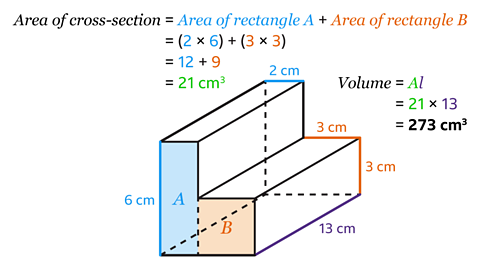
The L-shaped cross-section can be split into two rectangles:
So the total cross-sectional area is:
The prism has length , so:
Notice a small but important unit issue in the diagram: the area of the cross-section should be , not . Its final volume of is correct.
How to calculate the volume of cylinders and prisms - BBC Bitesize
Read the relevant prism section of this BBC Bitesize article. It reinforces the general rule V = Al and gives a worked L-shaped-prism example.
In the section “How to find the volume of a prism,” scroll past the triangular-prism example and the short unknown-dimension example until you reach the diagram of the L-shaped solid. Read the L-shaped example, then continue through the final multiplication below it. Focus on why the two rectangle areas are added before the common prism length is used.
A rectangular prism with a triangular-prism roof
A useful composite shape is a “shed” cross-section: a rectangle with a triangle on top. Suppose the cross-section has:
- a rectangular part wide and high;
- a triangular roof with base and perpendicular height ;
- a constant length of .
Find the rectangle area:
Find the triangle area:
Add them to get the whole cross-sectional area:
Finally, multiply by the length:
You could also calculate the rectangular-prism volume and triangular-prism volume separately, then add them. Both methods describe the same space.
Composite cylinders
Cylinders can be joined too. Calculate the volume of each cylinder separately unless the joined cylinders have the same radius and form one longer cylinder.

In this diagram, all three cylinders have diameter , so:
The combined length is:
Since the radius stays the same throughout, treat it as one cylinder of length :
If the cylinders had different radii, you could not merge their lengths. Instead, calculate each cylinder’s volume using its own radius and add the answers.
How To Find The Volume of Composite Rectangular Prisms
Watch “How To Find The Volume of Composite Rectangular Prisms” from The Organic Chemistry Tutor to see the standard composite-volume method: split, find missing dimensions, calculate each part, and add.
Watch one full composite example. The measurements are given in feet, but the method is exactly the same for centimetres or metres. Pay special attention to how missing side lengths are found by subtraction before either volume is calculated.
A test-ready checking routine
Before writing your final answer, scan your work with these checks:
| Check | What to look for |
|---|---|
| Correct shape formula | , , or |
| Cylinder radius | Halve the diameter before squaring |
| Triangle height | It must be perpendicular to the chosen base |
| Composite pieces | Every piece counted once; no overlap |
| Units | Final answer is in , , , or cubic units |
| Reasonableness | A composite solid should have more volume than any one of its positive-volume parts |
A quick size check can catch calculator slips. For example, a cylinder with radius about and height about should have volume a little under , not and not .
Key takeaways
For a single solid, calculate using the appropriate formula:
For composite solids, either split the whole solid into simple volumes or split its repeated cross-section into simple areas. Add only non-overlapping parts, and always finish with cubic units.
Next, you will move from calculating a volume in one unit to converting between units such as , millilitres, and litres.
Can't find a good explanation? Sign up and we'll make it for you
Sign up