
Hello! This course will prepare you for the Year 8 volume and time topics by building reliable methods you can use under test conditions. In this first module, the key skill is recognising a solid, choosing the right formula, and identifying exactly which measurements belong in it.
Today is about selection before calculation. If you can correctly identify the base shape and the distance between matching bases, the formula becomes much easier to choose.
One big idea behind all three formulas
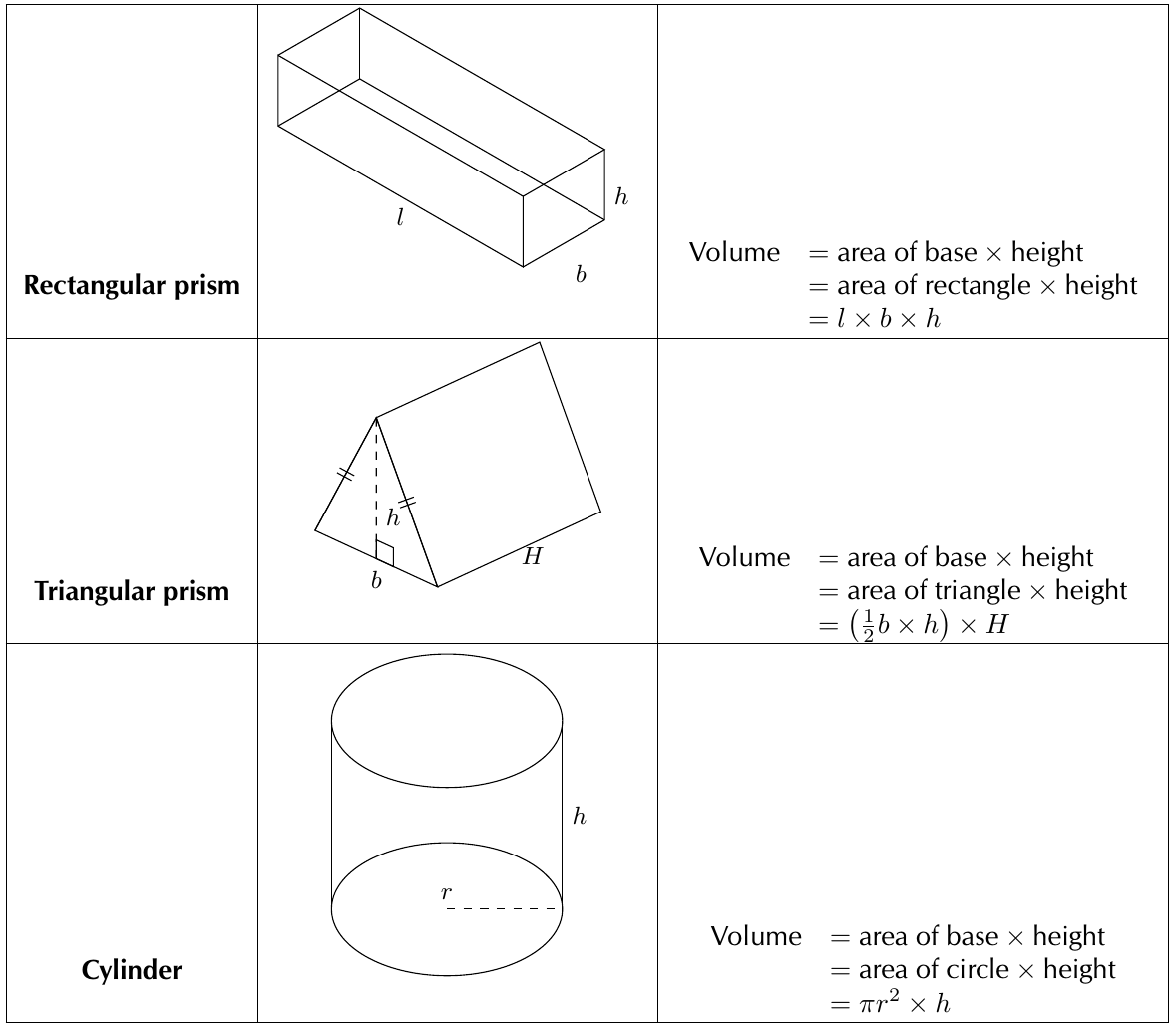
A prism or cylinder has the same cross-section all the way through. Its volume is found by taking the area of one base and multiplying by the distance to the matching base:
Here:
- is volume.
- is the area of the base face.
- is the perpendicular distance between the two matching bases.
The word base does not necessarily mean “the face at the bottom of the page.” A solid can be turned around. Look instead for the two faces that are identical and parallel.
How to Find the Volume of Cylinders & Prisms
Watch “How to Find the Volume of Cylinders & Prisms” by Cognito for a short visual explanation of the shared base-area idea and how it creates the cylinder and triangular-prism formulas.
Watch the core formulas. Focus on the phrase “uniform cross-section”: it explains why the same general method works even though the base shapes are different.
A useful test habit is to write the general rule first:
Then work out what is for the shape in front of you.
Rectangular prisms: three perpendicular dimensions
A rectangular prism is a box-shaped solid. You may also see it called a cuboid. Examples include a storage box, brick, rectangular tank, or shipping carton.
Its base is a rectangle. The area of a rectangle is:
Multiplying this by the third dimension gives:
The letters can change in a test. You might see , , and , or length, breadth, and height. What matters is that you use the three perpendicular dimensions of the box.
Selecting dimensions in a diagram
For a rectangular prism, choose:
- one edge for the length;
- an edge at right angles to it for the width;
- the remaining perpendicular edge for the height.
For example, if a rectangular storage container is long, wide, and high, your setup is:
It does not matter which rectangular face you call the base. Multiplying the same three dimensions still gives the same volume.
Common trap: Do not use a diagonal drawn across a rectangular face. A diagonal is not one of the three dimensions needed for .
Triangular prisms: separate the two different “heights”
A triangular prism has two matching triangular faces. Think of a tent-shaped tunnel, a wedge of cheese, or a triangular roof section.
The general rule still applies:
The area of the triangular face is:
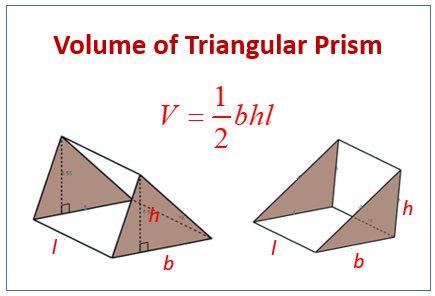
So the volume formula is:
where:
- is the base of the triangle;
- is the perpendicular height of the triangle;
- is the length of the prism, meaning the distance from one triangular end to the other.
Using and is helpful because diagrams often label both measurements with an , which can be confusing.
How to find the right three measurements
First, locate the two triangular ends. These are the bases of the prism.
Next, on one triangular face, find:
- the side chosen as the triangle’s base;
- the line perpendicular to that side, which is the triangle’s height. A right-angle symbol is a strong clue.
Finally, find the distance between the triangular faces. It may run left to right, front to back, or diagonally across the page. It is often called the prism’s length, rather than its height.
Suppose a triangular prism has:
- triangular base ;
- perpendicular triangle height ;
- prism length .
The correct formula selection and substitution are:
Common trap: A sloping side of the triangle is usually not the triangle’s height. The height must meet the chosen base at .
Volume formulas review (article) | Khan Academy
Read this concise review to connect the formulas for rectangular prisms, triangular prisms, and cylinders to the single idea of base area times perpendicular height.
In “Prisms and prism-like figures,” read the parts titled “Rectangular prisms,” “Triangular prisms,” and “Cylinders.” Use the formula overview to compare the base shape in each solid. Pay special attention to the triangular-prism diagram: distinguish the triangle’s perpendicular height from the distance between the two triangular faces.
Cylinders: use the radius, then square it
A cylinder has two matching circular bases. Common examples are cans, pipes, drums, and round water tanks.
The base is a circle, whose area is:
Therefore:
where:
- is the radius of the circular base;
- is the perpendicular distance between the circular bases.
The height of a cylinder may be drawn vertically, but it does not have to be. If a cylinder lies on its side, its height is still the distance from one circular end to the other.
Radius or diameter?
This is one of the most common volume-test mistakes.
- The radius goes from the centre of a circle to its edge.
- The diameter goes all the way across the circle through its centre.
They are related by:
So if you are given a diameter, halve it before using the volume formula.
For a cylinder with diameter and height :
Then the correct setup is:
Not:
Common traps:
- using the diameter as ;
- forgetting to square the radius;
- using the curved outside surface instead of the circular base area.
A fast formula-selection routine
When you see a diagram or word problem, use this routine before doing any arithmetic.
-
Name the solid.
Box shape means rectangular prism; matching triangular ends mean triangular prism; circular ends mean cylinder. -
Find one base shape.
Is it a rectangle, triangle, or circle? -
Identify the distance to the matching base.
This is the prism’s length or height, or the cylinder’s height. -
Choose the formula.
| Solid | Formula | Dimensions you need |
|---|---|---|
| Rectangular prism | Three perpendicular edge lengths | |
| Triangular prism | Triangle base, triangle perpendicular height, prism length | |
| Cylinder | Radius and cylinder height |
- Check each number has a job.
Every value substituted should match a letter in the formula. If a number is a sloping edge, diagonal, or diameter, pause and check whether it truly belongs.
For worded questions, translate the description into labelled information. For example:
- “A triangular trough is long” gives .
- “Its triangular end has a base of and a perpendicular height of ” gives and .
- “A cylindrical tank has diameter ” gives , not .
At this stage, you should be able to set up the correct formula even before calculating the final volume.
Key takeaways
All three solids use the same central idea:
The base shape determines the formula:
- rectangle: ;
- triangle: ;
- circle: .
The important accuracy checks are to use a perpendicular triangle height, distinguish the triangular face measurements from the prism length, and convert a cylinder’s diameter to a radius before squaring it.
Next lesson, you will use these formulas to calculate volumes of individual solids and solids made by joining shapes together, with correct cubic units.
Can't find a good explanation? Sign up and we'll make it for you
Sign up