
Hello, and welcome to the first lesson in Biomolecules, Food Tests, and Human Nutrition. This module begins with the chemical foundations of food: what carbohydrates, fats, and proteins are made from, how their molecules are assembled, and later how we can test for them in samples.
For this lesson, the key assessment skill is to move confidently between three levels of explanation:
- the elements present in a biological molecule,
- the small building units it is made from, and
- the process that joins those units into a larger molecule.
By the end, you should be able to write a concise, accurate explanation of how each major nutrient group is formed—not just recognise a diagram.
The big pattern: small units make larger molecules
Living things contain many large carbon-based molecules. Because they contain carbon, carbohydrates, fats, and proteins are described as organic molecules.
Carbon is especially useful in biology because each carbon atom can form four covalent bonds. This lets carbon atoms form chains, rings, and large complex structures.
A useful vocabulary set is:
- Monomer: a small molecular building block.
- Polymer: a large molecule made from many repeating monomers joined together.
- Macromolecule: a large biological molecule. Some, but not all, macromolecules are polymers.
- Covalent bond: a strong bond formed when atoms share electrons.
For example, glucose is a small sugar molecule. Many glucose molecules can be joined into a large carbohydrate such as starch.
4. Biological Molecules (Cambridge IGCSE Biology 0610 for exams in 2026, 2027 and 2028)
Watch “Biological Molecules” by IGCSE Study Buddy for a concise overview at the right level for this course. It introduces the elements in carbohydrates, fats, and proteins, then connects each group to its smaller units.
Watch the element overview, focusing on which elements all three groups share and the extra elements found in proteins. Then watch the molecule examples. Make a three-row note table headed carbohydrate, fat, and protein; record the building units for each as you watch.
One important distinction will prevent a common exam error:
- Carbohydrates and proteins are polymers because they are made from repeating types of monomer.
- A typical fat, more precisely called a triglyceride, is a large molecule but is not strictly a polymer. It is built from one glycerol molecule and three fatty acids, rather than a long chain of repeating identical units.
Elements and building units: the comparison to learn
The following table is a strong starting point for short-answer questions.
| Biological molecule group | Main chemical elements | Smaller basic units | Large molecule examples |
|---|---|---|---|
| Carbohydrates | Carbon, hydrogen, oxygen | Monosaccharides, such as glucose | Maltose, starch, glycogen, cellulose |
| Fats / lipids | Carbon, hydrogen, oxygen | Glycerol and fatty acids | Triglycerides (fats and oils) |
| Proteins | Carbon, hydrogen, oxygen, nitrogen; sometimes sulfur | Amino acids | Enzymes, antibodies, keratin, haemoglobin |
Carbohydrates
Carbohydrates contain carbon, hydrogen, and oxygen. A common simple carbohydrate is glucose, with the formula:
A glucose molecule is a monosaccharide: “mono” means one, and “saccharide” means sugar.
Carbohydrates can be grouped by the number of sugar units joined:
- Monosaccharide: one sugar unit, for example glucose.
- Disaccharide: two monosaccharides joined, for example maltose.
- Polysaccharide: many monosaccharides joined in a chain or branched structure, for example starch, glycogen, or cellulose.
Starch, glycogen, and cellulose are all made largely from glucose, but the glucose units are joined and arranged differently. That difference changes their properties and biological roles. You will return to starch and cellulose when studying nutrition and digestion.
Fats
Fats are a group of lipids. Like carbohydrates, they contain carbon, hydrogen, and oxygen, but fats usually contain proportionally much less oxygen than carbohydrates.
A triglyceride is formed from:
- one glycerol molecule, and
- three fatty acid molecules.
Glycerol is a small three-carbon molecule. Fatty acids have long chains mainly made of carbon and hydrogen, which is one reason fats store a large amount of chemical energy.
Proteins
Proteins contain carbon, hydrogen, oxygen, and nitrogen. Some proteins also contain sulfur.
Their basic units are amino acids. There are about 20 different amino acids commonly used to build proteins. Each amino acid contains an amino group containing nitrogen, which explains why nitrogen is a defining element of proteins.
A protein is made when amino acids join into a long chain. Later in this module, you will investigate why the order of amino acids matters: a changed sequence can produce a differently shaped protein with a different function.
How large molecules are formed: dehydration synthesis
Large biological molecules form through dehydration synthesis, also called a condensation reaction.
The word gives you a clue:
- dehydration means water is removed;
- synthesis means something is built.
During this reaction:
- One small molecule loses a hydrogen atom, .
- Another loses a hydroxyl group, .
- The hydrogen and hydroxyl combine to form water, .
- A new covalent bond forms between the two molecules.
In summary:
The reverse process is hydrolysis. In hydrolysis, water is used to break a bond in a large molecule, splitting it into smaller units. This is particularly important in digestion: enzymes help hydrolyse large food molecules into small molecules that can be absorbed.
2.5 Organic Compounds Essential to Human Functioning - Anatomy and Physiology 2e | OpenStax
Read the short explanation from OpenStax to make the mechanism of dehydration synthesis and hydrolysis precise. This will help you explain the process rather than merely state that “water is removed.”
In the section beginning with the discussion of monomers and polymers, read dehydration and hydrolysis. Focus on where the hydrogen and hydroxyl group go in each reaction, and on the fact that dehydration forms a covalent bond whereas hydrolysis breaks one.
Carbohydrate formation: glucose to maltose and starch
Two glucose molecules can join by dehydration synthesis to form maltose, a disaccharide. One water molecule is released.
The covalent bond between two sugar molecules is called a glycosidic bond.
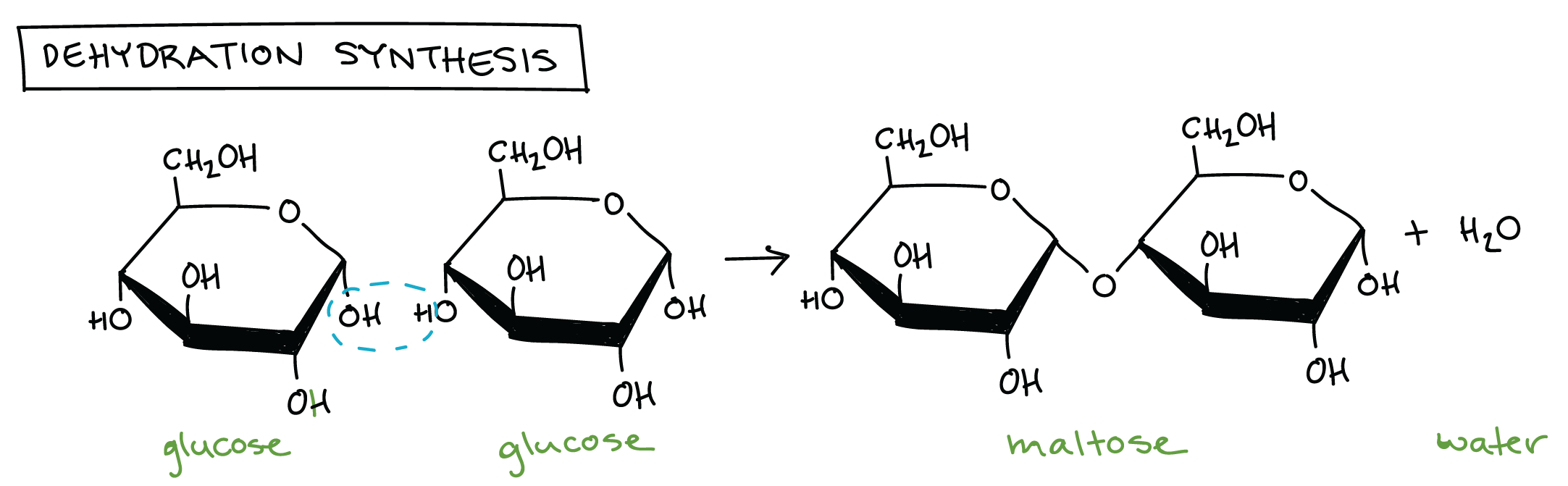
Read the diagram from left to right:
- On the left are two glucose molecules, the reactants.
- The marked and are removed from the two glucose molecules.
- These combine to make .
- The oxygen remaining between the sugars is part of the bond linking them.
- The product is maltose, a disaccharide.
The same overall process repeats when many glucose molecules join to create a polysaccharide such as starch:
A high-quality statement would be:
Starch is a polysaccharide formed when many glucose monosaccharides join by dehydration synthesis. Glycosidic bonds form between the glucose molecules, and water is released.
Notice the useful combination of name of units, process, bond, and water. That is the level of precision to aim for in written answers.
Fat formation: glycerol plus fatty acids
A fat molecule, or triglyceride, forms when one glycerol joins to three fatty acids.
Each fatty acid forms one bond with glycerol. Because there are three bonds made, three water molecules are released.
The bond between glycerol and a fatty acid is an ester bond.
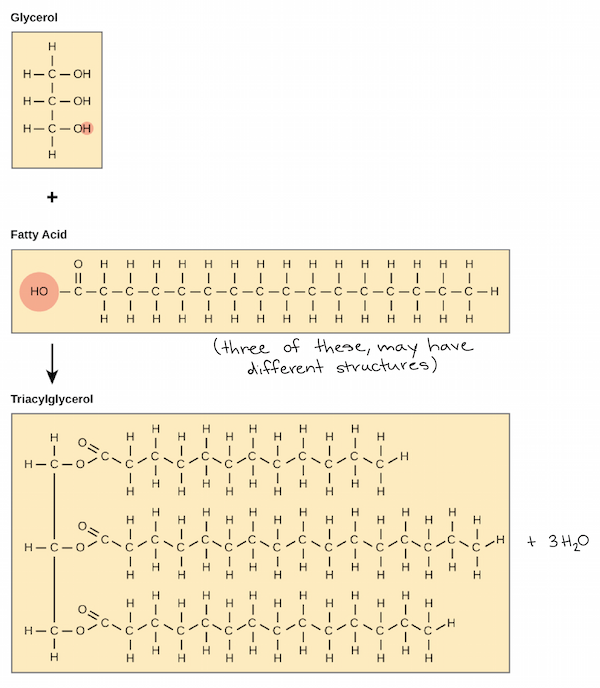
In the triglyceride diagram, identify the pattern rather than trying to memorise every atom:
- Glycerol is the short vertical molecule on the left.
- Each fatty acid has a long hydrocarbon chain.
- The three long chains remain attached to the glycerol backbone in the triglyceride.
- At each attachment point, a water molecule is released.
- Therefore, one triglyceride formation reaction produces three water molecules.
A common error is writing that fats are made from “three glycerol and one fatty acid.” Reverse that: a triglyceride always has one glycerol and three fatty acids.
Protein formation: amino acids to polypeptides
Proteins are made when many amino acids join in a chain. The bond between adjacent amino acids is a peptide bond.
If many amino acids join:
A protein may contain one or more polypeptide chains folded into a particular three-dimensional shape. For this lesson, the key point is the basic formation pattern:
Proteins are polymers formed from amino acids. Amino acids join by dehydration synthesis, forming peptide bonds and releasing water.
Keep the terms separate:
| Question asks about… | Best answer |
|---|---|
| Protein elements | Carbon, hydrogen, oxygen, nitrogen; sometimes sulfur |
| Protein monomer | Amino acid |
| Bond in proteins | Peptide bond |
| Process joining amino acids | Dehydration synthesis / condensation |
| Resulting chain | Polypeptide |
A reliable method for diagram and written questions
When an assessment gives you an unfamiliar molecule diagram, work through four questions.
1. Which elements are present?
Look for the element symbols:
- , , and suggest carbohydrate or lipid.
- strongly suggests protein if the question is comparing these three groups.
- may be present in some proteins.
Do not claim that every molecule containing carbon, hydrogen, and oxygen must be a carbohydrate. Fats also contain these elements. You need to look at the structure and the stated context.
2. What smaller units can you identify?
Look for repeating units:
- repeated glucose-like rings: carbohydrate;
- one glycerol with three long carbon chains: triglyceride;
- a chain of repeating amino-acid-type units containing nitrogen: protein.
3. What type of large molecule is formed?
Use the correct name:
- glucose units joined: disaccharide or polysaccharide;
- glycerol plus three fatty acids: triglyceride;
- amino acids joined: polypeptide or protein.
4. What happened to water?
If a bond is being formed between basic units, it is usually a dehydration synthesis reaction:
- water is released,
- not added.
If a large molecule is being split, it is hydrolysis:
- water is used,
- and bonds are broken.
A compact answer structure that works well is:
A [large molecule] is made from [smaller units]. The units join by dehydration synthesis, forming [bond name] and releasing water.
For example:
A triglyceride is made from one glycerol molecule and three fatty acids. They join by dehydration synthesis, forming ester bonds and releasing three water molecules.
Quick consolidation
Before moving on, make sure you can recall this without looking:
| Molecule group | Elements | Basic units | Link formed |
|---|---|---|---|
| Carbohydrate | Monosaccharides, such as glucose | Glycosidic bond | |
| Fat / triglyceride | Glycerol + 3 fatty acids | Ester bonds | |
| Protein | , sometimes | Amino acids | Peptide bonds |
A useful five-minute revision activity is to cover the last three columns and reproduce the table from memory. Then check not only whether the facts are present, but whether you have kept fatty acids, amino acids, and monosaccharides clearly separate.
Key takeaways
Carbohydrates, fats, and proteins are organic molecules containing carbon. Carbohydrates and fats contain carbon, hydrogen, and oxygen; proteins also contain nitrogen and may contain sulfur.
- Carbohydrates are made from monosaccharides such as glucose. Two can form a disaccharide, while many form polysaccharides such as starch.
- Triglycerides are made from one glycerol molecule and three fatty acids.
- Proteins are made from amino acids joined into polypeptide chains.
- These large molecules form by dehydration synthesis: a covalent bond forms and water is released.
- The relevant bond names are glycosidic bonds in carbohydrates, ester bonds in triglycerides, and peptide bonds in proteins.
- Hydrolysis is the reverse reaction: water is used to break large molecules into smaller units.
Next, you will build on amino acids and protein formation by examining how the sequence of amino acids determines a protein’s three-dimensional shape and function.
Can't find a good explanation? Sign up and we'll make it for you
Sign up