
Hello! Welcome to the first lesson in our new module, "Production-Ready Testing."
In the previous module, we built a complete real-time feature, from a backend event dispatch to a dynamic frontend update. Building features is the core of development, but how do we ensure they continue to work correctly as the application grows and changes? The answer is automated testing. It's our safety net, allowing us to refactor code and add new functionality with confidence.
This lesson kicks off our journey into testing by establishing the fundamental concepts. Our goal is to differentiate between unit, feature, and integration tests. Understanding the purpose, scope, and trade-offs of each type is the first step toward building a robust and efficient test suite for your Laravel applications.
1. The Landscape of Automated Testing
Before diving into Laravel's specifics, let's start with the "why." At its core, automated testing is about writing code that checks your application code to ensure it behaves as expected.
Laravel 12 Testing with Pest – Beginner’s Guide (Unit & Feature Tests Explained)
To begin, this video from the Programming Fields channel provides a concise overview of what testing is and why automated tests are superior to manual testing.
Watch from 01:09 to 02:33 to understand the basic value proposition of automated testing: speed, repeatability, and confidence.
As the video explains, tests act as a safety net. They are much faster and more reliable than manually clicking through your application every time you make a change.
Not all tests are created equal, however. They operate at different levels of granularity. A common way to visualize this is with the Testing Pyramid.

The key idea is that you should have many small, fast unit tests at the base, a smaller number of more comprehensive integration tests in the middle, and very few slow, end-to-end tests at the top. This structure gives you the best balance of confidence and speed.
2. The Laravel Approach: Unit vs. Feature Tests
While the testing world has many terms (unit, integration, end-to-end, behavioral, etc.), the Laravel framework simplifies this by organizing tests into two primary categories out of the box: Unit and Feature.
When you look inside a fresh Laravel project, you'll see this separation reflected in the directory structure.
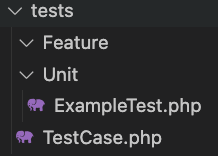
Let's explore what each of these means.
Laravel Feature or Unit Tests: The Difference
The Laravel Daily channel offers an excellent explanation of why Laravel focuses on just these two types and provides clear, practical examples of each.
First, watch the introduction from 00:00 to 00:47 to understand how Laravel simplifies the testing landscape.
Feature Tests: Testing the Whole Picture
A feature test examines a piece of functionality from the outside in, much like a user or an API client would interact with it. It tests the integration of many parts of your application working together.
- Scope: Broad. A single feature test might involve an HTTP request, routing, middleware, a controller method, an Eloquent model, and a database query.
- Purpose: To verify that a complete user-facing feature (like creating a post, logging in, or fetching API data) works as expected.
- Characteristics: Boots the entire Laravel application, often interacts with a database, and is consequently slower than a unit test.
Laravel Feature or Unit Tests: The Difference
Now, let's see what a feature test looks like in practice. This part of the same video demonstrates testing a page that lists videos.
Continue watching from 00:47 to 01:52. Notice how the test makes an HTTP GET request to a URL and asserts that the response is successful and contains expected text. It's testing the feature, not the individual components.
In Laravel's world, feature tests are a form of integration test, as they test how multiple components integrate.
Unit Tests: Testing the Smallest Pieces
A unit test zooms in on a tiny, isolated piece of your code—a "unit." This is often a single method within a class.
- Scope: Narrow and isolated. It tests one thing and one thing only.
- Purpose: To verify that a specific piece of logic (like a calculation, a data transformation, or a specific algorithm) is correct under various conditions.
- Characteristics: Does not boot the Laravel framework or interact with external services like a database, cache, or network API. This makes them extremely fast.
Laravel Feature or Unit Tests: The Difference
To solidify the difference, let's now look at a unit test for a piece of 'invisible' logic within the same application.
Watch from 01:52 to 06:26. Pay close attention to how this test works. It creates a new model object in memory (not in the database), sets a property, and then asserts that a calculated attribute (the formatted duration string) is correct. It's testing a single function in complete isolation.
3. Clarifying the Terminology: What is an Integration Test?
You've heard "feature test" and "integration test" used together. Let's formalize the distinction.
- Unit Test: Tests one class in isolation.
- Integration Test: Tests how two or more classes/components work together.
In Laravel, a feature test is a high-level integration test that simulates an HTTP request. However, you might have other integration tests that don't involve an HTTP request but still check the interaction between, for example, a service class and an Eloquent model.
A very practical rule of thumb in the Laravel community is:
If a test touches an external service (like a database, cache, or file system), it's an integration test.
Patterns for Testing Laravel Projects
This article from Nikki's Blog provides a clear, practical definition of this distinction within the context of Laravel.
Read the section 'Unit Testing vs Integration Testing vs Feature Testing'. Focus on the 'golden rule' and the simple definition of an integration test as any test that consumes a database or other external service.
The distinction is crucial. When a test that you think is a unit test suddenly needs the database, it's a sign that it has become an integration test.
Unit vs Feature Tests in Laravel: When and How to Use Each
This blog post from d4b.dev gives a sharp checklist for identifying when a unit test crosses the line into being a feature/integration test.
Read the short section titled 'When a unit test becomes a feature test'. This provides a clear set of conditions that define a feature test.
To summarize this with a memorable analogy, let's return to the Laravel Daily video.
Laravel Feature or Unit Tests: The Difference
The 'Titanic' analogy perfectly illustrates why both unit and feature/integration tests are necessary.
Watch the conclusion from 07:59 to 09:17. This explains that while all the individual 'units' (engine parts, lights) might pass their tests, you still need a 'feature' test to see if the whole ship can actually swim.
4. A Practical Guide: When to Use Each
Now for the most important part: how do you decide which type of test to write? The goal is not to achieve 100% test coverage with only one type of test, but to use the right tool for the job.
Here is a summary based on best practices.
Unit vs Feature Tests in Laravel: When and How to Use Each
The d4b.dev article provides an excellent breakdown of what each test type is best suited for.
Read the sections 'What each test type is great at' and 'A pragmatic split'. This will give you concrete guidelines for your own projects.
In summary:
-
Use Unit Tests for:
- Pure business logic: Complex calculations (e.g., tax calculation, shipping cost logic).
- Data formatting: Transforming data from one format to another (like the video duration example).
- Simple services or Action classes: Classes that perform a single, focused task.
- Testing many edge cases: It's fast and easy to test a function with
0,null,-1, or a very large number in a unit test.
-
Use Feature (Integration) Tests for:
- API Endpoints: Verifying correct status codes, JSON structure, and headers.
- Controller Logic: Ensuring a request is validated correctly, the right service is called, and the correct response is returned.
- Database Interactions: Testing your custom query scopes or complex repository methods return the correct data.
- Authorization: Confirming that your policies and gates correctly allow or deny user actions.
- Cross-cutting concerns: Verifying that events are dispatched, jobs are queued, or notifications are sent as part of a larger flow.
A final, crucial piece of advice: don't test the framework itself. Laravel is already well-tested.
Patterns for Testing Laravel Projects
This is a common mistake for beginners. Let's read a short section on what this means in practice.
Read the section 'Stop testing the framework'. You don't need to assert that $model->save() works, but you should write an integration test for a complex Eloquent query you wrote.
Conclusion
You have now learned the fundamental differences between the main types of automated tests in a Laravel application. This knowledge is the bedrock upon which you'll build a reliable and maintainable test suite.
Key Takeaways:
- Unit Tests are for small, isolated pieces of code. They are fast and do not interact with the database or other external services. Think of them as testing the internal mechanics of a single component.
- Feature Tests (a type of Integration Test) are for larger pieces of functionality. They test how multiple components work together, often simulating a real user request. They are slower but provide confidence that the application works as a whole.
- The Testing Pyramid is a mental model that guides us to write many fast unit tests and fewer, more targeted feature tests.
- The key to effective testing is choosing the right type of test for the job and avoiding re-testing the framework's own functionality.
Up Next:
Now that we understand the theory, it's time to put it into practice. In the next lesson, we will get our hands dirty and write feature tests for API endpoints. You will learn how to make virtual HTTP requests to your application and assert that it responds exactly as you expect—a critical skill for any backend developer.