
Hello! Welcome to the third lesson in our thermodynamics module.
In our last two lessons, we built a descriptive foundation. We learned how to define a thermodynamic system and describe its condition, or state, using properties like pressure, temperature, and volume. We then learned how to relate these properties for gases using the Ideal Gas Law.
Now, we move from describing states to analyzing the changes between them. Energy is the currency of these changes, and this lesson is about understanding the rules of that currency exchange.
Our learning outcome is to distinguish between heat, work, and internal energy, and apply their sign conventions. Mastering these concepts is the final step before we can formally state and use one of the most fundamental principles in all of science: the First Law of Thermodynamics.
1. Internal Energy (U): The Energy a System Has
First, let's look at the energy stored within a system. We call this internal energy, symbolized by . It represents the sum of all the microscopic energies of the molecules within the system—their kinetic energy from moving and vibrating, and the potential energy stored in their chemical bonds and intermolecular forces.
The most important thing to understand about internal energy is that it is a property of the system. This means it depends only on the system's current state (its temperature, pressure, etc.), not on how it got there.
The following video provides an excellent explanation of internal energy.
No ONE has explained First Law of Thermodynamics Like This EVER Before! Solved Examples
Watch this first segment from the video 'No ONE has explained First Law of Thermodynamics Like This EVER Before!' to get a clear definition of internal energy and understand why it's considered a state property.
Watch from 2:39 to 5:12. Pay attention to the distinction between the microscopic energy included in U and the macroscopic energy (like the whole system moving) that is excluded. The 'height of a hill' analogy is a perfect way to remember the concept of a state property.
2. Heat (Q) and Work (W): Energy in Transit
If internal energy is the energy a system has, how do we change it? Energy can cross the boundary of a closed system in only two forms: heat and work.
Unlike internal energy, heat and work are not properties. A system doesn't "contain" work or heat. Instead, they are processes of energy transfer—energy in transit. Because they depend on the process taken between two states, they are known as path functions.
To understand these concepts more formally, please read the following sections from the provided notes.
First Law of Thermodynamics: Closed Systems
These notes from Simon Fraser University clearly define heat and work and highlight the crucial distinctions between them and properties like internal energy.
Please read the following three parts of the document: Start at the beginning and read the sections 'Heat Transfer' and 'Work' (pages 1-3). Focus on the core definitions: heat is energy transfer due to a temperature difference, and work is energy transfer via a force acting through a distance. On page 3, read the list under 'Similarities between work and heat transfer'. This powerfully summarizes why they are not properties. Finally, read the first paragraph under 'Electrical Work' and 'Example 1' on page 4. This example is particularly relevant given your electronics background, as it shows how the choice of system boundary determines whether an energy transfer is classified as heat or work.
3. Sign Conventions and the First Law of Thermodynamics
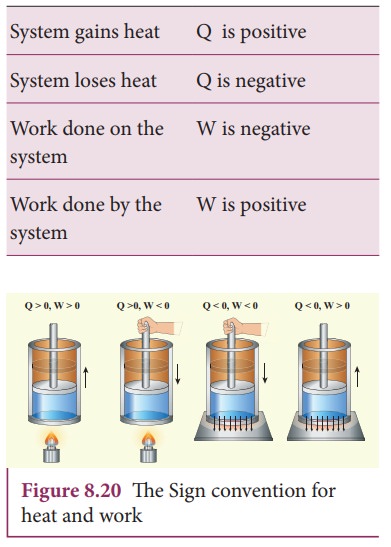
To account for energy transfers, we need a consistent bookkeeping system. This is where sign conventions come in, and they are absolutely critical. In engineering, the standard convention is focused on the system from the perspective of a power-producing device, like an engine.
- Heat (Q):
- Positive (+Q): Heat is added to the system.
- Negative (-Q): Heat is removed from the system.
- Work (W):
- Positive (+W): Work is done by the system on its surroundings (e.g., expanding gas pushing a piston).
- Negative (-W): Work is done on the system by its surroundings (e.g., a piston compressing gas).
This is analogous to the passive sign convention in circuit theory. If you define current flowing into a resistor's positive terminal, the calculated power is positive, meaning the resistor is absorbing or dissipating energy. Here, we've defined a convention that lets the signs tell us the direction of energy flow relative to our system.
The image below provides a great visual summary of this convention.
With these definitions, we can state the First Law of Thermodynamics for a closed system. It is a statement of the conservation of energy:
The change in a system's internal energy () is equal to the net heat added to the system () minus the net work done by the system ().
This equation makes intuitive sense with our sign convention:
- Adding heat () increases the system's internal energy.
- The system doing work () expends its own energy, which decreases its internal energy, hence the minus sign.
The following video segment explains these concepts in detail and, importantly, highlights a different convention you might encounter elsewhere.
No ONE has explained First Law of Thermodynamics Like This EVER Before! Solved Examples
Now, let's watch the main segment of the 'Brain Station Advanced' video. It ties together the concepts of heat, work, the first law, and the sign conventions we've just discussed. It also explains the difference between the engineering and chemistry conventions, which is vital to know.
Watch from 5:12 to 13:04. This is a crucial section. Focus on: The definition of heat and its sign convention. The definition of work. How the First Law equation, ΔU = Q - W, is constructed from these conventions. The explanation of the alternative chemistry convention (ΔU = Q + W), where W is defined as work done on the system. Being aware of this difference will prevent future confusion.
4. Applying the First Law: Worked Examples
Let's see this law in action. The best way to solidify your understanding of the sign conventions is to apply them to solve problems.
No ONE has explained First Law of Thermodynamics Like This EVER Before! Solved Examples
This final clip from the same video provides three clear numerical examples. Notice how the first step in each case is to correctly assign signs to the values of Q and W based on the problem description.
Watch the examples from 13:04 to 16:40. Pay attention to how the same action (compressing a gas) results in different outcomes for internal energy depending on whether the system is insulated (adiabatic) or loses heat.
Test your understanding!
A gas in a piston-cylinder assembly undergoes a process where 200 kJ of heat is transferred from the gas to the surroundings. During this process, a paddle wheel does 50 kJ of work on the gas. What is the change in the internal energy of the gas?
Show answer
-
Identify Q and W with correct signs:
- Heat is transferred from the system, so .
- Work is done on the system, so .
-
Apply the First Law of Thermodynamics:
The internal energy of the gas decreases by 150 kJ.
Conclusion
This lesson introduced the three central players in the energy balance of a thermodynamic system: internal energy, heat, and work. Understanding their distinct roles and the rules governing their interaction is fundamental to all of thermodynamics.
Key Takeaways:
- Internal Energy (U): A property of a system representing its stored microscopic energy. It depends only on the state.
- Heat (Q) and Work (W): Modes of energy transfer across a system's boundary. They are path-dependent processes, not properties.
- First Law of Thermodynamics: A statement of energy conservation for a closed system, written as .
- Sign Convention: The signs are critical for correct calculations. In engineering, heat into the system is positive (), and work done by the system is positive ().
Preview of the Next Lesson:
We now have the First Law as our primary tool for energy analysis. In the next lesson, we will apply this law to four common types of thermodynamic processes that ideal gases can undergo:
- Isobaric (constant pressure)
- Isochoric (constant volume)
- Isothermal (constant temperature)
- Adiabatic (no heat transfer)
Analyzing these idealized processes is the first step toward understanding the complex cycles that power real-world machines, including the jet engines central to your aerospace goal.
Can't find a good explanation? Sign up and we'll make it for you
Sign up