
Welcome back. In the previous lesson, you learned to read job descriptions as hiring scorecards: separate competencies from tools and company-specific filters, then look for patterns across roles. Now you will make that research useful by connecting it to your own work.
For this lesson, we will use Head of Client Onboarding and Implementation as the working target role. It fits the direction you described: broader ownership of onboarding strategy, implementation quality, client outcomes, capacity, and the systems that allow a team to scale. The same map will also give you strong material for Implementation Manager, Customer Success Operations, and senior Customer Success applications.
By the end, you will have a role-evidence map: a concise, honest record of which target competencies you already demonstrate, what proof supports each one, and where you need stronger evidence rather than a different job title.
Start with a target-role competency model
A role title is not a competency. “Head of Onboarding” means different things across companies: at one firm, it may be a senior implementation leader; at another, a people manager overseeing a global post-sale function. Therefore, your goal is not to prove that your current title matches the target title. It is to show that your work solves the problems the target role exists to solve.
For a Head of Client Onboarding and Implementation, a practical competency model has six areas:
| Target competency | What the hiring manager needs to trust |
|---|---|
| 1. Onboarding strategy and operating design | You can design a repeatable delivery model, not just execute individual projects. |
| 2. Implementation governance | You can keep complex launches moving through plans, milestones, dependencies, scope control, and risk management. |
| 3. Client value and relationship leadership | You can connect onboarding activity to client goals, adoption, satisfaction, and early retention. |
| 4. Cross-functional and executive influence | You can align Sales, Delivery, Product, leadership, and client stakeholders without relying solely on direct authority. |
| 5. Performance, capacity, and continuous improvement | You use KPIs, reporting, capacity assumptions, and process improvement to improve reliability and scale. |
| 6. Team and functional leadership | You can set expectations, coach others, establish decision rights, and make a credible case for resources. |
This model combines the expectations you identified in the last lesson: implementation delivery, customer value, operational systems, and strategic leadership.
The distinction between related roles still matters. Implementation Managers tend to own delivery through launch. CSMs typically own customer outcomes across retention and renewal. CS Operations leaders build the systems, data, and workflows that make customer-facing teams effective. A Head of Onboarding needs enough fluency in all three areas to lead the function, while being especially accountable for the launch experience and the operating model behind it.
What you need to know about customer success in SaaS
Read HubSpot’s role descriptions to reinforce the differences among Implementation Managers, Customer Success Managers, Customer Success Operations Managers, and senior customer-success leadership. This will help you avoid presenting your experience as a vague mix of responsibilities.
In the section “The Roles You Need on Your Customer Success Team,” read from the “Implementation Managers” subsection through the “VP of Customer Success” subsection. Follow the role descriptions, focusing on each role’s center of accountability: launch execution, customer retention, operating systems, or functional leadership.
A useful rule follows:
Map your experience to the business problem a target role owns, not merely to the task vocabulary used in its posting.
For example, “maintaining project plans” becomes more meaningful when linked to the business problem: reliable launches despite client dependencies, platform constraints, competing priorities, and executive expectations.
Your current evidence: stronger than a task list
You already have substantial material for this target role. The work itself includes strategy, delivery governance, client relationships, operational design, and executive communication. The key is to separate what you have done from what you can prove changed because of your work.
Here is a first-pass role-evidence map based on the responsibilities you described. Treat it as a working draft, not as résumé language yet.
| Target competency | Your current responsibility evidence | Current proof level | Evidence to collect or strengthen |
|---|---|---|---|
| Onboarding strategy and operating design | Independently redesigning onboarding processes; building onboarding strategy and playbooks | Direct evidence of ownership | Before-and-after process map; the problem the redesign addressed; adoption by others; change in delays, rework, or launch consistency |
| Implementation governance | Managing project plans, risks, escalations, client constraints, and launch coordination | Direct evidence of delivery ownership | One representative launch plan, risk log, escalation example, and time-to-launch result |
| Client value and relationship leadership | Managing client relationships, executive stakeholders, client satisfaction, and early-retention signals | Direct evidence; outcome evidence needs validation | Client goals, satisfaction trend, early retention indicator, launch success criteria, or a client-risk recovery example |
| Cross-functional and executive influence | Coordinating across functions; working with client and company executives; making strategic decisions | Strong direct evidence | Example of a decision you influenced, the conflicting priorities involved, and the outcome of the decision |
| Performance, capacity, and continuous improvement | Tracking KPIs, monitoring implementation capacity, reporting to executives, and improving playbooks | Direct evidence; analytical depth is developing | A KPI definition, capacity model, dashboard, trend analysis, and one decision informed by the data |
| Team and functional leadership | Previously supervised a team of four; currently operating independently after staffing cuts | Direct people-leadership evidence; current team-scale evidence is limited | Clear coaching or performance-management example; delegation model; proposed team structure and capacity case |
Two themes stand out.
First, you have strong direct evidence in four highly transferable areas: onboarding process design, implementation management, stakeholder leadership, and operational ownership. These should be central to your target-role narrative.
Second, the likely development areas are not necessarily missing skills. They are often missing documented proof:
- Measurable outcomes from process improvements
- More confident spreadsheet and dashboard analysis
- Formal examples of people leadership, resource planning, and decision authority
- Clearer evidence connecting onboarding work to early client value and retention
That difference is important. “I have not documented this result” is a very different problem from “I have never done this work.”
Use a disciplined evidence standard
A hiring manager cannot see your internal systems, client conversations, or project plans. Your résumé, portfolio, and interview answers must therefore make your work legible quickly.
The strongest evidence usually contains six elements:
- Context: What client, process, portfolio, or operating problem was involved?
- Scope: How many clients, workstreams, departments, stakeholders, or launches were affected?
- Ownership: What did you decide, design, lead, or manage?
- Action: What specifically changed in the process or project?
- Result: What measurable operational or client outcome followed?
- Business relevance: Why did that result matter: faster launch, lower risk, higher satisfaction, stronger retention, better capacity, or lower cost?
Not every example will include every element. But a Head-level application should contain a portfolio of evidence across all of them.
Consider the difference:
| Weak task statement | Evidence-oriented statement |
|---|---|
| Managed onboarding projects for clients. | Owned end-to-end onboarding plans for a portfolio of clients, coordinating client and internal stakeholders, managing launch risks, and reporting delivery status to executive leaders. |
| Created onboarding playbooks. | Redesigned the onboarding workflow and playbooks to standardize handoffs, milestone tracking, and escalation practices across client launches. |
| Worked with leadership and clients. | Facilitated cross-functional decisions with client executives and internal leaders when scope, platform constraints, or timing put launch commitments at risk. |
These are still evidence statements, not final achievement bullets, because they do not yet claim a verified numerical result. They show scope and ownership accurately while identifying the metric that should be investigated.
For an achievement statement, add a result only when you can substantiate it:
Redesigned the onboarding workflow and playbooks, reducing median time to launch from to days while improving client satisfaction from to .
Do not estimate numbers after the fact or borrow a team result that you did not materially influence. If the exact metric is unavailable, use a defensible operational result instead: fewer handoff errors, earlier identification of risks, a reduced number of stalled launches, improved visibility for executives, or adoption of a standardized playbook.
Ex-Google Recruiter Explains: 6 Résumé Secrets That Get You Hired
Watch selected sections of “Ex-Google Recruiter Explains: 6 Résumé Secrets That Get You Hired” by Farah Sharghi. The useful idea here is not to make your résumé sound grander; it is to show concrete, relevant outcomes and translate portable work into target-role language.
Watch results and credibility for the difference between a duty list and evidence that makes you look reliable. Then watch portable translation to see why employers will not infer transferable capability on their own. Finish with ownership verbs, paying attention to the difference between leading work and merely participating in it.
Build your role-evidence map
Use this map as an evidence bank before trying to revise a résumé. A résumé is selective; your evidence bank should be more complete and factual.
Create one row for each meaningful example from your work. Start with six to eight examples, rather than trying to document every responsibility.
| Target competency | Example or initiative | Your ownership | Proof or artifact | Metric or observable result | Evidence strength |
|---|---|---|---|---|---|
| Implementation governance | At-risk onboarding launch | Owned project plan, identified dependency, escalated decision | Project plan, meeting notes, client status update | Launch date protected; delay reduced; risk resolved | Direct / outcome-ready |
| Operating design | Onboarding-process redesign | Designed workflow and playbook | Process map, template, rollout documentation | Fewer handoff gaps or faster launch cycle | Direct / outcome-ready |
| Capacity and performance | Capacity-planning process | Built or maintained capacity view; recommended prioritization | Capacity tracker, executive report | Better allocation, forecast accuracy, or workload visibility | Direct / developing |
| Executive influence | Scope or client-constraint decision | Presented options and recommendation to leaders | Decision log, deck, stakeholder email | Decision reached; risk avoided; commitment reset | Direct / outcome-ready |
| Client value | Early-adoption or satisfaction intervention | Diagnosed barrier and coordinated action | Client plan, feedback, follow-up record | Improved satisfaction, adoption, or retained client | Direct / developing |
| Team leadership | Supervision of four-person team | Set priorities, coached, delegated, resolved blockers | Team plan, performance notes, work allocation | Improved execution, quality, or team reliability | Direct / outcome-ready |
Use three evidence-strength labels:
- Outcome-ready: You can state a verified result, ideally with a baseline, end point, time period, or clear business consequence.
- Direct: You clearly owned the work and can provide an artifact or detailed example, but you need to confirm the result.
- Developing: The competency is relevant, but your responsibility, scale, or outcome proof is limited.
This is not a judgment of your ability. It is a tool for deciding what should appear prominently in a résumé and what needs strengthening through your current work, a portfolio artifact, or a more precise interview story.
A focused 15-minute evidence capture
Build your first six rows using the following sequence:
- Select one example for each of the six target competencies.
- For each example, write the specific decision or action you personally owned. Avoid vague phrases such as “was involved in.”
- Identify one artifact that could verify the example: a project plan, playbook, KPI report, presentation, stakeholder update, meeting agenda, client feedback, or capacity tracker.
- Add the best available result. If you do not know the number yet, write the metric you need to inspect rather than inserting a guess.
- Mark the evidence strength honestly.
A concise evidence card can help when a project spans several months:
| Field | What to record |
|---|---|
| Problem | What was at risk, inefficient, unclear, or inconsistent? |
| Scope | Which clients, stakeholders, workflow stages, or functions were involved? |
| Your decision or action | What did you personally design, lead, recommend, or resolve? |
| Artifact | What document, system, report, or stakeholder can substantiate it? |
| Result | What changed, and how was it measured or observed? |
| Business impact | Why did the result matter to the client or company? |
This format protects you from two common résumé errors: underselling yourself with generic task lists and overstating a team outcome without clear ownership.
Translate responsibilities into target-role signals
The image below shows a common achievement-bullet pattern: an ownership-focused verb, the work or initiative, and a measurable result. Its value is the structure, not the exact wording or numbers.
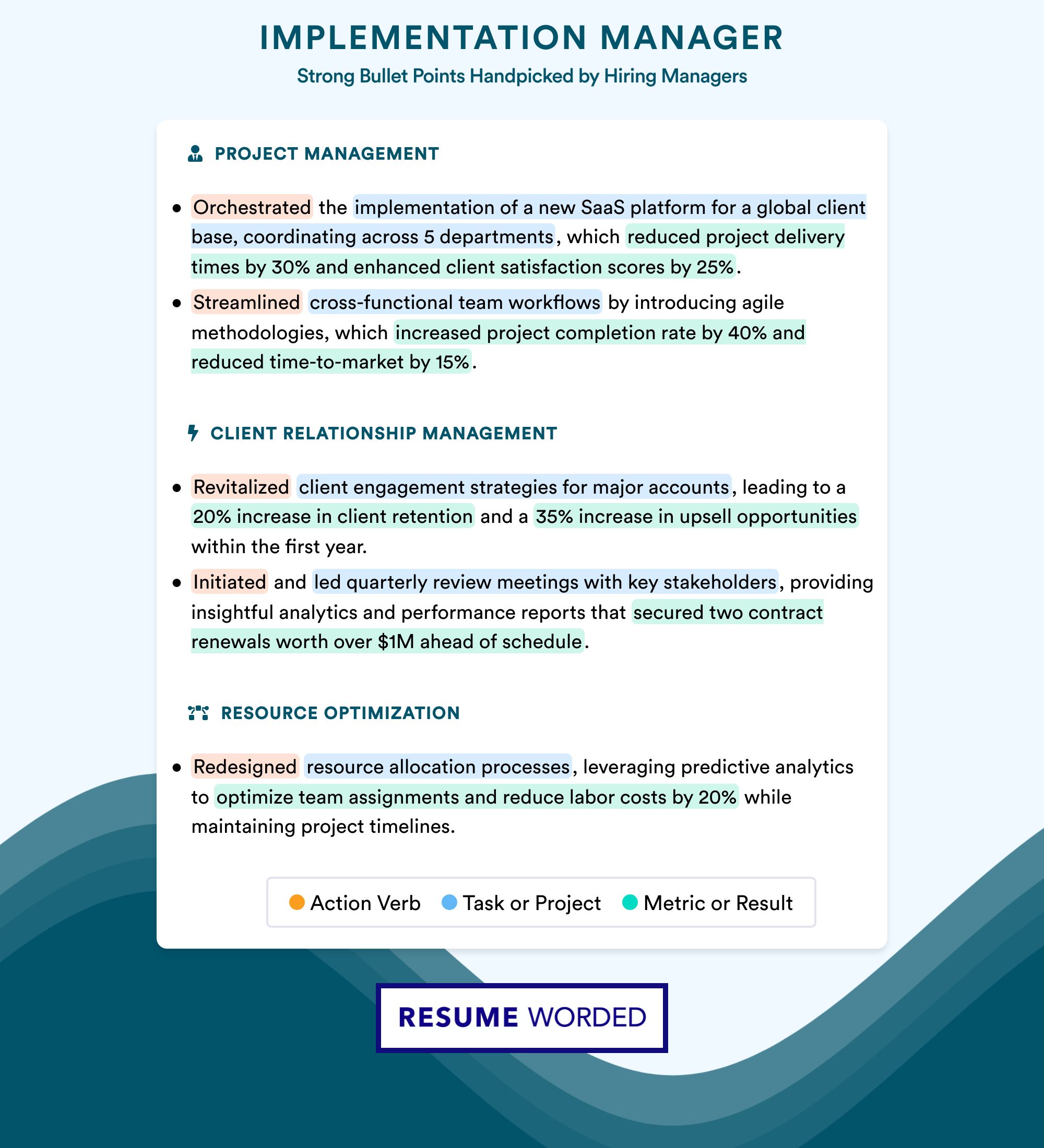
For your experience, the first phrase should reflect your true level of authority.
| If you truly… | Use verbs such as… | Avoid, unless accurate |
|---|---|---|
| Made the decision or owned the outcome | Owned, led, directed, designed, established, redesigned | Assisted, helped, supported |
| Brought stakeholders into alignment | Facilitated, aligned, influenced, convened, negotiated | Managed, if you did not have control over their work |
| Built an operating asset | Developed, implemented, standardized, created, operationalized | Spearheaded, if you did not actually lead the initiative |
| Identified and handled a risk | Diagnosed, mitigated, escalated, resolved, stabilized | Eliminated, unless the risk was genuinely removed |
| Reported or analyzed performance | Measured, analyzed, tracked, surfaced, synthesized | Improved, unless your action caused the improvement |
Your current work can be translated into target-role language without misrepresenting it:
| Current-work description | Target-role framing |
|---|---|
| “I manage project plans and client onboarding.” | “Owned onboarding delivery plans, milestones, stakeholder coordination, and risk management through launch.” |
| “I update leadership on clients.” | “Produced executive implementation reporting that clarified delivery progress, decisions required, risks, and next steps.” |
| “I redesigned how onboarding works.” | “Redesigned the onboarding operating model and playbooks to make delivery more consistent and scalable.” |
| “I track delays and time to launch.” | “Established visibility into time-to-launch, delay causes, and implementation capacity to support delivery decisions.” |
| “I work with client executives.” | “Managed executive client relationships and facilitated decisions when scope, timing, or delivery constraints required trade-offs.” |
| “I used to supervise four people.” | “Supervised a four-person team, setting priorities, removing delivery blockers, and maintaining accountability across client work.” |
Notice what these statements do not do:
- They do not claim you owned renewals if you did not.
- They do not imply that you hired staff if you did not have hiring authority.
- They do not present early-retention tracking as proof that you caused retention.
- They do not use “Head of Onboarding” as a title you have not held.
They do communicate that you have performed meaningful components of the target role and understand their business purpose.
Your digital-marketing environment may use industry-specific language that SaaS employers do not immediately recognize. For now, preserve the substance: policy constraints, platform dependencies, approval cycles, client risk, launch timing, and cross-functional coordination. The next lesson will focus specifically on translating that regulated-industry experience into neutral, portable language.
Use AI as a comparison tool, not an evidence generator
AI can accelerate the comparison between a target job description and your evidence bank. It cannot verify your achievements, infer your actual authority, or safely invent numbers.
AI for Resumes and Cover Letters – Harvard FAS
Read Harvard FAS’s example AI prompts for analyzing a job description and comparing it with your experience. Use them after you build your own map, so AI helps you check for overlooked signals rather than deciding what you have done.
In “Example prompts,” review the prompts labeled “KEYWORDS,” “ROLE PLAY,” “REVISE,” and “SKILL COMPARISON.” Start with the keyword prompt, then note how the other prompts ask for comparison and revision rather than fabricated content. Do not paste confidential client names, private company data, or non-public metrics into any AI tool.
A safer prompt for your own use is:
Compare this target job description with my evidence bank below. Return a table with: target competency, direct evidence, partial evidence, and missing evidence. Quote my evidence accurately. Do not invent metrics, responsibilities, titles, tools, or outcomes. Identify the three strongest examples for a résumé tailored to this role.
Then review every output against your own records. If AI labels a skill “strong” because it sees a related word, that is not enough. Ask whether you can explain a concrete example to a hiring manager and produce supporting evidence if needed.
Key takeaways
A role-evidence map turns “I do a lot of onboarding, implementation, client relations, and project management” into a focused leadership narrative.
- A Head of Client Onboarding and Implementation role requires evidence across operating design, implementation governance, client value, executive influence, performance management, and team leadership.
- Your current work already maps directly to several core competencies: onboarding redesign, project and risk management, executive communication, playbooks, capacity planning, KPIs, and cross-functional coordination.
- Responsibilities demonstrate scope and ownership; verified results demonstrate effectiveness. Keep those distinct.
- Use calibrated verbs that reflect what you actually led, designed, influenced, or supported.
- Your evidence bank should be more detailed than your résumé. It becomes the source for résumé bullets, interview stories, a portfolio case study, and a future Head of Onboarding business case.
In the next lesson, you will translate your regulated digital-marketing experience into industry-neutral language that SaaS and professional-services employers immediately understand.
Can't find a good explanation? Sign up and we'll make it for you
Sign up