
Hello. In the previous lesson, you built a role-evidence map for a Head of Client Onboarding and Implementation path. You identified that much of your work already signals strategic onboarding design, implementation governance, executive communication, KPI ownership, and cross-functional leadership.
The remaining challenge is translation. A SaaS or professional-services recruiter may not understand the operational complexity of regulated digital marketing immediately. Your goal is not to hide that background or pretend you implemented SaaS software. It is to describe your work so they can quickly recognize the portable capabilities: client onboarding, launch governance, risk management, stakeholder alignment, process design, and operational improvement.
By the end of this lesson, you will be able to turn a specialized work description into accurate, industry-neutral résumé and interview language.
Industry-neutral does not mean vague
A weak translation removes so much context that the work becomes generic:
Managed marketing clients and campaigns.
A stronger translation preserves the business challenge while using terms that a target employer recognizes:
Owned client onboarding and launch delivery for regulated digital-marketing accounts, coordinating stakeholder approvals, platform-policy constraints, internal workstreams, and milestone-based execution.
The second statement still tells the truth: the work occurred in digital marketing, involved regulated clients, and required platform knowledge. But it emphasizes the operating problem you solved rather than assuming the reader understands hemp advertising, peptide marketing, or telehealth campaign constraints.
Think of each accomplishment as having three layers:
| Layer | Example from your work | What a target employer hears |
|---|---|---|
| Industry context | Regulated hemp, peptide, or telehealth marketing | A high-constraint client environment |
| Operating mechanism | Platform policies, approvals, launch timing, client dependencies | Risk, governance, stakeholder coordination |
| Portable capability | Process redesign, project plans, executive updates, escalations | Onboarding leadership and implementation management |
The context gives your experience credibility. The portable capability makes it relevant.
A SaaS employer does not need you to claim that a paid-social launch was a software configuration. They do need to see that you can coordinate a complex client launch with external dependencies, changing requirements, competing stakeholders, and meaningful commercial risk.
Translate the work, not just the vocabulary
The infographic below illustrates the basic principle: a specific achievement can demonstrate several broader competencies. Your work history should use this same reasoning, but with evidence attached to each competency.
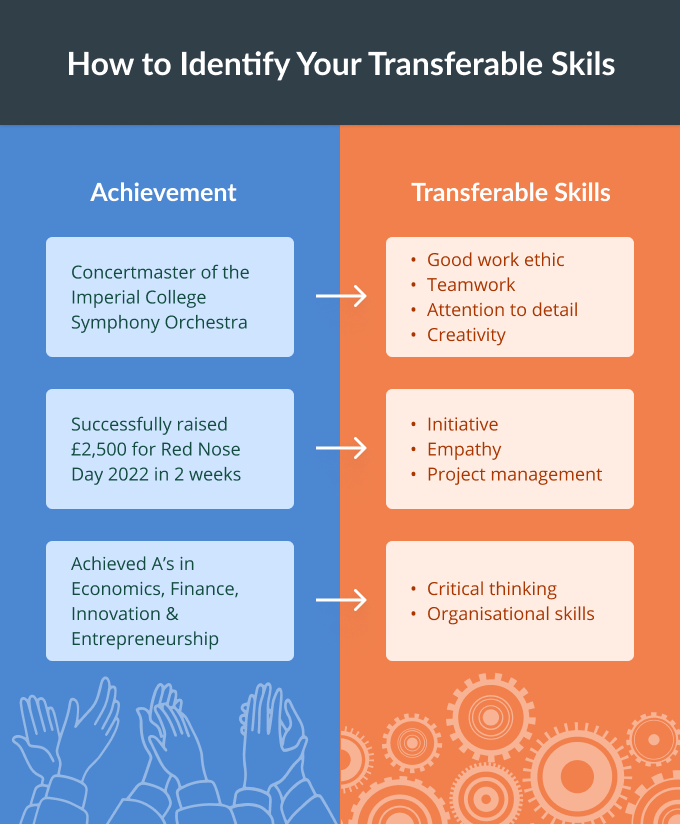
A useful translation process has four steps:
- State the factual work. Start with what actually happened, using the language you would use internally.
- Identify the business problem. Was the work about reliable launch delivery, reducing risk, improving client experience, standardizing a process, or resolving a blocker?
- Name the portable capability. Use language common to onboarding, implementation, customer success, and professional services.
- Add scope and evidence. Include stakeholders, complexity, measurable results, or a clear operational consequence.
For example:
| Internal or niche wording | Business problem underneath it | Industry-neutral framing |
|---|---|---|
| “Managed hemp campaigns across Meta and TikTok.” | Launching client work under strict external constraints | “Managed multi-platform client launches in a regulated category, coordinating platform requirements, client approvals, and delivery milestones.” |
| “Handled ad rejections and policy issues.” | Reducing launch risk caused by a third-party dependency | “Diagnosed and mitigated platform-policy blockers that threatened launch timing and client commitments.” |
| “Updated clients on campaign progress.” | Maintaining trust and accountability during delivery | “Provided structured client status updates that clarified progress, risks, decisions required, and next steps.” |
| “Built a new onboarding playbook.” | Making delivery repeatable and less dependent on individual knowledge | “Redesigned onboarding workflows and playbooks to standardize handoffs, milestone tracking, and escalation practices.” |
| “Worked with leadership when a client had an issue.” | Making a decision across competing constraints | “Facilitated cross-functional decisions with internal and client executives when scope, timing, or platform constraints placed delivery commitments at risk.” |
| “Tracked time to launch and delays.” | Improving delivery predictability and capacity decisions | “Tracked time-to-launch and delay patterns to improve delivery visibility and inform implementation-prioritization decisions.” |
Notice that the translations do not remove marketing completely. They place it in the background while bringing your management and operating skills to the foreground.
Keep claims calibrated
Regulated work can be an advantage because it shows you are used to constraints. But it is important to describe those constraints precisely.
If you coordinated platform requirements and client approvals, write:
- “Navigated platform-policy constraints”
- “Coordinated policy-related approvals”
- “Managed third-party platform dependencies”
- “Escalated launch blockers with internal and client stakeholders”
Do not write “ensured regulatory compliance” unless you genuinely owned a formal compliance process or had authority to interpret and enforce regulatory requirements. Similarly, do not claim that you “implemented SaaS solutions” if your implementation work was marketing-service delivery. A hiring manager will test that distinction in an interview.
The aim is neither understatement nor inflation. It is accurate equivalence.
For example, this is a credible professional summary for a SaaS or services application:
Onboarding and implementation leader with experience designing scalable client-delivery processes for regulated digital-marketing accounts. Leads cross-functional launches, stakeholder communication, risk management, playbook development, and performance reporting to improve launch reliability and early client experience.
Your actual employment title should remain Onboarding Success Manager. A summary can describe the function you perform; it should not rewrite your job history.
Build bullets around evidence, not a list of skills
The University of Michigan Career Center calls its structure the Bullet Plus model: action verb, what you did, and how, why, or impact. It is particularly useful when the original work has specialized terminology, because it forces the bullet to show capability rather than merely name a task.
Resume Resources - University Career Center
Read the University Career Center’s “Resume Resources” guidance for a concise model of evidence-based bullets. Focus on turning responsibilities into proof of capability and impact.
In the section “Write Higher Quality Bullet Points,” read the Bullet Plus examples. Notice how each stronger bullet supplies context or purpose rather than merely naming a skill. Apply that same structure to your onboarding work: action, operational contribution, and verified outcome or business reason.
Use this pattern:
Action verb + deliverable or responsibility + how you handled complexity + verified result or business purpose
Here are evidence-oriented drafts based on the work you described. They deliberately avoid invented numbers.
- Owned end-to-end onboarding plans for regulated digital-marketing clients, coordinating client stakeholders, internal delivery teams, approval dependencies, and launch milestones.
- Redesigned onboarding workflows and playbooks to create more consistent sales handoffs, risk visibility, client communication, and launch governance.
- Managed client and executive stakeholder communication during at-risk launches, surfacing decisions required, resolving blockers, and resetting expectations when scope or timing changed.
- Tracked time-to-launch, delays, client satisfaction, early-retention signals, and implementation capacity to support operational reporting and delivery decisions.
- Supervised a four-person team, setting priorities, removing delivery blockers, and maintaining accountability across concurrent client work.
Each bullet demonstrates a hiring signal:
| Bullet emphasis | Hiring signal |
|---|---|
| End-to-end plans and milestones | Implementation governance |
| Workflow and playbook redesign | Scalable operating design |
| Executive updates and decisions | Client leadership and influence |
| KPIs and capacity | Operational management |
| Supervision and prioritization | People and functional leadership |
When you have verified evidence, strengthen the bullet with a baseline, result, and time period:
Redesigned onboarding workflows and playbooks, reducing median time to launch from to days over while improving visibility into approval-related delays.
Do not leave placeholders in a final résumé. Either confirm the figures or use a defensible non-numerical result, such as “standardized launch-readiness reviews across active accounts” or “introduced a consistent escalation process for at-risk launches.”
Choose language based on the target role
The same accomplishment can be framed slightly differently for SaaS and professional-services employers. The facts stay the same; the emphasis changes.
| Your work | SaaS onboarding or implementation framing | Professional-services framing |
|---|---|---|
| Client launch management | Client onboarding, implementation delivery, go-live readiness | Client engagement delivery, workstream coordination, delivery readiness |
| Platform-policy limitation | External platform dependency, launch blocker, implementation risk | Third-party constraint, delivery risk, client dependency |
| Campaign assets and approvals | Client readiness requirements, approval milestones, launch dependencies | Client deliverables, approval gates, engagement dependencies |
| Onboarding playbook | Scalable onboarding operating model, implementation playbook | Standardized delivery methodology, engagement playbook |
| Client status update | Implementation status reporting, risk and decision log | Client governance update, delivery status, decision register |
| Capacity planning | Implementation capacity and portfolio planning | Resource planning and delivery capacity management |
For a Head of Onboarding or Implementation Manager role, terms such as onboarding, implementation delivery, go-live, risk management, client readiness, and time-to-launch will usually be useful.
For professional-services roles, engagement delivery, workstreams, client governance, deliverables, scope, and resource planning may fit more naturally.
Do not force every keyword into every bullet. A résumé is clearer when a reader can see a consistent story:
- You led complex client delivery.
- You made launches more reliable.
- You managed risk and expectations.
- You built repeatable systems.
- You used data and reporting to improve decisions.
Make the translation interview-ready
A recruiter may accept a résumé phrase quickly, but an interviewer will ask what it meant in practice. Your explanation needs to reconnect the neutral language to the real situation.
The following short segment from How to actually get hired as a Customer Success Manager by Customer Success Collective demonstrates the level of specificity that makes an onboarding example credible: a structured workflow, a clear customization choice, and an outcome.
How to actually get hired as a Customer Success Manager
Watch this segment to see how a broad claim about onboarding becomes credible when it includes a concrete workflow, decision, and outcome.
Watch the onboarding example. Focus on the structure: discovery and success criteria, readiness work, tailored enablement, and a measured result. You do not need to copy the SaaS scenario; use the same level of specificity when describing your regulated-marketing client launches.
For your background, an interview-ready answer might sound like this:
In my current role, I manage client onboarding and launch delivery for regulated digital-marketing accounts. The main complexity is that launch timing depends on several parties: the client, internal delivery teams, and third-party platform requirements. I use a milestone-based plan, clarify client approvals and dependencies early, track risks, and escalate decisions when a constraint could affect scope or timing. I also use delay and time-to-launch patterns to identify where our process needs stronger controls or clearer ownership.
This answer is portable because it explains your method, not only your industry. It is also truthful because it identifies the actual environment in which you used that method.
Create a small translation bank
Before revising an entire résumé, create a one-page bank of four to six translated examples. This will later feed your résumé bullets, LinkedIn profile, portfolio case study, and interview stories.
For each example, record:
| Field | What to write |
|---|---|
| Original description | The internal language you would normally use |
| Business problem | The underlying delivery, client, risk, or process issue |
| Portable capability | The competency a target employer recognizes |
| Industry-neutral draft | A concise evidence-oriented bullet |
| Proof | Metric, artifact, stakeholder, or observable result |
Start with these six examples from your experience:
- A client onboarding process or playbook redesign.
- An at-risk launch involving platform, approval, scope, or timing constraints.
- An executive-level client decision or escalation.
- A KPI or reporting process involving time-to-launch, delays, satisfaction, retention, or capacity.
- A capacity-planning or prioritization decision.
- Your supervision of a four-person team.
Use this final quality check before keeping a translated statement:
- Truthful: It reflects your actual authority, work, and results.
- Portable: A SaaS or professional-services recruiter can identify the capability without knowing your industry.
- Specific: It names the operational problem, stakeholders, method, or result.
- Defensible: You can explain the example in detail and support any metric you include.
Key takeaways
Your regulated digital-marketing experience is not a barrier to portability. It is evidence that you have delivered client outcomes in an environment with high external constraints, approval dependencies, and reputational risk.
- Keep the regulated context, but do not make it the entire story.
- Translate specialized tasks into the business problem and transferable capability they represent.
- Use onboarding, implementation, risk, stakeholder, process, capacity, and performance language when it accurately describes your work.
- Preserve title integrity and avoid claiming formal compliance, SaaS configuration, hiring authority, or retention outcomes you did not own.
- Build résumé bullets around action, operational contribution, and verified impact rather than generic skills.
In the next lesson, you will use this role-evidence map and translation bank to identify the highest-priority gaps between your current evidence and a chosen target role.
Can't find a good explanation? Sign up and we'll make it for you
Sign up