
Hello and welcome back to the course.
In our last lesson, you built a crucial asset: a target list of 20 niche-specific newsletters and podcasts whose audiences align with your Ideal Customer Profile. This list represents a series of high-leverage opportunities to get your SaaS in front of the right people.
Today, we move from research to action. This lesson directly addresses the learning outcome: Craft a personalized pitch template to secure features in high-value newsletters or communities. Having a list is one thing; successfully getting on it is another. We'll deconstruct the art and science of the "cold pitch," focusing on creating a system that is both scalable and highly effective. You will learn how to balance the efficiency of a template with the critical element of personalization that actually gets responses.
The Mindset: Value Exchange, Not a Sales Pitch
Before we write a single word, it's vital to understand the perspective of the person you're contacting. Newsletter authors and community managers are gatekeepers to the audience you want to reach. They are inundated with requests and have one primary goal: to deliver value to their audience.
A successful pitch is not about what you want; it's about what you can offer them and their readers. Think of it as a value exchange. You're offering compelling content, a unique story, or an expert perspective in exchange for their audience's attention.
The image below provides a high-level guide to structuring a compelling narrative. While it's designed for investor pitches, the core principles of having a clear problem, a superior solution, and a strong narrative apply directly to our task.
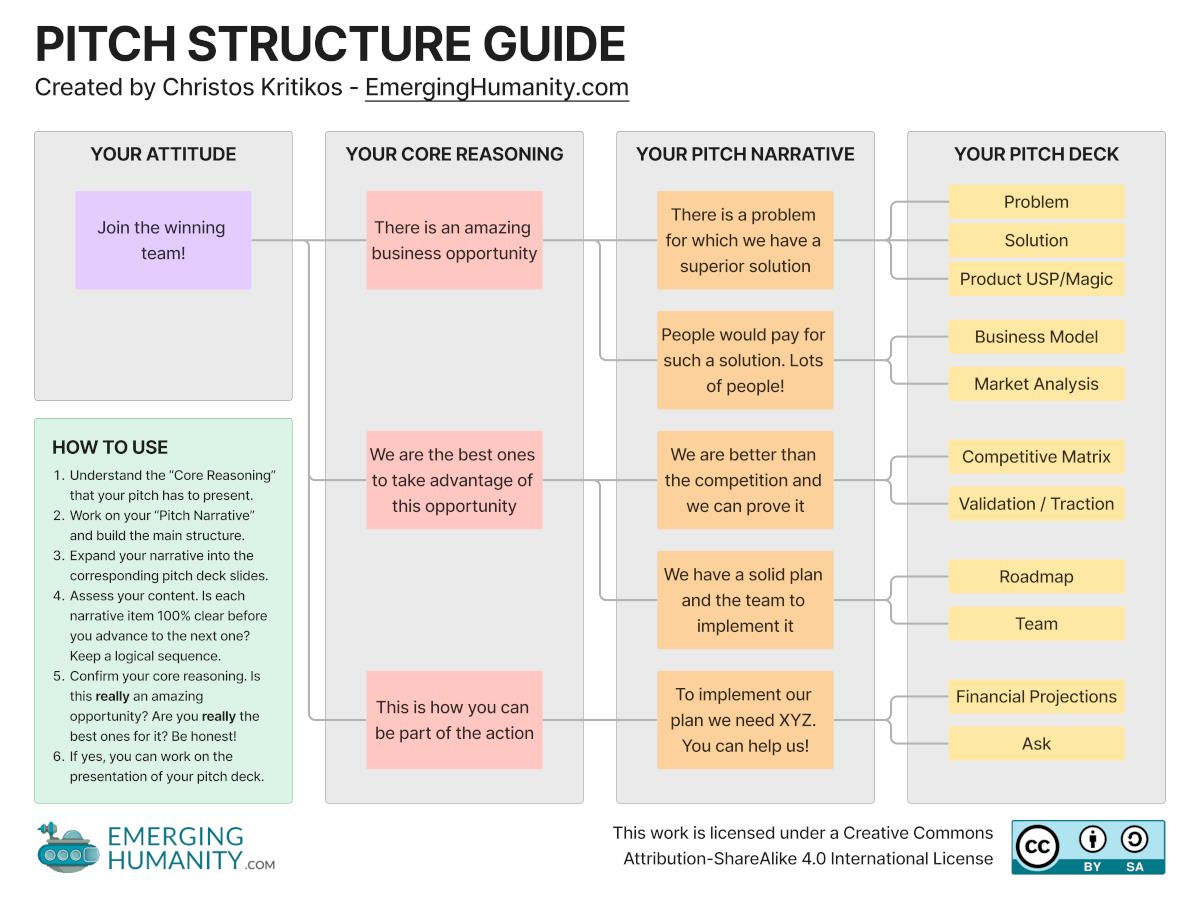
The Anatomy of a High-Converting Pitch
An effective pitch is a carefully constructed message with several key components. We'll use a simple four-part structure as our foundation, which is a common framework used by PR professionals.
This Media Pitch Template Will Help You Land More PR
To start, let's get a high-level overview of the structure of a media pitch from the video 'This Media Pitch Template Will Help You Land More PR'. This will provide the basic 'skeleton' for our template.
Watch the video from the beginning until 10:36. Pay close attention to the four main steps the presenter outlines: The Hook: How to grab attention immediately. The Intro: How to introduce yourself and establish a connection. The Pitch Ideas: How to offer specific, valuable ideas. The Call to Action (CTA): How to make it easy for them to respond.
Now, let's break down each of these components in more detail, incorporating tactical insights to make your pitch stand out.
1. The Subject Line: Your First Impression
The subject line determines whether your email gets opened or ignored. Journalists and creators are busy; your subject line must be clear, concise, and compelling.
How to Write a Media Pitch (7 Real Examples from Experts)
The article 'How to Write a Media Pitch' from Prowly provides excellent, no-nonsense advice on crafting subject lines.
Read 'Step 3: Write your subject line.' The key takeaways are to keep it clear and short (under 49 characters is a good rule of thumb).
Effective Subject Line Formulas:
- Direct & Clear:
Pitch: [Your SaaS Name] for [Newsletter Name] - Intrigue & Value:
Idea for your readers: [A compelling topic] - Personalized:
Loved your piece on [Topic], have an idea - Question:
Quick question about [Newsletter Name]
2. The Hook: Personalization is Everything
The first 1-2 sentences are the most important part of your email. This is where you prove you're not a spammer and that you've done your homework. A generic "I love your newsletter" is not enough. Be specific.
- Reference a specific article or post they wrote: "I really enjoyed your recent issue on bootstrapping. The point about avoiding premature scaling was spot on."
- Mention a guest they had or a tool they featured: "The interview with the founder of [X company] was insightful. I was particularly interested in how they solved [Y problem]."
- Connect with something personal they shared (if appropriate): "As a fellow [hobbyist/parent/etc.], I appreciated your recent post on [topic]."
This initial effort to build rapport signals that you respect their work and are not just firing off mass emails.
3. The Intro & Value Proposition: "Why You and Why Now?"
After the hook, briefly introduce yourself and your SaaS. Crucially, you must immediately connect what you do to the interests of their audience. This is where you can apply some psychological frameworks from cold emailing.
How To Write Killer Cold Emails That GUARANTEE Responses (45.8% Reply Rate?!)
The video 'How To Write Killer Cold Emails' offers powerful formulas that we can adapt for our pitches. While it's focused on sales, the principles of addressing pain points and desires are universal.
Watch the sections on the 'PC formula' (Pain point -> CTA) from 00:55 to 02:41 and the 'PEC formula' (Prospect's desire -> Evidence -> CTA) from 02:41 to 04:24. Think about how you can frame your SaaS as a solution to a pain point or a path to a desire for the newsletter's audience.
Instead of saying, "My SaaS does X, Y, and Z," frame it as a solution: "Many of your readers are founders struggling with [Pain Point, e.g., creating video content]. My tool, [SaaS Name], helps them solve this by [brief, high-level benefit]."
This shows you understand their audience's problems and positions your story or tool as a valuable resource for them.
4. The Pitch Ideas: Make Their Job Easy
Don't just ask for a feature. Propose concrete ideas that would make a great piece of content for them. Offer 2-3 specific angles.
- A Guest Post Idea: "I'd be happy to write a guest post for you on '5 Tactical Ways Founders Can Repurpose One Video into a Week of Content'."
- An Exclusive Story: "As we're launching, I could offer your readers an exclusive look into how we [achieved a specific result] using [a specific strategy]."
- A Unique Data Point: "We just analyzed data from 1,000 users and found that [surprising insight]. This could be an interesting data point for an upcoming issue."
By doing the creative work for them, you drastically increase your chances of getting a "yes."
5. The Call to Action (CTA): Be Clear and Low-Friction
End your email with a clear, simple, and low-commitment question. Avoid vague closers like "Hope to hear from you."
Good CTAs:
- "Are any of these ideas something you'd be interested in exploring?"
- "Would you be open to me sending over a brief outline for that guest post?"
- "Happy to share more details if this sounds like a good fit for your audience. What do you think?"
The goal is to start a conversation, not to close a deal in the first email.
Building Your Master Pitch Template
Now, let's combine these elements into a reusable template. The goal is to create a structure where you can easily swap out the personalized components for each target.
Subject: Pitch: [Your Idea/Topic] for [Newsletter/Community Name]
Hi [Recipient Name],
[Personalization Point: A specific, genuine compliment or observation about their work. Reference a recent article, post, or topic.]
My name is [Your Name], and I'm the founder of [Your SaaS Name], a tool that helps [Their Audience/ICP] solve [Pain Point].
Given your focus on [Their Newsletter's Core Topic], I thought your readers might find our story interesting. Specifically, I had a few ideas that could provide a lot of value:
- [Pitch Idea 1]: A guest post on
[Specific, Value-Driven Topic]. - [Pitch Idea 2]: An exclusive look into
[A unique process, data point, or story about your journey]. - [Pitch Idea 3]: A quick feature on how
[Your SaaS Name]helps solve[Specific Problem]for founders.
[Call to Action: A simple, low-friction question.] e.g., "Would any of these be a good fit for your audience?"
Thanks for your time and for the great work you do with [Newsletter Name].
Best,
[Your Name][Your Title], [Your SaaS Name][Link to your website]
Scaling Your Outreach with AI
Manually researching and personalizing every pitch can be time-consuming. This is where AI, specifically tools like ChatGPT or Claude, becomes your force multiplier. Your CS background will make you adept at crafting the precise prompts needed for high-quality output.
How To Use ChatGPT for Email Marketing: Expert Tips and ...
The article 'How To Use ChatGPT for Email Marketing' provides a fantastic framework for writing effective prompts. We can apply these principles directly to our pitch-crafting workflow.
First, read the section 'How To Craft Effective Email Prompts for ChatGPT' to understand the SCIRP framework (Specific, Contextual, References, Parameters, Iteration). Then, read the section 'Draft Personalized Email Messages' to see how this can be applied to generating tailored outreach.
Here is a practical workflow using ChatGPT and your template:
Step 1: AI-Powered Research
Copy the text from a target's recent newsletter or "About" page and feed it into ChatGPT.
Prompt: "I am the founder of a SaaS called
[SaaS Name]that[briefly describe your tool]. I want to pitch the author of this newsletter[Newsletter Name]. Based on the text below, identify 3-5 key themes they write about and suggest one specific personalization point I can use in my opening line.Newsletter Text:
[Paste the text here]"
Step 2: AI-Powered Idea Generation
Use the themes from Step 1 to brainstorm pitch angles.
Prompt: "Based on the themes of
[Theme 1]and[Theme 2], generate 3 potential guest post titles or story angles that would be a perfect fit for this newsletter's audience of[ICP]and connect to my SaaS, which helps with[Problem you solve]."
Step 3: Fill in Your Template
Take the output from the AI and plug the best personalization point and pitch idea into your master template.
Step 4: AI-Powered Refinement (Optional)
Paste your completed pitch into ChatGPT.
Prompt: "Review this email pitch. Make it more concise and ensure the tone is respectful, confident, and focused on providing value. The recipient is a busy newsletter author."
Test your understanding!
Let's say your SaaS is a tool that automates social media content creation for busy founders. Your target is the Failory newsletter, which is for startup founders (see image LINK).

Based on the content shown in the image (articles on fundraising, LTV:CAC, user personas), what would be a strong, personalized Hook and one compelling Pitch Idea for your pitch?
Show answer
-
Hook (Personalization Point): "Hi Nico, I'm a long-time reader of Failory and particularly enjoyed the recent breakdown on LTV:CAC. It's a metric we're obsessively tracking as we grow." (This is specific and shows you understand their content).
-
Pitch Idea: "A guest post titled 'How Founders Can Spend 30 Minutes a Week on Social Media and Still Drive Growth,' where I share the automation framework we built for our SaaS." (This is highly relevant, offers a clear benefit, and ties back to your product without being overly promotional).
Conclusion
You now have a complete system for reaching out to high-value newsletters and communities. This isn't just a one-off email; it's a repeatable process that combines strategic communication with the power of AI to help you scale your efforts efficiently.
Key Takeaways:
- Pitching is a value exchange: Always focus on what's in it for them and their audience.
- Structure is key: A great pitch has a clear Hook, Intro, Value Prop, Pitch Ideas, and CTA.
- Personalization is non-negotiable: The first two sentences can make or break your pitch.
- Templates + AI = Scale: Use a master template for structure and AI tools to accelerate research and personalization, allowing you to conduct high-quality outreach efficiently.
Preview of the Next Lesson:
Now that you're equipped to conduct targeted, personalized outreach, we'll turn our attention to a powerful, broad-distribution channel. In the next lesson, you will learn how to develop a launch strategy for Hacker News, respecting community guidelines and posting best practices. This will be a key part of your launch day playbook.