
Hello and welcome back!
In our last session, we laid the groundwork for building your SaaS's initial exposure. We covered the passive, foundational step of listing on SaaS directories and the more active, community-focused approach of engaging with startup subreddits. These are excellent ways to get your first users and create a digital footprint.
Today, we shift from foundational presence to proactive outreach. Instead of waiting for users to find you, we're going to find where they already are. This lesson directly addresses the learning outcome: Use SparkToro or advanced Google searches to build a target list of 20 niche-specific newsletters and podcasts. We will explore two powerful methods for identifying established channels that have already captured the attention of your ideal customers, allowing you to "borrow" their audience and trust.
The "Borrowed Audience" Strategy
One of the fastest ways to scale your reach is to get in front of an audience that someone else has spent months or years building. Appearing as a guest on a podcast or getting your SaaS featured in a niche newsletter allows you to:
- Reach a concentrated, relevant audience immediately.
- Gain instant credibility by being endorsed (even implicitly) by a trusted source.
- Drive high-intent traffic to your website.
Your goal is not just to find any podcast or newsletter, but to find the right ones—those whose audience perfectly aligns with your Ideal Customer Profile (ICP).
Method 1: Audience Intelligence with SparkToro
The most direct way to discover what your audience pays attention to is to use a tool built for that exact purpose. SparkToro is an audience research tool that analyzes what millions of people talk about, follow, and share online.
The Smarter-Not-Harder Guide to Content Marketing in 2024
To understand the philosophy behind this approach, let's start with this article from SparkToro's blog. It explains why modern content marketing requires you to be present where your audience already is.
Read 'Step 1: Uncover your audience’s sources of influence.' This section sets the stage by explaining the need to go beyond keyword research to find the actual sources that influence your customers.
As the article mentions, knowing the specific podcasts, websites, and social accounts your audience follows is a competitive advantage. SparkToro makes this process straightforward.
How to Use SparkToro to Find Podcasts and Newsletters
-
Define Your Audience: You start by telling SparkToro who your audience is. You can do this by searching for people who:
- Use specific words in their profile/bio (e.g., "B2B marketing manager")
- Talk about certain topics (e.g., "no-code tools")
- Follow specific social accounts (e.g., accounts of your competitors)
- Visit specific websites (e.g., industry blogs)
-
Analyze the Results: SparkToro will then generate a report showing the top sources of influence for that audience.
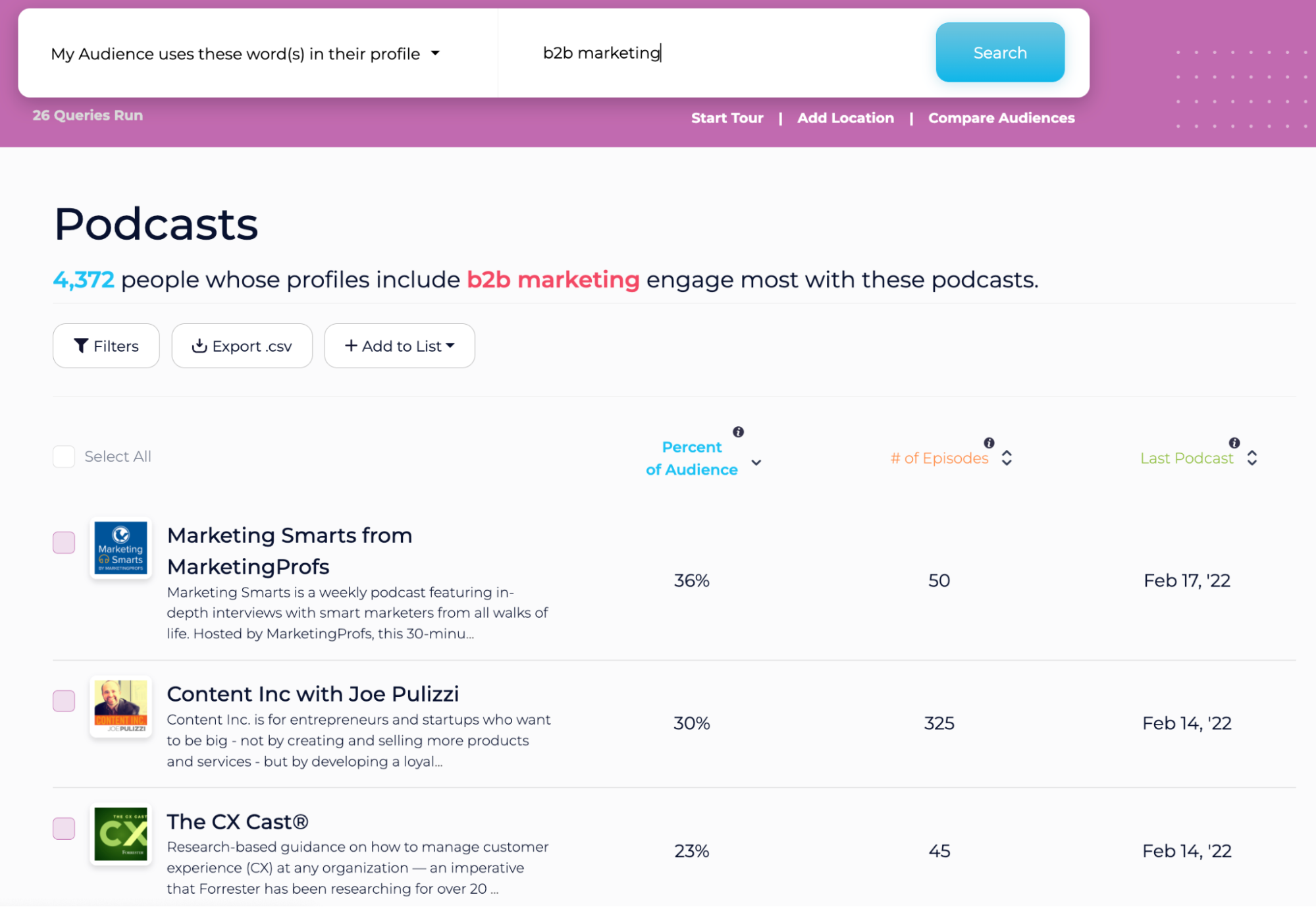
To find your targets, you would navigate to the Podcasts and Websites tabs in the results. The "Websites" section will often reveal popular blogs and newsletters in your niche.
The SparkToro article you just reviewed also contains a "cheat sheet" for this.
The Smarter-Not-Harder Guide to Content Marketing in 2024
Now, let's look at the tactical guide for using SparkToro. This section gives you the exact steps to find relevant podcasts and publications.
Read the section 'Step 5: Distribute like a pro' and focus on the sub-section 'Here’s a cheat sheet on how to find them in SparkToro.' Pay special attention to the part about finding relevant podcasts.
A key tip from the article is to look for niche shows. Securing a guest spot on a massive, mainstream podcast can be difficult, but a smaller, highly-focused show might be a perfect fit and deliver a more engaged audience. SparkToro's "Hidden Gems" feature is designed to help you find exactly these kinds of opportunities.
Method 2: Advanced Google Searches
While SparkToro is highly effective, it's a paid tool. You can achieve similar, and sometimes even more specific, results for free by mastering advanced Google search operators. Given your computer science background, you'll likely appreciate the logic and precision these operators provide.
Think of search operators as a query language for Google. They allow you to filter and refine your searches to cut through the noise.

To get a solid grasp of the fundamentals, the following video offers an excellent tutorial.
Google Like a Pro – All Advanced Search Operators Tutorial
This video from freeCodeCamp provides a comprehensive tutorial on Google search operators. We'll focus on the core operators that you'll be using most often.
Watch the following segments: Be Thoughtful (09:22 - 14:16): To understand how to frame your queries. Source Operators (29:52 - 33:08): Focus on the site: operator. 'In' Operators (34:58 - 37:16): Focus on inurl: and intitle:. Combining Operators (40:56 - 43:23): This is the most critical part, showing how to string operators together for precise results.
Now, let's turn these operators into a tactical playbook for finding newsletters and podcasts. The following resource is framed for link-building, but the search queries are perfectly suited for our goal.
Google Search Operators: Build Natural Backlinks [Full List]
This article is a goldmine of practical search queries. We'll adapt its 'link prospecting' techniques for our 'audience prospecting' goal.
First, quickly review the section '#1 Core Search Operators' to reinforce your understanding of site:, intitle:, and inurl:. Then, read section '#3.2 Finding podcast and interview opportunities' carefully. This gives you exact search strings you can modify.
Playbook for Finding Podcasts
Combine your niche keyword with podcast-related terms.
- Basic Search:
"[your niche]" + podcast(e.g.,"devops" + podcast) - Using
intitle:intitle:"[your niche]" podcast(e.g.,intitle:"b2b sales" podcast) - Finding Guest Opportunities:
"[your niche]" (podcast guest OR "be a guest" OR "apply to be a guest") - Finding Podcasts That Interview Founders:
intitle:"saas founder" (podcast OR interview)(as seen in the LINK resource). - Finding "Best of" Lists:
best "[your niche]" podcasts 2024
Playbook for Finding Newsletters
Finding newsletters involves searching for subscription pages and platforms like Substack or Beehiiv.
- Platform-Specific Search:
site:substack.com "[your niche]"site:beehiiv.com "[your niche]"
- Finding Subscription Pages:
"[your niche]" inurl:subscribe newsletter - Finding Sponsorship Opportunities:
"[your niche]" newsletter sponsor OR "advertise with us" - Finding "Best of" Lists:
"best [your niche] newsletters"
Test your understanding!
Imagine your SaaS is a tool that helps online course creators manage their student communications. Construct two advanced Google search queries: one to find relevant podcasts and one to find relevant newsletters.
Show answer
Here are some effective queries:
-
For Podcasts:
intitle:"course creator" (podcast OR interview) -site:youtube.com- This query looks for pages with "course creator" in the title that also mention "podcast" or "interview," and it excludes YouTube to reduce noise from video results.
-
For Newsletters:
site:beehiiv.com "online course" OR site:substack.com "online course"- This query specifically searches two of the largest newsletter platforms for publications focused on "online course" creation.
- Another great option:
"online course" "newsletter" inurl:subscribe
Building and Qualifying Your Target List
Finding potential channels is just the first step. The next is to vet them to ensure they're a good fit. Your goal is to create a list of at least 20 highly qualified targets.
Create a spreadsheet or a table in Notion with the following columns:
- Name: The name of the podcast or newsletter.
- URL: A direct link.
- Type: Podcast or Newsletter.
- Audience Notes: Who is their audience? How well does it match your ICP? (Listen to an episode or read a few issues to find out).
- Activity: When was the last episode/issue published? Is it active?
- Est. Size/Reach: Is it a huge channel or a small, niche one? (You can sometimes find this on their "Sponsor" page).
- Contact/Pitch Info: A link to their contact form, "be a guest" page, or an email address.
- Pitch Angle Idea: A quick note on why you/your SaaS would be a good fit for their audience.
This organized list will be the foundation for your outreach campaign, which we'll cover in the next lesson.
Conclusion
You now have a systematic process for identifying high-leverage marketing opportunities. By finding and engaging with the newsletters and podcasts your ideal customers already trust, you can bypass the slow grind of building an audience from scratch and put your SaaS directly in front of people who need it.
Key Takeaways:
- "Borrowing" an audience through podcasts and newsletters is a powerful strategy for rapid growth.
- SparkToro offers a data-driven way to discover what your audience listens to and reads.
- Advanced Google search operators are a free, precise tool for finding niche channels. Your CS background gives you a natural advantage in mastering these queries.
- Building a qualified list is more important than building a long one. Vet each opportunity for audience fit, activity, and relevance.
Preview of the Next Lesson:
You've built your target list of 20 high-potential podcasts and newsletters. So, what's next? In our next lesson, we will focus on the art of outreach. You will learn how to craft a personalized pitch template to secure features in high-value newsletters or communities, turning your research into real-world marketing opportunities.