Hello! Welcome back to our module on "Accelerator Program Design and Delivery."
In our last lesson, we outlined a core curriculum designed to build a startup's "fundability" by focusing on action-oriented workshops. A curriculum, however, is just a roadmap. To truly bring it to life and deliver exceptional value, you need experienced guides. This brings us to the human capital of your accelerator: your mentor network.
This lesson addresses the learning outcome: Design a system for recruiting, vetting, and managing a high-quality mentor network. A world-class mentor network is often the single most valuable asset an accelerator provides. It’s a powerful engine for de-risking startups, accelerating their growth, and differentiating your program in a crowded market. We will design a structured system to ensure this asset is built and managed effectively.
1. The Foundation: From Ad-Hoc to Systematic Mentorship
Many programs treat mentorship as an informal, unstructured activity. This often leads to common problems: mentors who are disengaged, founders who receive conflicting or irrelevant advice, and a general feeling of wasted time for everyone involved.
A systematic approach is the solution. To understand the challenges we need to solve, let's look at what can go wrong.
Mentoring strategies for startup incubators and accelerators
The article 'Mentoring strategies for startup incubators and accelerators' from Acterio highlights the typical pain points of managing a mentor network. Understanding these is the first step in designing a system to prevent them.
Please read the section 'Navigating the challenges of startup mentoring'. Pay close attention to the three main challenges identified: engaging mentors effectively, mismatches in involvement desire, and the difficulty for mentors to see tangible results.
As the article points out, the voluntary nature of mentorship means you must be deliberate in how you structure it. We will build a three-part system to address these challenges head-on:
- Recruiting: Attracting the right people.
- Vetting: Selecting for quality and fit.
- Managing: Engaging and deploying mentors for maximum impact.
2. Part 1: Recruiting - Building Your Mentor Pipeline
Before you can manage mentors, you need to attract them. This starts with defining who you're looking for and what you can offer them in return.
Defining Your Ideal Mentor Profile
Your mentor network should be a direct reflection of the needs of your startups and the curriculum you designed. Look back at the core modules from our last lesson (Validation, GTM, Financials, Legal, Fundraising). Your mentor profiles should map to these areas.
- Functional Experts: Operators with deep, recent, hands-on experience in areas like B2B sales, performance marketing, product management, or engineering leadership.
- Industry Veterans: People who have deep domain expertise in the specific industry your accelerator focuses on (e.g., FinTech, HealthTech, AI).
- Experienced Founders & CEOs: Individuals who have successfully built and scaled companies. They provide strategic guidance and can empathize with the founder journey.
- Investors: Angels and VCs who can provide feedback on fundability and potentially become a source of capital for your graduates.
Crafting the Mentor Value Proposition
High-quality mentors are busy and in-demand. They are rarely motivated by direct financial compensation. Your "offer" must appeal to their intrinsic motivations.
Mentoring strategies for startup incubators and accelerators
The same Acterio article provides excellent insights into what motivates mentors. We'll use this to craft a compelling value proposition.
Please read the section 'Attracting and retaining high-quality mentors', focusing specifically on the sub-section 'Attraction through a clear value proposition'.
Based on this, your value proposition for mentors could include:
- Re-engagement with Innovation: A chance to get back into the dynamic, fast-paced startup world.
- Impact and Give-Back: The opportunity to shape the next generation of entrepreneurs.
- Curated Deal Flow: Early access to a vetted pipeline of promising startups for potential angel investment.
- Exclusive Community: Access to a private network of other high-caliber mentors, fostering valuable peer relationships.
- Personal Branding: Opportunities to be featured as an expert through your accelerator's content and events.
Sourcing Channels
With a clear profile and value proposition, you can begin sourcing. Given your background in startup consultancy, your personal network is your strongest starting point.
- Your Professional Network: Tap into the founders, investors, and executives you've worked with over the last 10 years.
- LinkedIn Outreach: Systematically search for individuals with the right titles and experience (e.g., "VP of Marketing" at a Series B SaaS company).
- Referrals: Ask your first few confirmed mentors to recommend other qualified individuals in their network.
- Portfolio Company Alumni: As your accelerator matures, successful founders who have graduated from your program can become your best future mentors.
3. Part 2: Vetting - Curating for Quality Over Quantity
A large but low-quality mentor network is more harmful than a small, high-quality one. A rigorous vetting process is non-negotiable. It protects your founders from bad advice and your program's reputation.
Let's look at a real-world example of a company that has built its entire brand on mentor quality.
Building a curated marketplace: How we vet growth mentors
GrowthMentor runs a marketplace for mentors and has a best-in-class vetting process. Their article, 'Building a curated marketplace: How we vet growth mentors', provides a practical, step-by-step blueprint we can adapt for your accelerator.
Read the article from the beginning to the end. Focus on the philosophy of 'culture fit' and the multi-step vetting process: the application questionnaire, the LinkedIn pre-screen, and the interview. Pay special attention to their 'red flags' and their bias towards operators over consultants.
Based on the GrowthMentor model, here is a four-step vetting funnel for your accelerator:
Step 1: The Application Form
This is your first filter. Go beyond just collecting a LinkedIn profile. Ask questions that reveal motivation and mindset:
- "Why are you interested in mentoring startups in our program?"
- "Describe a time you gave advice that significantly helped a founder or team."
- "What is your philosophy on mentorship?" (Look for answers about listening and guiding vs. dictating).
Step 2: Profile Pre-Screening
This is a quick check against your baseline requirements, inspired by GrowthMentor's process:
- Minimum Experience: e.g., 5-7 years of relevant experience.
- Recency: Is their experience current? Hands-on work within the last 2-3 years is critical.
- The Operator vs. Consultant Filter: Prioritize full-time operators (employees/founders) over professional consultants or advisors. As the article notes, this reduces the risk of mentors using the program for self-promotion or lead generation, ensuring their primary motivation is to help.
Step 3: The Vetting Interview
This is the most important step. A 30-minute video call is essential to assess what a resume can't tell you.
- Probe Motivations: "What do you hope to get out of this experience?"
- Test Communication Style: Give them a hypothetical startup problem (e.g., "A founder is struggling with high customer churn.") and ask, "What would be the first five questions you'd ask them?" This reveals if they jump to solutions or diagnose the problem first.
- Assess Culture Fit: Explain your program's ethos (e.g., "We have a strict 'no-selling' rule for mentors."). Gauge their reaction. Do they understand and support it?
Step 4: The Final Decision
Only about 5-10% of applicants should make it through this funnel. It's better to have 20 outstanding, fully-aligned mentors than 100 mediocre ones. Create a "worthy contenders" list for those who are good but not an immediate fit, as you may need their expertise later.
Test your understanding!
An applicant to be a mentor has the following profile:
- 15 years of experience in marketing.
- For the last 5 years, has been running a solo marketing consultancy firm.
- In the application, their answer to "Why do you want to be a mentor?" is "To connect with interesting new companies that might become clients."
Based on the vetting funnel we just designed, identify at least two red flags and explain your decision to either accept, reject, or place them on a "worthy contenders" list.
Show answer
Based on our vetting funnel, this applicant should be politely rejected.
Red Flags:
- The Consultant Filter: The applicant is a full-time consultant. As per the GrowthMentor model, this presents an inherent conflict of interest. Their primary business model involves selling services, which is at odds with the goal of providing unbiased guidance.
- Explicit Sales Motivation: Their application answer explicitly states their motivation is to find clients. This is a major red flag indicating they are there to "get," not to "give." This directly contradicts the desired culture of a strong mentor network and could lead to founders feeling pressured or pitched to.
This isn't a borderline case. The combination of their professional role and stated motivation makes them a poor fit for the core mentorship program.
4. Part 3: Managing - Activating Your Network for Success
Recruiting and vetting build the foundation. The management system determines the long-term success and impact of your mentor network.
Onboarding and Setting Expectations
Once a mentor is accepted, provide a structured onboarding experience:
- Mentor Handbook: A clear document outlining time commitments, roles and responsibilities, code of conduct (e.g., confidentiality, no-selling), and communication protocols.
- Profile Creation: Collect detailed information on their expertise, industry focus, and availability. This data is crucial for the next step: matching.
- Welcome & Introduction: Introduce them to your program team and to the broader mentor community (e.g., via a private Slack channel).
The Matching Process
Connecting the right mentor with the right founder at the right time is where value is created. This is a perfect area to apply an AI-driven approach, aligning with your goal to build an AI-differentiated accelerator.
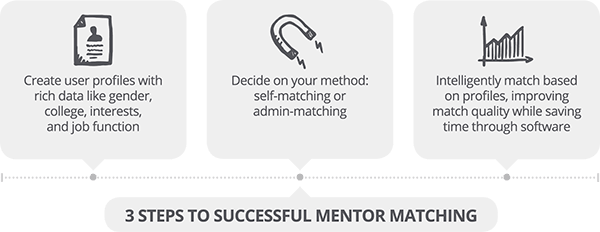
Let's break down the matching methods:
- Admin-led: You or your program manager manually match mentors to startups based on weekly needs. This is high-touch but can be a bottleneck.
- Self-serve ("Office Hours"): You provide a platform where mentors post their availability and founders book sessions. This is scalable but can lack strategic direction.
- Hybrid: A combination of both. You might have a general "office hours" system but also make specific, strategic introductions for high-priority challenges. This is often the best model to start with.
Leveraging AI for Smarter Matching
Your computer science background gives you a unique advantage in understanding and implementing a more sophisticated matching system. Instead of relying solely on manual tagging, you can use AI to create richer compatibility scores.
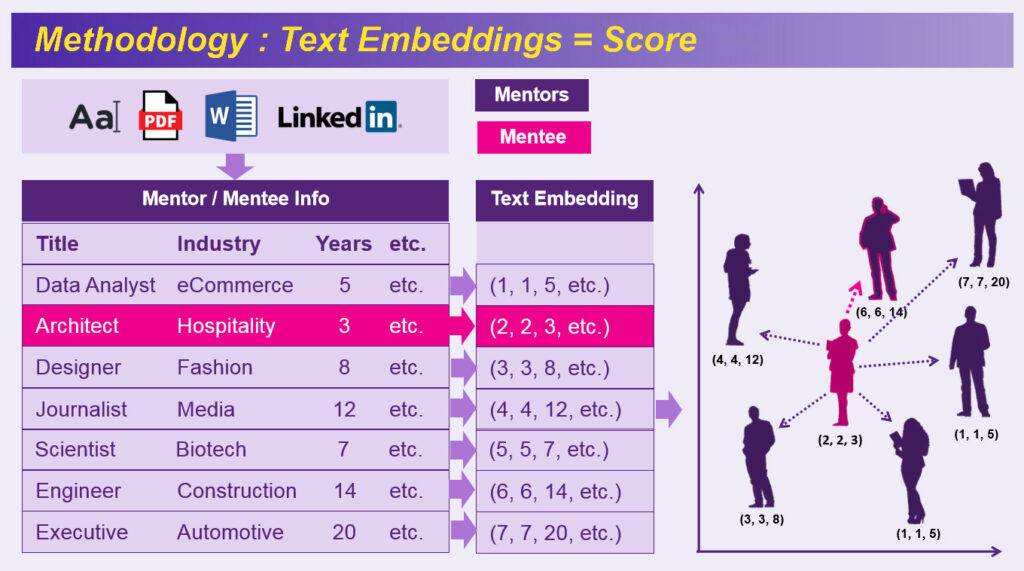
Here's how this works in practice:
- Data Ingestion: The system ingests unstructured text data from mentor LinkedIn profiles, application answers, and expertise summaries. It does the same for startups, using their application, problem statements, and weekly progress reports.
- Vectorization: Using text embedding models (like those from OpenAI or open-source alternatives), this text is converted into numerical vectors. Each vector represents the semantic meaning of the text in a high-dimensional space.
- Similarity Search: When a startup needs help (e.g., "We need to lower our Customer Acquisition Cost for our B2B SaaS product"), their request is also converted into a vector. The system then performs a similarity search to find the mentor vectors that are "closest" in this multi-dimensional space, providing a ranked list of the best potential matches.
Implementing such a system would be a powerful differentiator for your accelerator, promising a higher quality of mentor matching than competitors.
Sustaining Engagement and Retention
The final piece of the system is keeping your high-quality mentors engaged and feeling valued.
Mentoring strategies for startup incubators and accelerators
Let's return to the Acterio article, which offers excellent strategies for mentor retention.
Please read the sections 'Strategies for improving mentoring quality' and 'Engaging incubator and accelerator founders'. Focus on the strategies for sustaining engagement, such as involving mentors in selection, providing regular updates, and soliciting feedback.
Key retention strategies include:
- Involve Them Early: Invite your top mentors to be part of the startup selection committee. This gives them a sense of ownership from day one.
- Close the Feedback Loop: Regularly share updates on the progress of the startups they've mentored. Show them the tangible impact of their advice.
- Solicit Their Feedback: Actively ask for their input on the curriculum, the quality of startups, and the program itself. When they see their suggestions implemented, they feel more invested.
- Build a Community: Host exclusive, mentor-only events or virtual roundtables. This reinforces the value of being part of an exclusive peer group.
- Coach Your Founders: Teach your founders how to effectively manage the mentor relationship: be prepared for meetings, have clear asks, and always follow up with a thank you and a summary of actions taken.
Conclusion
You now have a complete, three-part system for building and managing a high-quality mentor network. This system transforms mentorship from a random series of conversations into a strategic, scalable asset for your accelerator.
Key Takeaways:
- System Over Ad-Hoc: A structured system for Recruiting, Vetting, and Managing is essential to avoid common pitfalls and maximize mentor value.
- Vet for Motivation, Not Just Experience: The best mentors are driven by a desire to give back. Your vetting process must filter out those with a sales-oriented agenda.
- Matching is a Core Competency: The method you use to connect founders with mentors is critical. Leveraging AI for matching can be a powerful differentiator for your program.
- Engagement is a Two-Way Street: To retain top mentors, you must actively show them their impact, solicit their feedback, and build a community they value.
Preview of the Next Lesson
With a curriculum in place and a system for building your mentor network, the next step is to plan the grand finale of your program. In our next lesson, we will address the learning outcome: Plan the format, logistics, and goals for a high-impact demo day. This is the culmination of your startups' hard work and the moment where they showcase their progress to investors, partners, and the wider community.