Hello! Welcome back to our module on making your strategy credible.
In our last lesson, we established the crucial difference between a simple, reversible action (a tactic) and a significant, hard-to-reverse strategic commitment. We saw through the "Burning Bridges" analogy that by deliberately limiting your own options, you can make your intentions credible.
Today, we'll dive deeper into that very idea. It might feel counterintuitive to purposefully restrict your own flexibility. So, our goal for this lesson is to answer a key question for any new entrepreneur facing a major purchase: Why are irreversible investments ('burning bridges') a strategic advantage, not a weakness? We'll explore how what is often seen as a financial liability—a sunk cost—can be transformed into your most powerful strategic weapon.
The Logic of Burning Your Bridge
Let's revisit the "Burning Bridges" story we saw in the last lesson. The key to that scenario wasn't just that Country 1 was brave; it was that by burning the bridge, it fundamentally changed the decision Country 2 had to make.
Game Theory 101 (#22): Tying Hands and Burning Bridges
Let's re-examine a part of the 'Tying Hands and Burning Bridges' video from William Spaniel. This time, I want you to focus not on what Country 1 does, but on how its action completely changes the rational choice for Country 2.
Please watch from 01:53 to 04:00. Notice the difference in Country 2's thought process. In the 'don't burn' scenario, invading is a winning move for them. In the 'burn' scenario, invading becomes a losing move. This shift is the entire point.
By making retreat impossible, Country 1 guaranteed a fight. For Country 2, the choice was no longer between "invade and win" versus "concede." It was now between "invade and fight a costly battle" versus "concede." Faced with those new options, conceding became Country 2's best move.
The strategic advantage came from influencing the other player's decision by making your own threat undeniably credible.
From Sunk Costs to Strategic Weapons
In business, your "bridge" is often a major investment you can't easily undo. The money you sink into a highly specialized machine, a long-term lease, or a massive marketing campaign is an irreversible investment, often called a sunk cost.
Traditional business wisdom says you should ignore sunk costs when making future decisions. For example, if you've spent $100,000 on a machine that doesn't work, you shouldn't spend another $50,000 trying to fix it "because you've already invested so much." From a purely financial standpoint, this is correct.
However, game theory shows us that making a large, irreversible investment before a competitor acts can be a powerful strategic move. The investment serves as a clear, loud signal of your intentions, altering how your competitors will behave.
Applications of game theory in business strategy
This study guide on game theory applications in business neatly summarizes the concept.
Please read the section 'Credible Threats and Commitments.' Note how 'Burning bridges (irreversible decisions)' and 'Sunk costs and irreversible investments' are presented as key methods for establishing credibility and deterring competitors.
The reading confirms the central idea: sunk costs act as credible commitments. They signal your long-term intentions and can deter potential competitors.
Application: Your CNC Machine as a "Burnt Bridge"
This brings us directly to your decision about purchasing CNC machinery. Is it just an expense, or is it a strategic statement?
An investment in a large, specialized piece of equipment for your woodworking business is a classic example of an irreversible commitment. Let's see why this is so powerful.
Capacity Decisions and Commitment | Game Theory ...
This resource, 'Capacity Decisions and Commitment,' perfectly bridges the theory to your real-world situation. It explains how investing in production capacity is a core strategic move.
Please read the sections titled 'Strategic importance of capacity decisions' and 'Role of commitment in capacity.' Focus on how increasing capacity can 'signal commitment and deter potential entrants' and how an 'irreversible investment' can 'serve as a credible threat' that signals a 'willingness to engage in aggressive competition.'
Let's translate this into the competitive landscape for your woodworking business.
Imagine the incumbent, "Traditional Tops Inc.," sees you, a new entrant. They could try to crush you by copying your modern designs and starting a price war. But what if you make a major, public investment in a specialized 5-axis CNC router that excels at complex modern cabinets but is inefficient for their traditional product line?
- You create a sunk cost: This is your "burnt bridge." You can't easily sell that specialized machine for what you paid for it.
- You send a credible signal: You are signaling to "Traditional Tops Inc." that you are 100% committed to the high-end modern niche. You're not just experimenting.
- You make your threat credible: To make your investment pay off, you must secure projects for that machine. This means that if "Traditional Tops Inc." were to enter your niche, you would have every incentive to fight viciously on price to win those projects. You have left yourself no choice but to defend your territory. Your threat to fight is no longer "cheap talk."
- You gain a strategic advantage: "Traditional Tops Inc." sees this. They calculate that entering your niche will now lead to a guaranteed, costly fight. It's more profitable for them to stick to their established business. Your irreversible investment has successfully deterred competition.
The sunk cost isn't a weakness; it's a fence you've built around your market niche, with a clear sign that says, "Trespassers will be fought."
Visualizing the Strategic Advantage
Let's look at a classic entry-deterrence game tree. Imagine an incumbent company (like Sears) and a potential entrant (Company X). This shows how an incumbent can use commitment to keep a new player out.
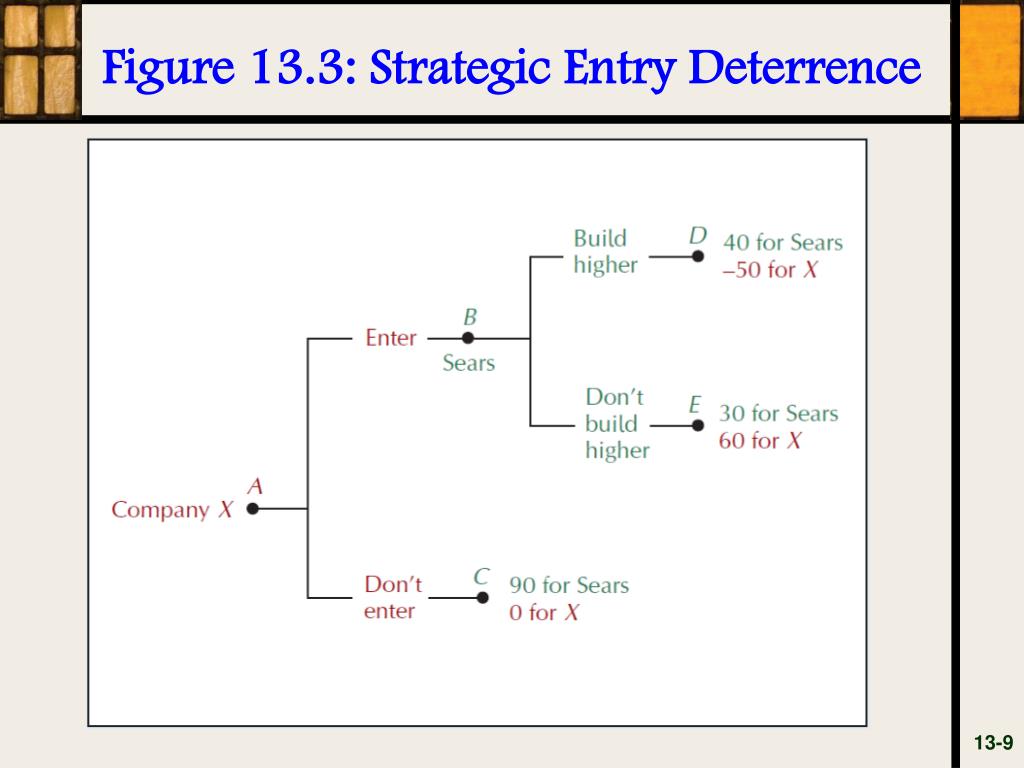
Let's analyze this using backward induction, which we learned in Module 2:
- Start at the end. If Company X enters, Sears has a choice: "Don't build higher" (and accommodate the entrant) for a payoff of 1, or "Build higher" (and fight) for a payoff of 0. Sears will rationally choose to accommodate.
- Company X anticipates this. It knows that if it enters, it will get a payoff of 2 (because Sears will accommodate). This is better than the payoff of 1 from not entering. So, Company X will enter.
- The result: Entry happens, and the incumbent, Sears, gets a low payoff of 1.
Now, how could Sears change this? By "burning a bridge." If Sears made an irreversible commitment to "Build higher" before the game even started (e.g., by signing a non-refundable construction contract), it would change Company X's entire calculation.
Company X would now be choosing between "Don't enter" (payoff of 1) and "Enter and face a fight" (payoff of 0). Suddenly, not entering is the better option. By committing, Sears changes the outcome from (1, 2) to (4, 1), a huge strategic win.
For you as a new entrant, the logic is flipped. Your irreversible investment in a specialized CNC machine is a way of saying to the incumbent: "I am entering this specific niche. I have burnt my bridges and cannot easily retreat. If you choose to follow me into this niche, I will fight you." This makes their potential entry costly and shields your business.
Test your understanding!
You are deciding between two machine investment strategies:
- Strategy A: Buy a smaller, versatile, used 3-axis CNC machine. It's cheaper, can do a bit of everything (both simple traditional and modern designs), and you could likely resell it for close to what you paid.
- Strategy B: Take out a loan to buy a large, highly specialized, new 5-axis CNC machine. It's a massive investment, excels at the complex premium work you want to be known for, and would be very difficult to sell without a significant loss.
From a purely strategic "burning bridges" perspective, which strategy gives you a greater advantage in establishing your premium modern niche, and why?
Show answer
Strategy B provides the greater strategic advantage.
While Strategy A is financially less risky, it sends a weak signal. It shows you're flexible and might pivot if things get tough. A competitor sees this and might decide to test your resolve, knowing you have an easy way out.
Strategy B, however, is a powerful and credible commitment. The high sunk cost and specialization of the machine tell competitors that you are locked into the premium modern niche for the long haul. It makes your implicit threat to defend that niche believable, as you must make the machine profitable. This can deter them from competing with you in that space altogether, giving you the time and room to build your brand.
Conclusion
Today we've seen that what looks like a risky, inflexible move can be the most rational strategy of all. The power of an irreversible investment lies not in the asset itself, but in the message it sends.
Key Takeaways:
- An irreversible investment, or sunk cost, is the business equivalent of "burning your bridges."
- Its strategic advantage comes from its power as a signal. It makes your commitment to a course of action credible to your competitors.
- By making your threats credible (e.g., to fight a price war in your niche), you can influence your competitors' behavior and deter them from challenging you.
- For your woodworking business, investing in specialized machinery is not just an operational decision; it's a strategic move to carve out and protect your market territory.
Preview of the Next Lesson:
We now understand how to make our own commitments credible by taking irreversible actions. In the next lesson, we will turn the tables and learn to assess the credibility of a competitor's threat or promise. This will help you distinguish between a competitor's genuine strategic move that you must respect, and "cheap talk" that you can safely ignore.