Hello! Welcome to the first lesson of our new module, "Making Your Strategy Credible: Commitment."
In our last module, we concluded that your best path for market entry is to differentiate your woodworking business by focusing on a premium, CNC-milled niche. We analyzed this as a sequential game and determined that your traditional competitors are unlikely to fight your entry because it wouldn't be in their best interest—their threat to compete in your modern niche isn't credible.
This raises a crucial question: if their threats can be empty, what about yours? How can you convince competitors, customers, and suppliers that your plans are serious? That brings us to today's learning outcome: to distinguish between a simple action and a strategic commitment. Understanding this difference is the first step toward making your strategy not just a plan, but a reality that others must react to.
"Talk is Cheap": The Problem of Credibility
Imagine you meet the owner of an established local kitchen company and tell them, "I'm launching a new business, and I'm going to become the market leader for high-end modern cabinets."
What is their likely reaction? A polite nod, perhaps, but they probably won't rush back to their office and change their entire business strategy. Why? Because your announcement is just words. In game theory, this is often called "cheap talk." A statement of intent is not binding and costs nothing to make, so it is often ignored.
For a threat or a promise to be effective, it must be credible. Your rival must believe that you have both the incentive and the ability to follow through.
3.3 — Entry Deterrence - Industrial Organization
These presentation slides on 'Entry Deterrence' from a course on Industrial Organization offer a clear explanation of why simple announcements are often not credible in a business context.
Please read through the slides titled 'SPNE and Credibility' and '“Talk is cheap” in game theory'. Pay close attention to the example of the professor's lateness policy. It's a great illustration of a threat that is not 'sequentially rational'—meaning, when the time comes, it's not in the threat-maker's best interest to carry it out.
The key takeaway is that a statement of intent is only credible if, when the time comes to act, it is still in your best interest to do so. This is where the distinction between everyday actions and strategic commitments becomes critical.
Tactical Moves vs. Strategic Moves
In business, you make decisions constantly. However, these decisions fall into two very different categories: tactical and strategic.
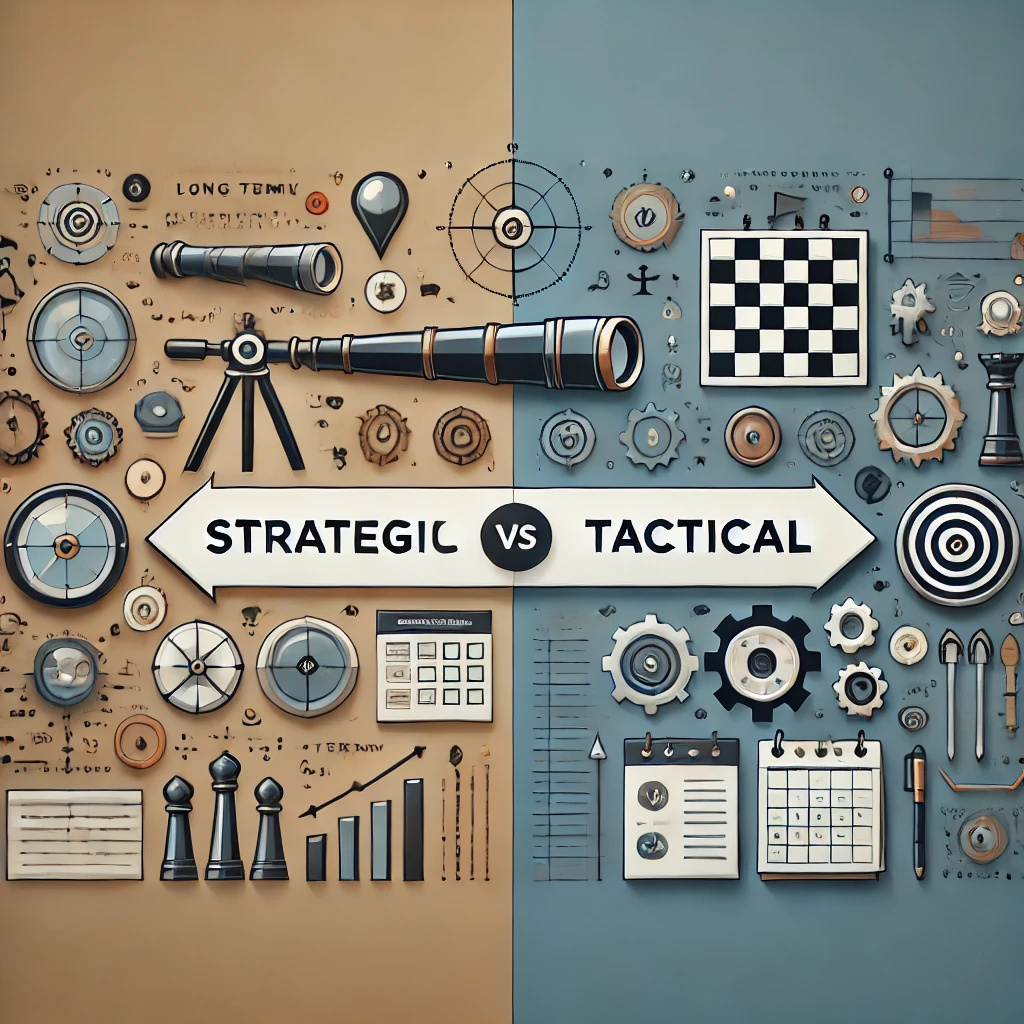
Let's get precise with our definitions.
From Strategy to Business Models and to Tactics Working ...
The Harvard Business School paper 'From Strategy to Business Models and to Tactics' provides excellent definitions to help us separate these concepts.
Please read the following three short sections to grasp the difference: Section III, 'Defining tactics' (starts on page 14): Focus on the idea that tactics are the 'residual choices open to a firm' within its existing model. Note the Metro newspaper example—they can change ad rates (tactic), but not the fact that the paper is free (a strategic choice). Section IV, 'Defining strategy' (starts on page 17): Note the emphasis on 'committed choices' that create a 'unique and valuable position.' Strategy is the high-level choice of a business model. Section V, Discussion (B) 'Strategy vs. Tactics' (starts on page 22): This part clarifies that strategic choices are 'not easily reversible,' while tactical choices are 'relatively easy to change.'
To summarize and apply this to your woodworking business:
-
A Simple Action (Tactic): This is a flexible, easily reversible move you make within your current business setup.
- Examples: Adjusting the price of kitchen doors for a month, deciding which project to prioritize this week, trying out a new wood stain on a single order.
- These moves don't fundamentally change what your business is or what it can do.
-
A Strategic Commitment: This is a significant, costly-to-reverse decision that fundamentally shapes your business and locks you into a path. It changes the game itself.
- Examples: Purchasing a $150,000 CNC machine, signing a 5-year lease on a workshop, building your brand exclusively around modern design and refusing all traditional work.
- These moves are powerful because they signal your long-term intentions in a way that "cheap talk" cannot.
The core difference is reversibility. A simple action is easy to take back. A strategic commitment is not.
The Power of Limiting Your Own Options
It seems counterintuitive, but strategically limiting your own future choices can be a source of immense power. By making an action irreversible, you make your intentions completely credible, forcing others to change their behavior.
The classic analogy for this is "burning the bridges."
Game Theory 101 (#22): Tying Hands and Burning Bridges
This video from William Spaniel's 'Game Theory 101' series brilliantly illustrates the concept of strategic commitment using the 'Burning Bridges' story. It uses a game tree, which you'll recognize from our previous lesson.
Please watch the video from the beginning until 04:26. Pay close attention to the backward induction analysis for both scenarios: not burning the bridge, and burning it.
Let's break down the logic from the video:
-
Scenario 1: Not Burning the Bridge (A Simple Action)
- Country 1 crosses the bridge and says it will fight. This is "cheap talk."
- Using backward induction, we see that if Country 2 invades, it is more rational for Country 1 to retreat (payoff 0) than to fight a costly battle (payoff -1).
- Knowing this, Country 2 sees the threat to fight is not credible and invades, taking the island. Country 1 is forced to retreat.
-
Scenario 2: Burning the Bridge (A Strategic Commitment)
- Country 1 crosses the bridge and burns it. This is a visible, irreversible action.
- Now, the option to retreat is gone.
- If Country 2 invades, Country 1 must fight. The threat is now 100% credible.
- Knowing it will face a costly battle (payoff -1), Country 2's most rational move is to concede the island (payoff 0).
- By making an irreversible commitment, Country 1 changes Country 2's choice and achieves its goal.
This is the essence of a strategic commitment: an action so decisive that it makes your stated intention your only possible move.
Applying Commitment to Your Business
Let's bring this back to your immediate decisions. Think about your plan to enter the premium modern cabinet market.
-
A Simple Action (Tactic): You could start by renting time on another workshop's CNC machine. This is a low-cost, flexible way to test the market. But what does it signal to competitors? Very little. It shows you're exploring, but it doesn't prove you're committed. They can afford to wait and see.
-
A Strategic Commitment: You could take out a business loan and purchase a large, specialized 5-axis CNC router. This is a "bridge-burning" move.
- It is visible: Competitors, suppliers, and potential clients (like architects and designers) will know you've made this investment.
- It is costly to reverse: The machine has a high sunk cost; you can't easily sell it for what you paid.
- It makes your threat credible: By buying this machine, you are committing to the high-end modern niche. A competitor like "Traditional Tops Inc." now sees that you are locked in. You've eliminated your own option to easily switch to making cheap traditional cabinets. They know you will fight hard for this segment because you have to in order to make your investment pay off. Their most rational response is now even more likely to be "accommodate" and focus on their own turf.
Your investment in machinery isn't just a production decision; it's a strategic move that sends a powerful, credible signal to the entire market.
Test your understanding!
For your new woodworking business, consider the following decisions. Classify each one as either a simple action (tactic) or a strategic commitment, and briefly explain why.
- Announcing a 15% discount on all kitchen cabinet orders for the month of February.
- Signing an exclusive 2-year contract with a high-end German hardware supplier (e.g., Blum or Hettich), requiring a minimum purchase volume.
- Posting photos of a completed project on your company's Instagram page.
- Investing in passive house certification for your products, a complex and expensive process that allows you to market your cabinets for energy-efficient homes.
Show answer
- Simple Action (Tactic): This is a short-term price change that is easily reversible. It doesn't fundamentally change your business model or lock you into a future course of action.
- Strategic Commitment: This is a commitment. It's a costly-to-reverse, medium-term decision that locks you into a specific quality tier and supplier. It signals to the market that you are a premium builder and limits your flexibility to use cheaper hardware.
- Simple Action (Tactic): This is a routine marketing action. It's easily done and doesn't commit you to anything in the long run.
- Strategic Commitment: This is a major commitment. The investment in time and money is significant and largely irreversible (a sunk cost). It credibly signals your focus on a specific, high-value market segment (eco-conscious, high-performance building) and limits your ability to compete on low price.
Conclusion
Today, we've drawn a crucial line between the everyday tactical adjustments all businesses make and the powerful strategic commitments that define a company's path.
Key Takeaways:
- Simple actions (tactics) are flexible and reversible moves made within the current "rules of the game." They are useful for optimization but don't change how others see your long-term intent.
- Strategic commitments are visible, irreversible (or very costly-to-reverse) decisions that change the game by limiting your own future options.
- The power of a commitment comes from its credibility. By "burning your bridges," you make your intentions believable and force others to adjust their strategies in your favor.
- For your business, large investments like specialized machinery are not just operational expenses; they are strategic commitments that signal your dedication to a niche and deter competition.
Preview of the Next Lesson:
We've seen that limiting your options can be powerful. In the next lesson, we will build directly on this idea. We'll ask the question: Why can irreversible investments ('burning bridges') be a strategic advantage? We'll explore how sunk costs, which are often seen as a negative, can be turned into a formidable competitive weapon.