
Hello. In the previous lesson, we traced how training adjusts a neural network’s parameters to reduce a loss. For a language model, the training target is usually the token that actually came next in text. This lesson examines what the trained model produces at inference time: not a single answer, but a probability distribution over possible next tokens.
By the end, you should be able to explain why two identical prompts can produce different completions, why a high-probability completion is not necessarily a true one, and what decoding settings such as temperature, top-, and top- do—and importantly, do not do.
A language model predicts a distribution, not a sentence
An LLM does not compose an answer in one indivisible act. Given the tokens already present in the prompt and conversation, it estimates a conditional probability for every token in its vocabulary:
A vocabulary may contain tens or hundreds of thousands of tokens. Tokens are fragments of text, rather than necessarily whole words; the next token could be a word, a suffix, punctuation, whitespace, or a common phrase fragment.
The probabilities have two defining properties:
and
The probability assigned to a token is relative to the model’s other available continuations for this exact context. It is not a statement that the token is factually true, morally desirable, or suitable for the user’s real-world decision.
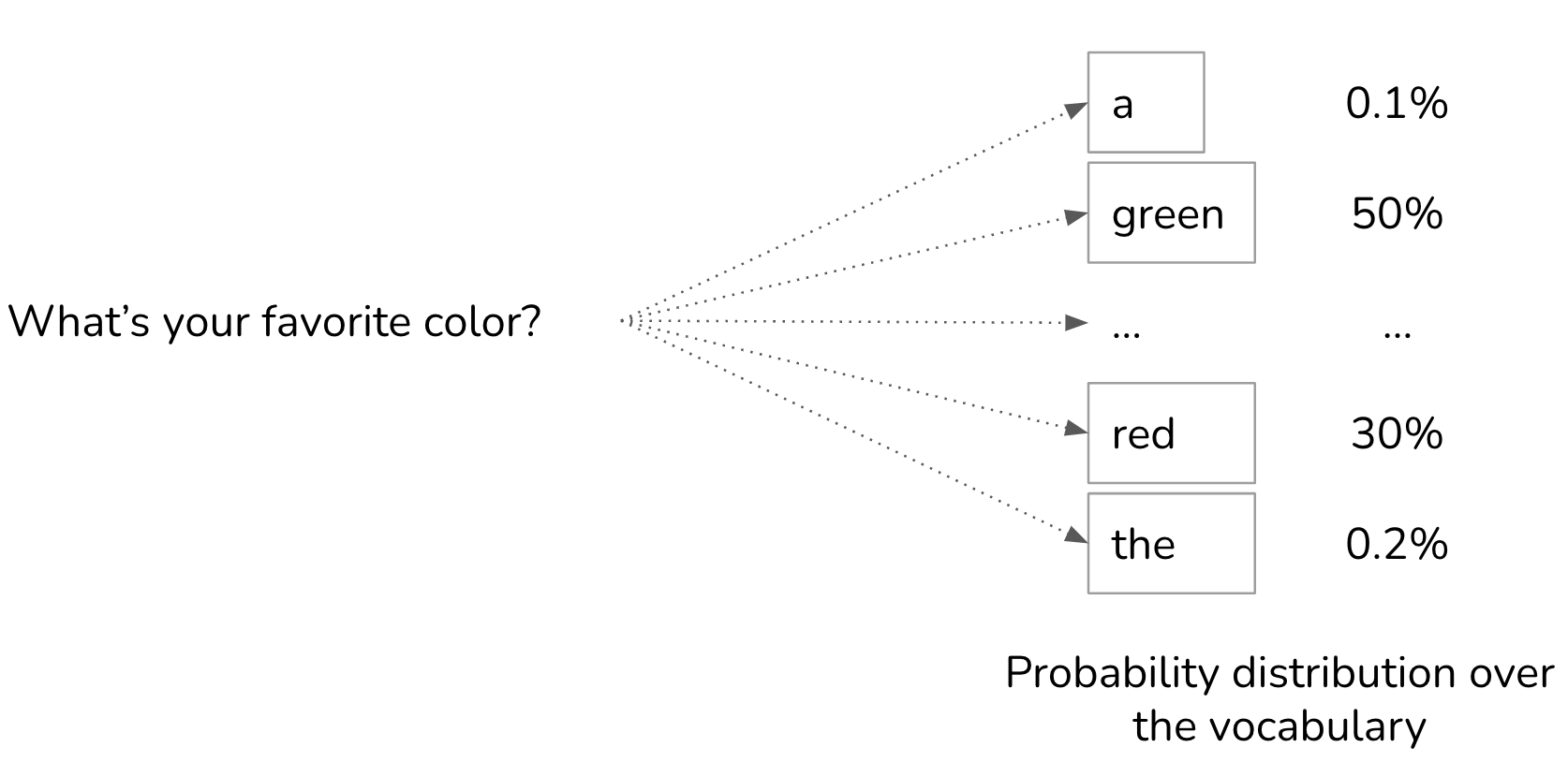
This is closely connected to the previous lesson. During next-token training, the model saw a context and was penalized when it assigned too little probability to the token that appeared next in the training text. Repeated gradient-based updates make the model better at assigning probability mass to continuations that resemble patterns in its data.
The model’s immediate numerical outputs are usually called logits: one unbounded score per vocabulary token. A final transformation called softmax converts those scores into probabilities. You do not need to calculate softmax to use this mental model. The practical point is that a larger logit becomes a larger probability after comparison with all the other candidate tokens.
[1hr Talk] Intro to Large Language Models
Watch “Intro to Large Language Models” by Andrej Karpathy for a compact visual account of LLMs as next-token predictors and of generation as repeated sampling.
Watch next-word prediction, which frames pretraining as learning to predict continuations from a vast corpus. Then continue with generation and hallucination to see why feeding each chosen token back into the context can yield fluent but invented text. Focus on the distinction between predicting a plausible continuation and checking a fact against the world.
Can't find a good explanation? Sign up and we'll make it for you
Sign up