
Hello! In the last lesson, you translated heights-and-distances stories into right triangles and used the right angle as the key structural clue. Circle tangents use the same habit: identify the special right angle first, then decide whether a triangle, Pythagorean theorem, or equal-length fact will reveal the unknown.
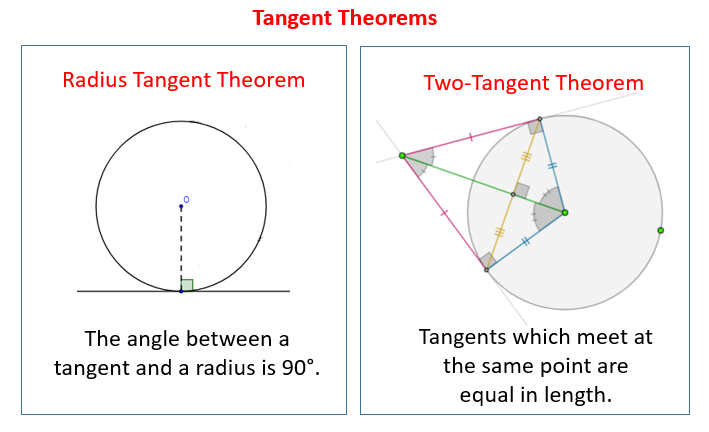
In this lesson, you will use two essential tangent properties to find missing lengths and angles:
- a radius is perpendicular to a tangent at the point where the tangent touches the circle;
- two tangent segments drawn from the same external point are equal in length.
1. Recognising the two tangent facts
A tangent is a straight line that touches a circle at exactly one point. That touching point is called the point of tangency.
Let be the centre of a circle, and let a line touch the circle at . The radius has a special relationship with the tangent:
So the angle between the radius and the tangent is always:
The second fact applies when an external point has two tangents to the same circle. If tangents from point touch the circle at and , then:
Be precise: it is the two segments from the same outside point to the circle that are equal, not every line in the diagram.
Tangent of a Circle - GCSE Maths - Steps, Examples & Worksheet
Read “Tangent of a Circle” from Third Space Learning to see the two properties stated clearly and to understand why equal tangents are equal.
In the subsection “What is the tangent of a circle?”, read the definition and two core facts. Then read the subsection “Proving that if two tangents meet, they are the same length,” following the congruent-triangle proof. Focus on the three matching facts in the two right triangles: equal radii, a shared line from the centre to the outside point, and two right angles.
Mark the diagram before calculating
For a typical question, make the following marks immediately:
- draw a small square at every point where a radius meets a tangent;
- put matching tick marks on radii of the same circle;
- if two tangent segments come from the same external point, put matching tick marks on those segments.
These marks turn a crowded circle diagram into familiar geometry.
A radius is perpendicular to a tangent only when the radius ends at the point of tangency. Do not mark a right angle just because a line happens to meet a circle or looks perpendicular in a sketch.
2. One tangent creates a right triangle
Suppose is tangent to a circle with centre at . Joining to makes triangle .
Because is a radius ending at the point of tangency,
That means triangle is a right triangle. The segment , opposite the right angle, is the hypotenuse.
Finding a tangent length
Assume:
- ,
- ,
- is tangent at .
Since , use Pythagoras in right triangle :
A length is positive, so the tangent segment is .
Notice the important identification: is the hypotenuse, not , because lies opposite the angle.
Example with tangent and radius | Circles | Geometry | Khan Academy
Watch “Example with tangent and radius” from Khan Academy for a compact worked example in which the radius–tangent right angle leads directly to Pythagoras.
Watch the right-angle setup to see why a tangent and radius form a right triangle. Continue with the radius reasoning, noting how another radius helps find the hypotenuse, then watch the calculation for the Pythagorean solution.
Finding an angle in the right triangle
The same right-angle fact helps with angle questions.
If is tangent at , and , then:
The angles in triangle total , so:
The reason for the must be stated in a written solution:
The radius is perpendicular to tangent at .
3. Two tangents from one point have equal length
Now let be outside a circle with centre . Tangents and touch the circle at and .
The equal-tangents property gives:
This lets you solve algebra questions quickly.
Example: solve for a variable
Suppose the diagram labels the two tangent lengths as:
Both tangents begin at , so they are equal:
After finding , check the actual tangent length:
That agrees with .
Why are the tangent lengths equal?
You do not need to reproduce this proof every time, but knowing its structure helps you recognise the property.
Compare right triangles and :
- , because both are radii;
- is shared;
- , because a radius is perpendicular to a tangent at the point of tangency.
The two right triangles are congruent, so their matching tangent sides are equal:
This also explains why the property only works when the tangent segments share the same external endpoint.
Perimeter questions
Suppose and are tangents from , and the chord has length . If , then:
So the perimeter of triangle is:
When a triangle surrounds a circle and each side touches the circle, split each side at its tangency point. Tangent segments drawn from each individual corner are equal.
4. Finding the angle between two tangents
The two properties can also be used together in an angle diagram.
Suppose and are tangents to a circle with centre , and:
Find , the angle between the two tangents.
Consider quadrilateral . Its four interior angles are:
- ;
- ;
- ;
- , the unknown.
The interior angles of a quadrilateral total :
The key is to include the radii and . Without them, the two hidden right angles are easy to miss.
Tangents of circles problems : Khan Academy
“Khan Man Math: Tangents of circles problems” shows both common school uses of the properties: matching tangent lengths and using the radius–tangent right angle for a length calculation.
Watch equal tangent segments for a perimeter-style diagram; focus on matching tangent pieces from each outside vertex. Then watch the right triangle to review how a tangent and radius create a Pythagorean-theorem problem.
5. A reliable exam method
When you see a tangent problem, work through this short routine.
-
Locate the point of tangency.
A tangent touches the circle once; a secant passes through the circle and meets it twice. -
Draw the radius to that point.
If the centre is given, join it to the tangency point. -
Mark the right angle.
A radius and tangent meet at . -
Look for a second tangent from the same external point.
If one exists, mark the two tangent segments equal. -
Choose the appropriate shape.
- Use a right triangle and Pythagoras for lengths.
- Use triangle angle sum for an angle within one radius–tangent triangle.
- Use a quadrilateral angle sum for the angle between two tangents.
- Use equal tangent lengths to form an algebra equation or a perimeter.
Common mistakes to avoid
| Mistake | Correct idea |
|---|---|
| Treating every line that meets a circle as a tangent | A tangent touches the circle at exactly one point. |
| Marking a right angle between any radius and any line | The radius must end at the point where the line is tangent. |
| Equating two tangents from different external points | Equal tangent segments must start from the same external point. |
| Choosing the tangent as the hypotenuse | In the radius–tangent triangle, the segment from centre to external point is the hypotenuse. |
| Assuming two equal tangents mean every side is equal | Only the specific tangent segments from the shared external point are equal. |
Key takeaways
A tangent problem becomes manageable once you mark its guaranteed information.
- A tangent touches a circle at one point.
- The radius to that point is perpendicular to the tangent:
- Two tangent segments from the same external point are equal:
- The perpendicularity property often creates a right triangle for Pythagoras or angle sums.
- The equal-tangents property is especially useful for algebra and perimeter questions.
- In full solutions, state the reason: “a radius is perpendicular to a tangent at the point of tangency” or “tangents from the same external point are equal.”
Next, you will move from tangent geometry to measuring parts of a circle: arc lengths and the areas of sectors and segments.
Can't find a good explanation? Sign up and we'll make it for you
Sign up