
Hello again. In the previous lesson, tangent questions became manageable once you marked the guaranteed facts: a radius meets a tangent at , and tangent segments from the same external point are equal. This lesson keeps the same diagram-first approach, but now the focus is on parts inside or along the edge of a circle.
You will calculate:
- the length of an arc;
- the area of a sector;
- the area of a segment, using the sector minus the triangle inside it.
The central idea is simple: an angle at the centre tells you what fraction of the full circle you are dealing with.
1. Identify the part of the circle before choosing a formula
A full circle has:
So a central angle of describes one quarter of a circle, while describes one half.
Three names matter:
- An arc is a curved part of the circle’s circumference.
- A sector is the wedge-shaped region bounded by two radii and an arc.
- A segment is the region bounded by an arc and a chord. A chord is a straight line joining two points on the circle.
Sectors Arcs and Segments of a circle - Math Steps & More!
Read the “Sectors, Arcs and Segments of a Circle” guide from Third Space Learning to secure the vocabulary and see how each measurement comes from a fraction of a whole circle.
Read the subsections “Arc of circle” and “Sectors of circles.” Begin with the definition of an arc, then follow the worked arc-length example. Next read from the definition of a sector through its perimeter and area example. Focus on the repeated idea that the central angle is compared with 360^\circ.
A useful first step in every question is to shade or trace the requested region. This prevents a frequent mistake: calculating the area of a sector when the question actually asks for the area of the smaller curved segment.
2. The “fraction of a circle” principle
Let the central angle be . The sector is:
of the entire circle.
The area of a full circle is:
and its circumference is:
Therefore, multiply the relevant whole-circle formula by .
| Quantity required | Formula | Units |
|---|---|---|
| Arc length | length units, such as | |
| Area of a sector | square units, such as |
Notice the difference:
- arc length is part of the circumference, so it uses ;
- sector area is part of the circle’s area, so it uses .
GCSE Maths - Area of a Sector and Length of an Arc of a Circle (Circles Part 3) (2026/27 exams)
Watch “GCSE Maths - Area of a Sector and Length of an Arc of a Circle” by Cognito. It explains why the formulas work, rather than treating them as rules to memorise.
Watch the definitions to distinguish the arc from the sector. Then watch the quarter-circle idea, where a 90^\circ sector is connected to one quarter of the full area and circumference. Continue with any angle for the general fraction \frac{\theta}{360}, and finish with the worked example. Pause before the final numerical answers and check that you can select the correct formula yourself.
Worked example: an arc and sector from the same diagram
A circle has radius , and a sector has central angle .
First find the fraction of the circle:
Arc length
Area of the sector
The same fraction, , is used both times. What changes is the full-circle quantity being shared out: circumference for an arc, area for a sector.
Sector perimeter
Occasionally the question asks for the perimeter of a sector. Its boundary contains two radii and one arc:
For the , example:
Do not confuse sector perimeter with sector area: perimeter has units of , while area has units of .
3. Minor and major arcs or sectors
A minor arc or sector is the smaller one, with angle less than . A major arc or sector is the larger one, with angle greater than .
If a diagram gives a small central angle but asks for the major arc or sector, calculate the missing central angle first:
For example, if the minor angle is , then the major angle is:
Suppose the radius is , and you need the major arc length.
A quick reasonableness check helps. The entire circumference is:
A major arc should be most of that circumference, so is sensible. An answer near would describe the minor arc instead.
4. Area of a segment: sector minus triangle
A segment is not a wedge. It is the curved “cap” between a chord and an arc.
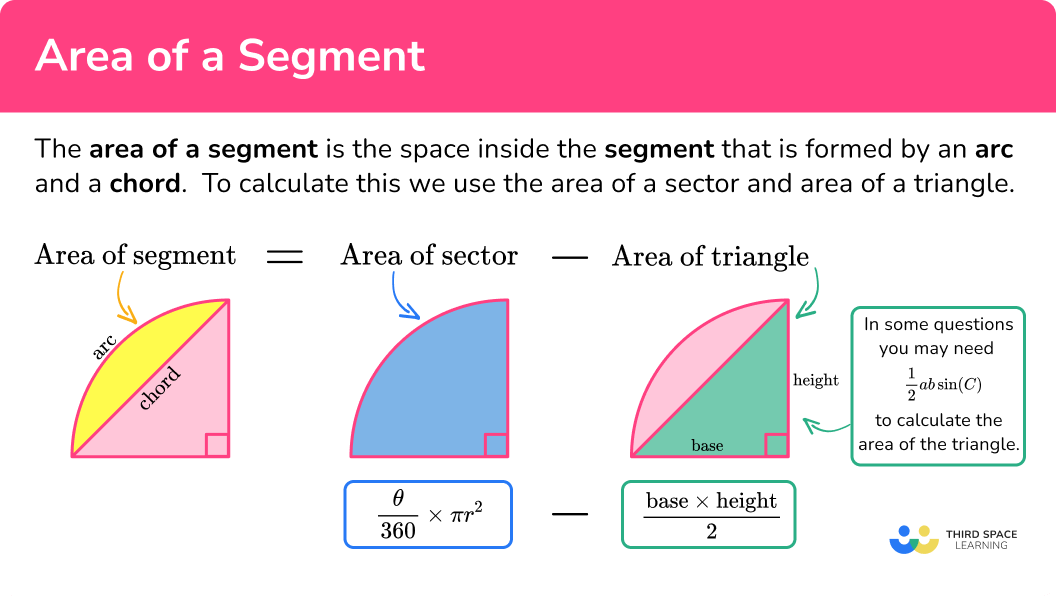
The segment sits inside a sector, but the triangle formed by the two radii is not part of the segment. Therefore:
Find Area of a Segment in a Circle (3 Methods)
Watch “Find Area of a Segment in a Circle (3 Methods)” by Mario’s Math Tutoring for a visual walkthrough of the subtraction method.
Watch the first example. Focus on the shape decomposition: calculate the sector first, calculate the triangle second, and subtract only at the end. The 90^\circ example is especially useful because the two radii form the base and height of a right triangle.
Worked example: a segment
A circle has radius . A chord joins the endpoints of two radii with a central angle of . Find the area of the minor segment.
First, calculate the sector area:
Now calculate the triangle area. Since the central angle is , the two radii form perpendicular sides of length :
Finally subtract:
Keep in the calculation until the final line unless the question tells you otherwise. Rounding early can make the final answer less accurate.
5. Finding the triangle area in a segment question
The triangle inside a segment may not always be right-angled. Look at the information supplied and select an appropriate triangle-area method.
When base and perpendicular height are given
Use:
For example, suppose a segment has:
- radius ,
- central angle ,
- chord length ,
- perpendicular distance from the centre to the chord .
The sector area is:
The triangle’s base is the chord, and the perpendicular height is :
So the segment area is:
When two radii and the included angle are given
If the radius is and the central angle is , the triangle has two sides of length , with included angle . Its area can be found using:
Make sure your calculator is in degree mode when using an angle measured in degrees.
For a circle of radius with central angle :
The triangle area is:
Therefore the segment area is:
The subtraction makes geometric sense: a sector is fairly narrow, and the triangle occupies most of that wedge, leaving a relatively small curved cap.
6. Major segments and a dependable solving routine
A chord divides a circle into a minor segment and a major segment. If you have found the minor segment and need the major segment, use the whole circle:
This is usually easier and safer than trying to work directly with the larger shape.
For every arc, sector, or segment question, use this routine:
-
Mark the central angle that belongs to the requested region.
If the question asks for a major region but shows a minor angle, use . -
Decide whether the answer is a length or an area.
Arc length uses circumference; sector and segment questions use areas. -
For a segment, split the work into two areas.
Find the sector area and triangle area separately before subtracting. -
Check units.
Arc lengths and perimeters use ordinary units. Areas use squared units. -
Check the size of the answer.
A minor arc must be shorter than half the circumference, and a minor segment must be smaller than its sector.
Common errors to avoid
| Error | Better habit |
|---|---|
| Using for arc length | Arc length is part of the circumference, so start with . |
| Forgetting that a given angle is minor when the major region is requested | Find the major angle using . |
| Calling a sector a segment | A sector has two radii; a segment has a chord. |
| Stopping after finding sector area in a segment question | Subtract the triangle area. |
| Giving for area | Use , , or the relevant squared unit. |
| Rounding every intermediate result | Keep exact values or calculator digits until the final answer. |
Key takeaways
Every calculation in this lesson starts from the same fraction:
Use it with the circumference for an arc:
Use it with the circle’s area for a sector:
For a segment, first identify the sector containing it, then subtract the triangle:
Finally, always check whether the question asks for a minor or major region and make your units match what you calculated.
You have now completed the circle-measurement work in this revision module. Next, the course returns to algebra: constructing a quadratic polynomial when its zeroes or other conditions are given.
Can't find a good explanation? Sign up and we'll make it for you
Sign up