
Introduction
Hello and welcome back. In our last lesson, we concluded our journey with the Muisca by exploring the famous El Dorado ceremony. We saw how their worldview was deeply rooted in the Cundiboyacense highlands, with sacred lakes serving as portals for cosmic renewal.
Today, we travel from the highlands to the Caribbean coast to begin a new module. We're heading to the Sierra Nevada de Santa Marta, a dramatic and unique landscape that is home to the Tairona civilization and their living descendants, the Kogi. Your learning outcome for this lesson is to describe the environment of the Sierra Nevada de Santa Marta and its role in Tairona and Kogi culture.
Think of this lesson as setting the stage for the myths we'll explore later. For a storyteller and designer like yourself, understanding the environment isn't just background detail; it's understanding the main character. The Sierra Nevada isn't just a place—it's the very foundation of a unique cosmology, a living entity that shapes every aspect of its people's culture and beliefs.
The "Heart of the World": A Unique Environment
The Sierra Nevada de Santa Marta is geographically exceptional. It's not part of the Andes range; it's an isolated, pyramid-shaped mountain that rises abruptly from the Caribbean Sea to snow-capped peaks nearly 19,000 feet high, making it the world's tallest coastal mountain.

This unique geography creates an astonishing variety of ecosystems. In a relatively small area, you can find tropical beaches, deserts, rainforests, and glacial tundra. To grasp this complexity, let's start with a rich description from National Geographic.
Indigenous protectors of these sacred peaks have kept ...
This article beautifully describes why the Sierra Nevada is considered a 'microcosm of the planet,' detailing its incredible geographical and biological diversity.
Please read the three paragraphs that begin with 'Seen from space, the Sierra Nevada de Santa Marta...' This section paints a vivid picture of the mountain's scale, structure, and incredible range of ecosystems.
Now, let's see and hear this environment described from the indigenous perspective. This clip from a landmark documentary immediately frames the Sierra not just as a mountain, but as a sacred entity.
From the Heart of the World The Elder Brother's Warning
This opening from the film 'From the Heart of the World' provides a stunning visual introduction and introduces the core concept of the Sierra as the 'Heart of the World' and its people as the 'elder brothers.'
Watch the first 1 minute and 40 seconds. Notice how the narration immediately links the physical environment to a spiritual responsibility.
As you can see, from the very start, the land and the culture are inseparable. The physical reality of a mountain containing every climate zone becomes the basis for a belief system where the mountain is a model of the entire world.
The Tairona: Masters of the Mountain
The ancestors of today's indigenous groups, the Tairona, built a large and sophisticated civilization in this challenging environment. They didn't conquer the mountain; they designed their society to be an integrated part of it. Their cities, farms, and road networks were masterful feats of engineering and environmental adaptation.
Let's return to the documentary to see how they achieved this.
From the Heart of the World The Elder Brother's Warning
This longer clip explores the ruins of the Tairona's 'Lost City' (Ciudad Perdida) and explains the principles behind their success. It shows how their society was built in harmony with the mountain's complex systems.
Please watch from 3:03 to 14:42. This section is rich with information, so focus on these key ideas: Architecture: How the city's stone terraces and paths were designed to manage heavy rainfall and prevent erosion. Systemic Thinking: The concept that the Tairona treated the 'whole Sierra as a single system.' Vertical Economy: How they used the different 'climate levels' for a complex system of agriculture and trade (e.g., fish and salt from the coast, maize and cotton from higher up).
The Tairona's success was rooted in their deep understanding of the Sierra. They built terraced cities that clung to the slopes, engineered drainage systems that have survived for centuries, and created a complex economy that leveraged the mountain's verticality. The entire mountain was a single, interconnected, and productive system.
Test your understanding!
Drawing on your background in systems thinking and product design, how would you describe the Tairona's approach to "designing" their society within the Sierra Nevada? What was their core design principle?
Show answer
The Tairona's approach is a masterful example of systems design. Their core principle was integration, not imposition. Instead of trying to force a pre-conceived model of a city or farm onto the landscape, they observed the existing system (the mountain's climate zones, water flows, and topography) and designed their society to function as a seamless part of it. The vertical economy was like a well-designed supply chain, and their cities were built with sustainable 'features' to handle environmental stresses like heavy rain. They designed their civilization with the mountain, not on it.
The Kogi: Guardians of a Living World
When the Spanish arrived, the Tairona retreated high into the mountains to preserve their culture. Their descendants—the Kogi, Arhuaco, and Wiwa—survive today and continue to practice this ancient worldview. They see themselves as the "Elder Brothers," responsible for maintaining the cosmic balance that is centered in their home, the "Heart of the World."
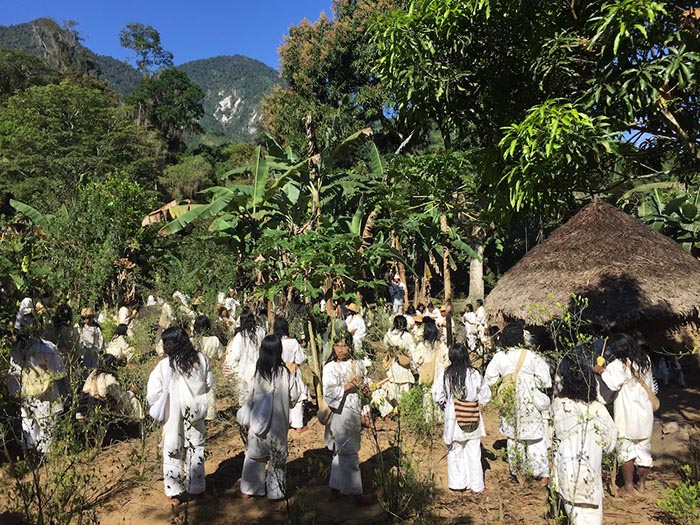
For the Kogi, the Sierra is not just a metaphor; it is a literal living body. This cosmological view dictates their every action and defines their role as guardians. Let's explore this concept in more detail.
The Kogi: An Urgent Call from Guardians of the Heart of the World
This article from Cultural Survival provides a clear explanation of the Kogi worldview, explaining how every part of the mountain is sacred and connected to their identity and knowledge.
Please read two sections from this article. First, read the section titled 'Defending Sacred Sites,' which explains the 'black line' and how natural features are seen as parts of a living being. Then, read the italicized section at the end, which is a powerful direct quote from a Kogi Governor on the link between territory and identity.
As the text makes clear, this connection is absolute. The mountains have a consciousness; the rivers are veins; the rocks are books of knowledge. To lose any part of this territory is to lose a part of their memory, identity, and ability to maintain balance. This is why they consider themselves guardians: their spiritual work, performed at sacred sites across the Sierra, is what they believe keeps not only the mountain, but the entire planet, in equilibrium. The environment is the source of their mythology, the temple for their rituals, and the library of their knowledge.
Conclusion
In this lesson, we have established the fundamental connection between the environment of the Sierra Nevada de Santa Marta and the cultures of the Tairona and Kogi. We've seen a landscape that is as unique and complex as the belief systems it has inspired.
Key Takeaways:
- A World in a Mountain: The Sierra Nevada is the world's highest coastal mountain, containing a "microcosm of the planet" with ecosystems ranging from tropical coasts to glacial peaks.
- Designed for Integration: The Tairona civilization thrived by designing their society with the environment, creating vertically integrated economies and cities with sustainable engineering that respected the landscape.
- The Heart of the World: The Kogi and other descendant groups view the Sierra as a living entity—the "Heart of the World." They are its "Elder Brothers," tasked with maintaining cosmic balance through spiritual work.
- Land as Identity: For these cultures, the environment is inseparable from their knowledge, memory, and spiritual purpose. The mountains, rivers, and rocks are sacred texts and living relatives.
Preview of the Next Lesson:
Now that we have explored the stage, we are ready to meet the actors in the cosmic drama. In our next lesson, we will delve into the Kogi's core cosmological principle by exploring their concept of the Sierra Nevada as the 'Heart of the World' in more detail, setting the stage for their creation myths.
Can't find a good explanation? Sign up and we'll make it for you
Sign up