
Introduction
Hello and welcome back. In our last lesson, we explored the Kogi's understanding of the Sierra Nevada de Santa Marta as the Corazón del Mundo, the Heart of the World. We saw how they view it as a living body and a microcosm of the entire planet, with its health maintained through an invisible network of energy called the Línea Negra.
Today, we move from the what to the how. If the Sierra is the physical system, what is the underlying consciousness or operating system that runs it? Your learning outcome is to describe the Kogi cosmological principle of 'Aluna' (the spiritual world) and the importance of maintaining balance.
We will delve into one of the most profound concepts in indigenous American thought. For you as a designer and storyteller, understanding 'Aluna' is like understanding the core principles that guide a design system. It's the invisible logic, the 'why' behind the 'what', that gives form and meaning to the material world. This concept is the key to unlocking the entire Kogi mythological structure.
1. Aluna: The World as an Idea
The Kogi believe that before the world existed, there was only darkness. In that darkness was the Great Mother. She was not a physical being, but a consciousness, a spirit, a pure thought. This primordial state of being, this realm of pure thought, is called Aluna.
In Aluna, the Mother began to think, and in her thoughts, she conceived everything that would ever exist—the mountains, the rivers, the animals, and us. Everything was first created as an idea, a spiritual potential, before it was manifested in the physical world.
To hear the Kogi describe this themselves, let's watch the opening of the film that shares its name with this concept.
Aluna - An Ecological Warning by the Kogi People
The opening sequence of 'Aluna - An Ecological Warning by the Kogi People' provides a poetic and direct explanation of Aluna as the world of thought that precedes reality.
Watch the first 3 minutes and 27 seconds of the video. Listen closely to how they describe the process of creation: 'The Mother conceived the world in the darkness... She conceived us as ideas... as if we were thinking of a house before we begin to make it real.'
This concept has a powerful parallel in your own work. Before a product, a user interface, or a story exists, it begins in the non-material realm of thought—as a strategy, a wireframe, a script. Aluna is, in a sense, the ultimate conceptual phase. The physical world is the finished product, but its fundamental design, its "original law," exists in the spiritual blueprint of Aluna.
The academic text below provides a more structured definition. It describes Aluna as the "web of relations" and the "thought" in which the Great Mother "wove life together."
nourishment and exchange among the Kogi
The academic paper 'Nourishment and Exchange among the Kogi' gives a precise definition of Aluna and its role in the 'fabric of life.'
Read the section titled 'A web of relations' (starts on page 5). Focus on the description of Aluna as the 'thought' of the Great Mother and how everything is part of a cosmic weave.
2. The Principle of Balance: Duality and Harmony
Because the material world is a manifestation of the spiritual world of Aluna, the two are inextricably linked. The Kogi worldview is therefore built on a principle of balance. The health of the physical world depends on maintaining harmony with the spiritual world.
This balance is often expressed through duality.
Kogis Colombia: Complete Article + pictures & Videos (2026)
The 'Kogis Colombia' article explains this concept of duality clearly.
Find the subheading 'Cosmo-vision' and read the short paragraphs on duality and the nine worlds. Notice the emphasis on opposites that cannot survive without each other.
As you just read, the universe is structured in complementary pairs: sun/moon, man/woman, hot/cold, light/darkness. One is not 'good' and the other 'bad'; they are necessary counterparts that create a balanced whole, which the Kogi call Yuluka (harmony).
This extends to the cosmic forces. The Kogi speak of the dynamic, creative energy of the material world as masculine (Father Sarankua) and the thoughtful, ordering essence of the spiritual world as feminine (Mother Aluna). An imbalance—especially an excess of masculine interference (extraction, destruction) with the feminine principle (the Earth, the original thought)—has immediate physical consequences.
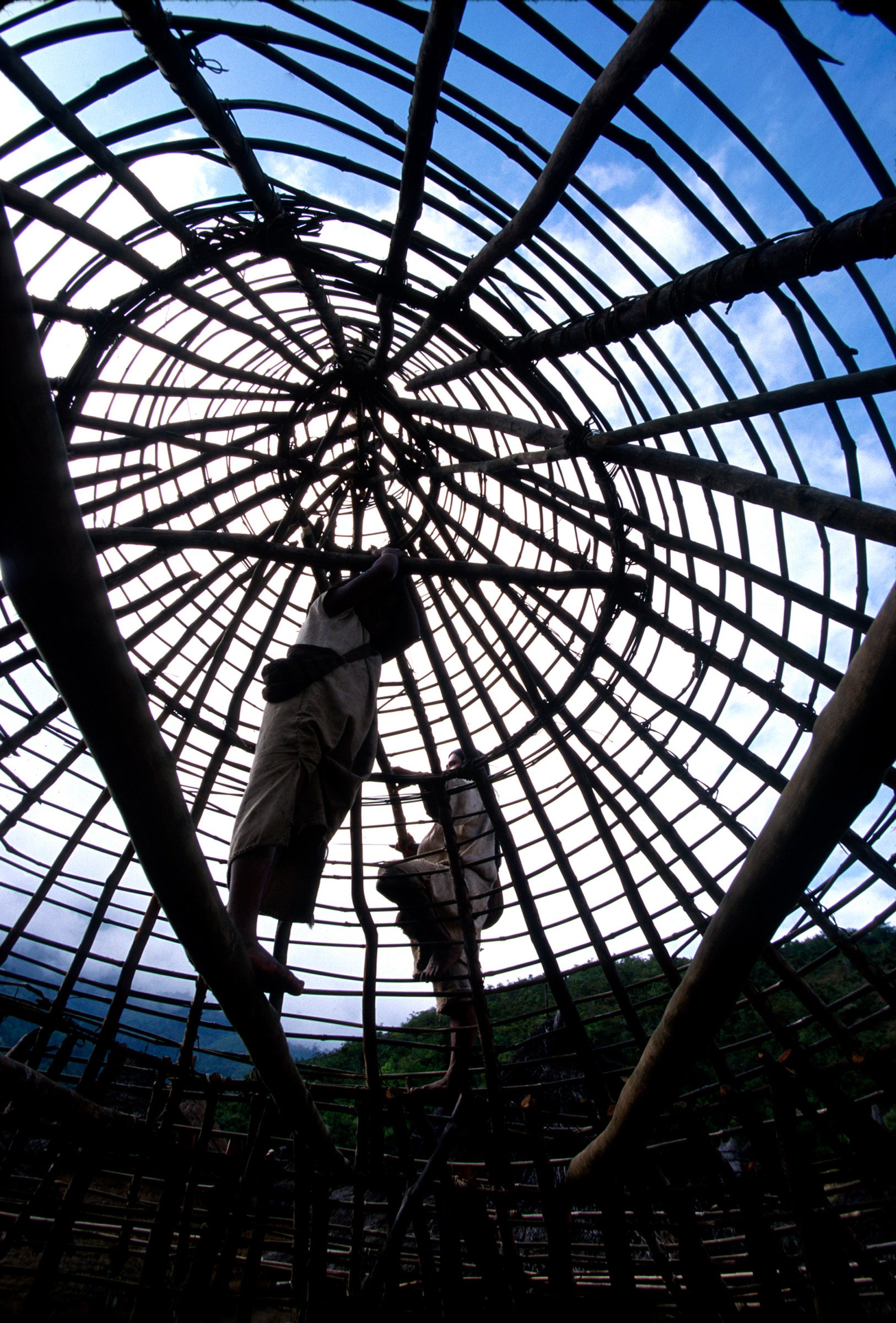
The Kogi's ceremonial houses, or nuhue, are physical models of this balanced cosmos.
3. Maintaining Balance: The Work of the Mamos
If the world is a complex system designed in Aluna, who are the system administrators? This is the role of the Mamos, the Kogi spiritual leaders.
Through a long, arduous training—often spending up to 18 years in darkness to heighten their perception of the spiritual world—Mamos learn to "see" into Aluna. They are not priests who simply follow dogma; they are spiritual scientists who observe, diagnose, and act to maintain the planet's equilibrium.
To see how they mediate between the two worlds, let's watch a short, crucial clip.
Living Mountain Kogi talk with Q&A
This segment from a talk by Alan Ereira, the filmmaker who worked with the Kogi, provides a very direct and clear explanation of Aluna and the Mamo's role.
Watch the clip from 14:08 to 14:39. This is perhaps the most concise definition you will find of the relationship between Aluna, reality, and the work of the Mamo.
The Mamo's job is to ensure the community's actions are aligned with the "Law of Origin." They do this through ritual practices of exchange, known as pagamentos (payments). When a tree is cut, a field is planted, or a child is born, something must be given back to the spiritual world to maintain the balance.
One of the most important practices is called aluna ishguashi, or "spiritual confession." This is a fascinating and tangible example of maintaining balance.
nourishment and exchange among the Kogi
The paper 'Nourishment and Exchange among the Kogi' gives a detailed account of this practice, showing how thoughts and intentions are treated as a form of spiritual currency.
Please read the section titled 'Aluna ishguashi' (starts on page 10). Pay close attention to how personal essences (thoughts, emotions) are discharged into cotton and offered as 'spiritual food' to nourish sacred sites and balance natural forces. The diagram is particularly helpful.
This is not just a metaphor. For the Kogi, thoughts and intentions are real energies that impact the world. By confessing them, they are purifying themselves and feeding the spiritual world, ensuring the reciprocal flow of life continues.
Test your understanding!
A mining company wants to extract gold from a site the Kogi consider sacred. From the Kogi perspective, based on the principle of Aluna, what is the real cost of this action, beyond the visible environmental damage? How would a Mamo explain the need for balance?
Show answer
A Mamo would explain that the action's cost is not just environmental, but cosmological.
- Violation of the Original Thought: The gold was placed in that location as part of the Great Mother's original design in Aluna. It serves a specific spiritual function, like an organ in the body of the Earth.
- Spiritual Plunder: As they state in the Aluna film, gold is spiritually connected to Aluna; it does not decay. Taking it is not just extracting a mineral; it is plundering a vital spiritual component of the world.
- Breaking the Reciprocity: The extraction is a one-way action. It takes without giving back, without pagamento. This breaks the cycle of nourishment and reciprocity that maintains harmony.
- Causing Imbalance: This spiritual disruption will manifest physically. The Mamos directly link the plundering of gold to the drying up of lagoons and rivers. By damaging the spiritual anchor, the physical system it supports collapses. The balance is broken, and the "fever" of the Earth (climate change, drought) gets worse.
Conclusion
Today, we have explored the foundational principle of the Kogi worldview. 'Aluna' is not just a myth; it is a complex and coherent philosophy of reality.
Key Takeaways:
- Aluna is the spiritual dimension of reality, a realm of pure thought where the Great Mother conceived the material world. It is the blueprint of existence.
- The physical world is a manifestation of the ideas in Aluna. Therefore, the health of the world depends on maintaining balance between the material and spiritual realms.
- This balance is maintained through reciprocity and duality. All actions in the physical world require a 'payment' (pagamento) to the spiritual world to maintain harmony.
- Mamos are the spiritual scientists trained to perceive Aluna. They guide their community and perform rituals, such as aluna ishguashi (confession), to diagnose and correct imbalances.
- Actions that ignore this spiritual dimension, like resource extraction, are seen as disrupting the fundamental order of the cosmos, leading to physical consequences like climate change.
Preview of the Next Lesson:
Now that we have a firm grasp on the concepts of the Sierra as the 'Heart of the World' and 'Aluna' as its consciousness, we are ready to see how these principles are woven into narrative. In the next lesson, we will recount the Kogi creation myth of Serankua and the Great Mother, which provides the dramatic story of how these cosmic laws were put into motion.
Can't find a good explanation? Sign up and we'll make it for you
Sign up