Hello! Welcome back to Module 9.
In our last lesson, you designed the strategic blueprint for your affiliate program. You learned how to calculate sustainable commission rates based on your product margins and how to set a competitive cookie duration. This laid the essential groundwork for what's next.
Today, we'll move from strategy to execution. This lesson focuses on the technology that powers an affiliate program, addressing the learning outcome: Select and set up an affiliate management platform (e.g., ShareASale, Impact). We'll explore the different types of platforms available and walk through the practical steps of choosing and configuring one, so you can transform your affiliate program from an idea into a functional, automated system.
1. What is an Affiliate Management Platform?
An affiliate management platform is the engine of your affiliate program. It's the software that handles all the critical operational tasks, allowing you to scale your partnerships without getting buried in manual work.
At its core, a platform provides:
- Tracking: It accurately tracks clicks, sales, and leads generated by each affiliate using unique links and tracking pixels.
- Reporting: It offers a dashboard for both you (the merchant) and your affiliates to monitor performance, commissions earned, and other key metrics.
- Commission Management: It automatically calculates and processes payments to your affiliates.
- Affiliate Portal: It gives your partners a dedicated space to get their tracking links, access promotional materials (like banners or coupon codes), and view their earnings.
- Recruitment (in some cases): Many platforms, especially networks, have a marketplace where you can discover and recruit new affiliates.
2. Types of Affiliate Platforms & Choosing the Right One
There are three main categories of platforms. Your choice will depend heavily on your budget, technical comfort, and business model—specifically, where you're selling your products (e.g., your own Shopify store, Amazon, Walmart).
A. Integrated E-commerce Apps (e.g., UpPromote for Shopify)
These are apps that plug directly into your e-commerce platform, like Shopify. They are often the simplest and most cost-effective way to get started if you are driving traffic to your own website.
B. Affiliate Networks (e.g., ShareASale, CJ Affiliate)
These are large, established marketplaces that connect merchants with tens of thousands of potential affiliates.
- Pros: Immediate access to a massive pool of affiliates, established trust and payment systems.
- Cons: Higher setup and transaction fees, less direct relationship with affiliates, more competition from other merchants on the platform.
C. Partnership Automation / SaaS Platforms (e.g., Impact.com)
These are modern, powerful platforms that allow you to manage a wide range of partnerships beyond traditional affiliates, including influencers, brand-to-brand collaborations, and more.
- Pros: Advanced tracking capabilities, powerful automation, direct control over your partnerships, and excellent integrations with major marketplaces.
- Cons: Can be more complex and expensive than other options.
Key Selection Criteria for Your Business
- Integration with Your Sales Channels: This is the most important factor for you. Can the platform track sales on Amazon, Walmart, and TikTok Shop, in addition to a potential Shopify store? Not all platforms can do this effectively.
- Cost Structure: You need to understand the full cost, which typically includes:
- A one-time setup fee.
- A monthly platform fee.
- A transaction fee (usually a percentage of the commission you pay out).
- Target Affiliate Type: Are you looking for bloggers and coupon sites (traditional networks like ShareASale are strong here) or social media influencers (platforms like Impact are often better)?
3. A Closer Look at ShareASale and Impact
Let's dive into the two platforms mentioned in the learning outcome, as they represent two excellent but different approaches.
ShareASale: The Go-To Affiliate Network
ShareASale is one of the most popular affiliate networks, especially for small-to-medium-sized e-commerce businesses. It's known for being relatively affordable and having a vast network of content creators, reviewers, and coupon sites.
To get a practical understanding of the costs and setup process, this resource is invaluable.
How to Start an Affiliate Program on ShareASale - Bobz Notes
The article 'How to Start an Affiliate Program on ShareASale' from Bobz Notes provides a clear, merchant-focused breakdown of what to expect when joining the network.
Please read sections 2 ('Which affiliate network to choose?') and 4 ('Start Affiliate Program on ShareASale Q&As'). Focus on: The fee comparison table in section 2. The answers to questions about setup fees, commission charges, agreement terms, and the integration timeline in section 4.
From this reading, you'll see the key financial details:
- One-time Access Fee: $550
- Minimum Deposit: $100 (to pre-fund your account for commissions)
- Transaction Fee: 20% of the commission you pay. (Example: If you pay a $10 commission, ShareASale takes an additional $2).
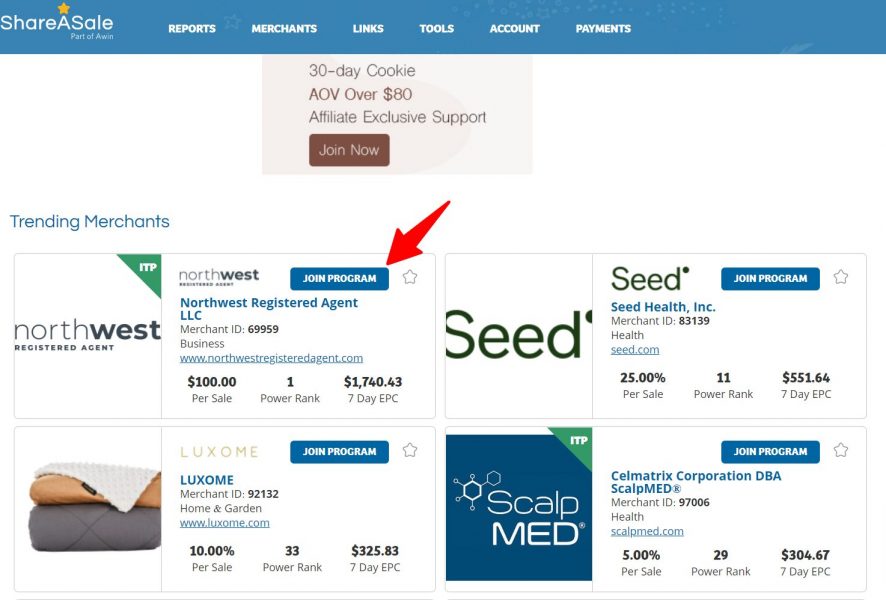
To see what your program would look like to a potential partner, take a look at the "Trending Merchants" list on ShareASale.
Impact.com: The Modern Partnership Platform
Impact is a more comprehensive platform designed for managing all types of partnerships. Its major advantage for your goals is its robust tracking and integration capabilities, especially with major e-commerce marketplaces.
For your goal of selling on Amazon and Walmart, Impact's direct Amazon Seller integration is a significant feature. It allows you to track affiliate-driven sales on Amazon, which is a challenge for many other platforms.
Impact.com's help documentation provides a structured guide for new brands. It also has specific information on their Amazon integration, which is highly relevant for you.
Explore these three sections in the Impact.com help center: 'I'm new to impact.com': Briefly look over the titles of the steps (Finance, Contracting, Discovery) to understand the onboarding flow. 'Technical Integration Guides': Notice the variety of platforms they integrate with, including Shopify and BigCommerce. 'Amazon Seller Program': Review the article titles in this section. This confirms that they have a dedicated system for tracking and managing affiliate sales on Amazon.
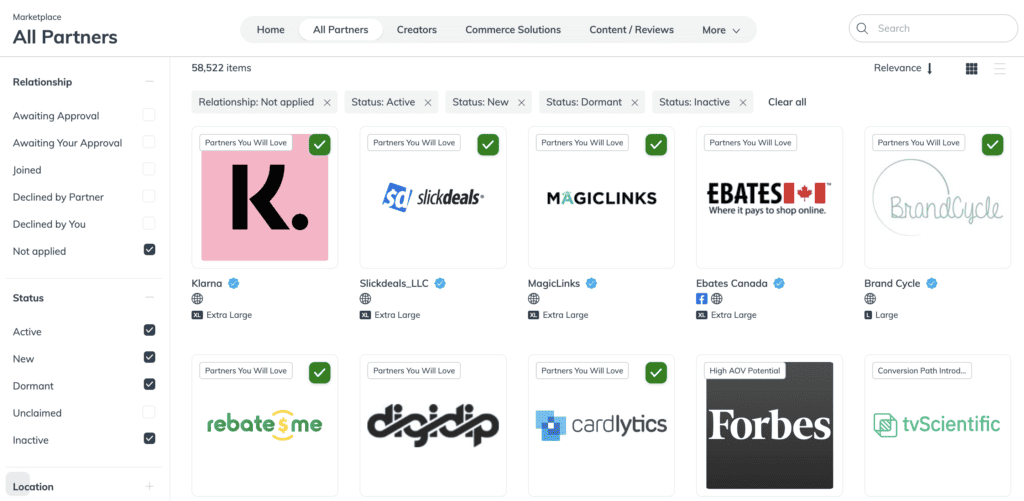
Impact allows you to discover partners in its marketplace, which includes high-value content publishers, influencers, and major media outlets.
Test your understanding!
You have two primary goals for the next year:
- Drive traffic to your new product launch on Amazon FBA.
- Build a brand presence for your own Shopify store using content bloggers and product reviewers.
Based on the descriptions above, which platform would be a better fit for each goal, and why?
Show answer
- Amazon FBA Goal: Impact.com would be the stronger choice here. Its dedicated "Amazon Seller Program" integration is specifically designed to solve the difficult problem of tracking external affiliate traffic to an Amazon listing.
- Shopify Store Goal: Both platforms could work, but ShareASale might be a more cost-effective and straightforward choice for this goal. It has a large network of traditional content bloggers and reviewers, and its setup process is well-documented for e-commerce merchants. An integrated Shopify app like UpPromote would be an even simpler, lower-cost alternative if you only wanted to focus on your Shopify store.
4. A Practical Guide to Setting Up Your Program
While every platform's interface is different, the setup process follows a consistent, logical flow. Let's use UpPromote, a Shopify app, as a concrete, visual example of this process. It's a great illustration of how you input your program's strategy into the platform's settings.
How To Start An Affiliate Program For Your Shopify Store (2026 Tutorial)
This video, 'How To Start An Affiliate Program For Your Shopify Store' by How To Shopify, provides a step-by-step walkthrough of setting up the UpPromote app. It's a perfect visual guide to the general setup process.
Watch the following segments to see the core setup steps in action: Installation (01:02 - 02:32): Shows how to find and install the app from the Shopify App Store. Program Configuration (03:03 - 05:14): This is where you'll input the commission structure you designed in the last lesson (e.g., percentage of sale, flat rate). Customization (05:34 - 09:37): Watch how you can customize the affiliate registration form with your own branding, like logos and colors.
Drawing from that video and the documentation for ShareASale and Impact, here is the universal 5-step setup process:
- Apply and Create Your Merchant Account: You'll provide your business information, website, and agree to the network's terms.
- Configure Program Terms: This is where you enter the strategic decisions from our last lesson:
- Commission Structure: (e.g., 12% of sale value)
- Cookie Duration: (e.g., 30 days)
- Program Description: A compelling pitch to attract affiliates, outlining what you sell and why they should partner with you.
- Install the Tracking Technology: This is the most technical step.
- For Shopify/BigCommerce: This is usually as simple as installing the platform's official app, which automatically adds the tracking code (pixel) to your store.
- For Custom Websites: You'll be given a snippet of code to place on your order confirmation or "thank you" page. This pixel fires after a successful purchase, sending the sale data back to the affiliate platform. The resources from Bobz Notes (LINK) link to detailed guides on this for ShareASale.
- Upload Creatives: Provide your affiliates with marketing assets. At a minimum, this includes your logo. You can also add banner ads, product photos, and pre-written text links.
- Fund Your Account & Go Live: You'll make your initial deposit to cover affiliate commissions and network fees. Once your tracking is tested and everything is approved, you can launch your program and make it visible in the affiliate marketplace.
Conclusion
You now have a practical framework for choosing the right affiliate platform and a clear, step-by-step process for setting it up. You've moved from the "what" and "why" of affiliate marketing to the "how."
Key Takeaways:
- An affiliate platform automates tracking, reporting, and payments, making your program scalable.
- Your choice of platform—be it an integrated app, a network like ShareASale, or a SaaS platform like Impact—should be driven by your sales channels (especially Amazon/Walmart), budget, and target partners.
- Impact.com offers powerful integrations for marketplace selling, while ShareASale is a strong, cost-effective network for driving traffic to your own site.
- The setup process universally involves application, configuring your program terms, installing tracking, and funding your account.
Next Up:
Your platform is set up, and your program is live. Now what? You need to find the right people to join. In the next lesson, we will focus on recruitment, covering how to develop criteria for identifying ideal affiliate partners and begin the outreach process.