
Hello again. In the previous lesson, Rutherford’s alpha-scattering evidence established the modern basic picture of the atom: a tiny, dense, positively charged nucleus surrounded by a much larger region of space containing electrons.
Now we zoom in on the three particles that make up that picture. By the end of this lesson, you should be able to distinguish a proton, neutron, and electron using the three details exam questions most often test: location, relative charge, and relative mass.
The atom: a small nucleus and a large electron region
An atom has two main regions:
- The nucleus is at the centre. It contains protons and neutrons.
- Electrons are found in shells around the nucleus.
The drawings used at this level show electrons moving on circular shells. This is a useful model for learning atomic structure and later electron configurations. Remember, however, that the diagram is not drawn to scale: the nucleus is extremely small compared with the space occupied by the electrons.
Watch this short section from “Atoms & Ions | Protons, Neutrons, Electrons” by Cognito for a visual overview of the atom before learning the values precisely.
Atoms & Ions | Protons, Neutrons, Electrons
Cognito’s “Atoms & Ions | Protons, Neutrons, Electrons” gives a concise visual explanation of where the three particles are found, then introduces their charges and relative masses.
Watch the atom layout to identify the nucleus and electron shells. Then watch particle properties, focusing on the paired facts: protons and neutrons have equal relative mass, but their charges differ; electrons have a negative charge and extremely small mass.
A useful way to organise the information is to treat the nucleus as the atom’s mass centre. Nearly all atomic mass is concentrated there because protons and neutrons are both relatively massive. Electrons make up most of the atom’s volume, but contribute almost none of its mass.
The three particles: one comparison you must know exactly
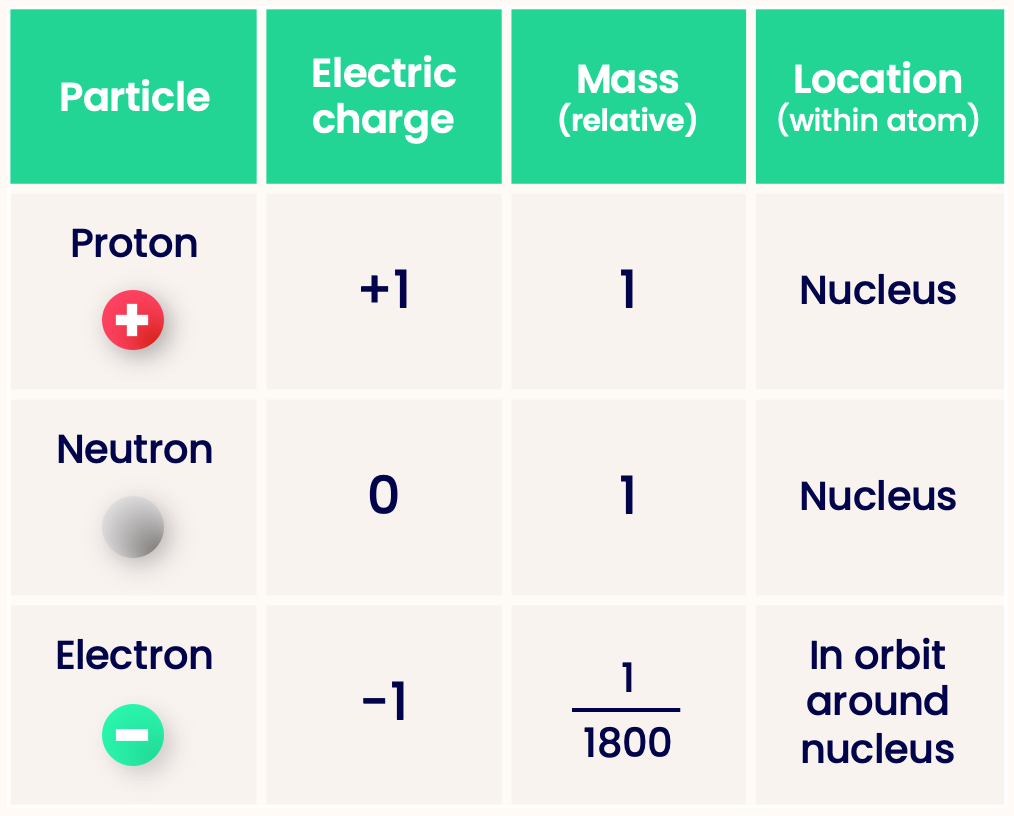
For your exam, learn this table accurately.
| Particle | Location | Relative charge | Relative mass |
|---|---|---|---|
| Proton | Nucleus | ||
| Neutron | Nucleus | ||
| Electron | Shells around the nucleus |
The BBC Bitesize table is a strong reference to use for your exact exam values.
What is atomic structure? - BBC Bitesize
Read BBC Bitesize’s “What is atomic structure?” to reinforce the layout of an atom and memorise the comparison table in the section “What are protons, neutrons and electrons?”
Begin in “The structure of atoms,” reading the atom layout to identify what belongs in the nucleus and what lies outside it. Then continue to “What are protons, neutrons and electrons?” and study the table beginning the particle comparison. Copy the three rows once from memory afterward, including the +1, 0, and -1 signs.
Let’s make each row meaningful rather than treating it as a list to memorise.
Proton: positive and heavy
A proton is found in the nucleus. Its relative charge is , and its relative mass is .
The word association proton, positive can help, but write the complete charge in an exam: , not merely “positive” or “+”.
Because protons are in the nucleus and have relative mass , they contribute both to the atom’s central positive charge and to almost all of its mass.
Neutron: neutral and heavy
A neutron is also found in the nucleus. Its relative charge is , meaning it is neutral: it has no electric charge. Its relative mass is , the same as a proton.
The most reliable memory link is neutron, neutral. Be careful: neutral does not mean the particle is absent or has no mass. A neutron has no charge, but it is still a substantial particle in the nucleus.
Electron: negative and very light
An electron is found in shells around the nucleus. Its relative charge is , equal in size but opposite in sign to a proton’s . Its relative mass is approximately .
That fraction means an electron has only about one eighteen-hundredth of the mass of a proton or neutron. Some questions or textbooks describe electron mass as “negligible” because it is so small. But if your exam asks for a relative mass, use the value your course expects, commonly .
Reading the table as patterns
Rather than memorising three disconnected rows, notice these patterns:
| Comparison | Correct conclusion |
|---|---|
| Proton vs neutron | Both are in the nucleus and both have relative mass . They differ in charge. |
| Proton vs electron | Their charges are equal in magnitude but opposite: and . They differ greatly in mass and location. |
| Neutron vs electron | Neither is positively charged, but a neutron has charge and mass ; an electron has charge and tiny mass. |
| Nucleus vs shells | The nucleus contains almost all the mass; electron shells occupy most of the atom’s space. |
This explains an important point from Rutherford’s experiment. Rutherford concluded that most mass lies in a tiny nucleus because both protons and neutrons are in that nucleus, whereas electrons are extremely light.
It also explains why atoms can be neutral overall. If an atom has equal numbers of positive protons and negative electrons, their charges cancel. Neutrons do not affect total charge because each has charge .
Do not confuse neutral atom with neutron:
- A neutron is one particle with no charge.
- A neutral atom has no overall charge because its positive protons and negative electrons balance.
What an exam question is really asking
Questions sometimes phrase this outcome in different ways. Translate the wording back to the same three facts.
| If the question asks… | Include… |
|---|---|
| “State the charge of an electron.” | |
| “Which particles are found in the nucleus?” | Protons and neutrons |
| “Compare a proton and neutron.” | Same location and relative mass; proton is , neutron is |
| “Why does the nucleus contain most of the atom’s mass?” | It contains protons and neutrons, each with relative mass ; electrons have negligible mass |
| “Which particle has a negative charge?” | Electron |
| “Which particle is neutral?” | Neutron |
For a compare question, always give both a similarity and a difference when possible. For example:
Protons and neutrons are both found in the nucleus and both have relative mass . However, a proton has a charge of , whereas a neutron has a charge of .
That is much stronger than writing only, “A proton is positive and a neutron is neutral.”
Common mistakes to eliminate now
-
Putting electrons in the nucleus
Electrons are in shells around the nucleus. Protons and neutrons are in the nucleus. -
Giving a neutron a negative charge
The name starts similarly to “negative,” but neutron means neutral. Its charge is . -
Saying electrons have no mass
Their mass is very small, not zero: approximately relative to a proton or neutron. -
Mixing up mass and charge
Protons and neutrons have the same relative mass, but different charges. Protons and electrons have opposite charges, but very different masses. -
Writing only or
Use and . The sign and number are both part of the relative charge.
A quick revision method is to draw a small nucleus, place a and inside it, and an on a shell. Then label the particles aloud: “proton: nucleus, , mass ; neutron: nucleus, , mass ; electron: shell, , mass .” Repeat until you can do it without looking.
Key takeaways
Every atom contains three key subatomic particles:
- Proton: in the nucleus; charge ; relative mass .
- Neutron: in the nucleus; charge ; relative mass .
- Electron: in shells around the nucleus; charge ; relative mass approximately .
The nucleus is tiny but contains nearly all the atom’s mass because it contains protons and neutrons. Electrons are extremely light and occupy the region around the nucleus. Equal numbers of protons and electrons make an atom neutral overall.
Next, you will use these particle facts to distinguish atomic number from mass number in atomic notation.
Can't find a good explanation? Sign up and we'll make it for you
Sign up