
Hello again. You already know that protons and neutrons are in the nucleus, while electrons occupy shells around it. This lesson gives you the labels used to describe that nucleus precisely: the atomic number and mass number.
These terms look similar, but they answer different questions. In exam questions, success depends on knowing exactly what each number counts and reading its position correctly in atomic notation. By the end, you should be able to look at a symbol such as and state what each number means without mixing them up.
Two numbers, two jobs
The atomic number tells you the number of protons in an atom’s nucleus.
This is the number that identifies the element. Every sodium atom has 11 protons, so sodium’s atomic number is 11. If an atom had 12 protons instead, it would be magnesium, not sodium.
The mass number tells you the total number of protons and neutrons in the nucleus.
Electrons are not included in the mass number. From the last lesson, recall that electrons have a tiny relative mass compared with protons and neutrons, so almost all the atom’s mass is concentrated in its nucleus.
Read the central definitions in BBC Bitesize’s Atomic Structure and Writing Formulae. The explanation connects the atomic number to element identity, then distinguishes it from the mass number.
Atomic Structure and Writing Formulae - BBC Bitesize
Read the BBC Bitesize explanation to secure the two definitions before applying them to notation.
In the subsection “Atomic number and mass number,” begin with the defining-number explanation. Focus on the difference between “protons only” and “protons plus neutrons.” Then continue into “Calculating the number of protons, neutrons and electrons in an atom” and use the sodium example to see where the two numbers are written. Stop once you understand the example; detailed particle calculations are the focus of the next lesson.
A compact comparison is worth memorising:
| Name | What it counts | Where those particles are |
|---|---|---|
| Atomic number | Protons only | Nucleus |
| Mass number | Protons and neutrons together | Nucleus |
A useful language check:
- Atomic number: “Which element is it?” Count protons.
- Mass number: “How many heavy nuclear particles are there altogether?” Count protons and neutrons.
Reading nuclear notation
The standard way of writing these numbers is called nuclear notation:
Here, is the chemical symbol, is the mass number, and is the atomic number.
The placement is fixed:
- The top-left number is the mass number.
- The bottom-left number is the atomic number.
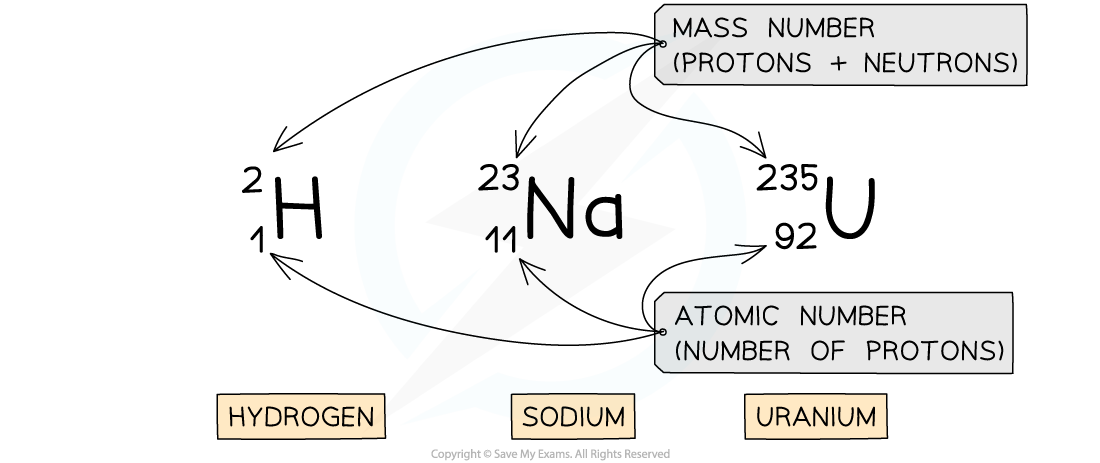
For sodium,
- is the atomic number, so sodium has 11 protons.
- is the mass number, so its nucleus contains 23 protons and neutrons in total.
The crucial distinction is that 23 does not mean 23 neutrons. It includes the 11 protons as well as the neutrons.
This short video section reinforces both the definitions and the positions in the symbol.
Nuclide Symbols: Atomic Number, Mass Number, Ions, and Isotopes
Watch “Nuclide Symbols: Atomic Number, Mass Number, Ions, and Isotopes” from Professor Dave Explains for a concise visual explanation of why the two numbers count different particles.
Watch the definitions to connect atomic number with protons and mass number with protons plus neutrons. Then watch the notation, paying particular attention to the lower-left atomic number and upper-left mass number.
Do not rely only on the idea that “the bigger number is the mass number.” It usually is larger, but position and definition are the reliable rules:
- Upper left means mass number.
- Lower left means atomic number.
For example:
The mass number is 2 and the atomic number is 1. Hydrogen is still hydrogen because it has one proton.
Why the atomic number matters more for identity
An element is defined by its proton number, not its mass number.
Consider these two symbols:
Both are chlorine because both have atomic number 17, meaning 17 protons. Their mass numbers differ because the total number of protons and neutrons differs.
For now, retain this rule:
Same atomic number means the same element.
In the next lesson, you will use the difference between mass number and atomic number to calculate the numbers of protons, neutrons, and electrons. Later, this same idea will help you understand isotopes.
Exam traps and precise answers
These questions often appear as one-mark multiple-choice items, but the same confusion can also weaken a longer answer. Eliminate these common errors now.
1. Including electrons in the mass number
Incorrect:
The mass number is protons, neutrons, and electrons.
Correct:
The mass number is the total number of protons and neutrons in the nucleus.
Electrons are outside the nucleus and have negligible mass compared with protons and neutrons.
2. Saying the atomic number is all particles in the nucleus
Incorrect:
Atomic number is the number of particles in the nucleus.
Correct:
Atomic number is the number of protons in the nucleus.
“Particles in the nucleus” describes the mass number, because it includes neutrons too.
3. Confusing mass number with relative atomic mass
A periodic table may show a decimal value, such as chlorine’s relative atomic mass of about . That is not a mass number.
A mass number:
- is a count of protons and neutrons;
- is always a whole number;
- refers to one particular atom.
For this topic, when you see a whole number at the upper left of a nuclear symbol, call it the mass number.
4. Forgetting the condition for electron number
For a neutral atom, the number of electrons equals the number of protons, so it also equals the atomic number. This works because the positive charges of protons balance the negative charges of electrons.
However, atomic number itself always means protons. It does not literally mean “electrons”; electrons only match it when the atom is neutral.
An exam-ready decoding routine
When presented with an unfamiliar nuclear symbol, use the same calm routine every time:
- Read the chemical symbol to identify the element.
- Read the lower-left number as the atomic number: number of protons.
- Read the upper-left number as the mass number: protons plus neutrons.
- Check your wording: atomic number means protons only; mass number means protons plus neutrons.
For a definition question, write full scientific phrases rather than just “protons” or “protons and neutrons.”
| Question | Full-mark response |
|---|---|
| Define atomic number. | The number of protons in the nucleus of an atom. |
| Define mass number. | The total number of protons and neutrons in the nucleus of an atom. |
| What does the lower-left number show? | The atomic number, which is the number of protons. |
| What does the upper-left number show? | The mass number, which is the total number of protons and neutrons. |
For a fast revision routine, cover the labels on a notation diagram and say aloud: “top left: mass number, protons plus neutrons; bottom left: atomic number, protons.” Then uncover the labels and correct yourself immediately. Two or three short repetitions are more useful than rereading the definitions passively.
Key takeaways
The atomic number is the number of protons in the nucleus. It identifies the element and appears at the bottom left of a nuclear symbol.
The mass number is the total number of protons and neutrons in the nucleus. It appears at the top left of a nuclear symbol. Electrons are not included.
In , 23 is the mass number and 11 is the atomic number. Sodium is sodium because it has 11 protons.
Next, you will turn this notation into particle counts: finding the number of protons, neutrons, and electrons in a neutral atom.
Can't find a good explanation? Sign up and we'll make it for you
Sign up