
Hello again. In the previous lesson, you used the past continuous for an action in progress and the past simple for a completed event that happened during it: “I was working when my manager called.”
Now we will compare two forms that both talk about the past but give the listener a different viewpoint: “I have done” and “I did.” This distinction is especially useful in online conversations, job interviews, and everyday small talk. By the end of the lesson, you will be able to discuss general experiences—such as places you have visited or skills you have developed—and then give clear details about a finished past event.
Two ways to look at the past
The past simple looks back at a completed time in the past.
I joined an online English course last year.
We had a meeting yesterday.
She applied for the job in May.
The present perfect connects a past action or experience to now. We often do not say exactly when it happened because the important point is the experience or its present relevance.
I have joined several online courses.
We have had a meeting.
She has applied for the job.
A useful question is:
Am I talking about a finished past moment, or about my experience up to now?
- A finished past moment calls for the past simple.
- An experience up to now calls for the present perfect.
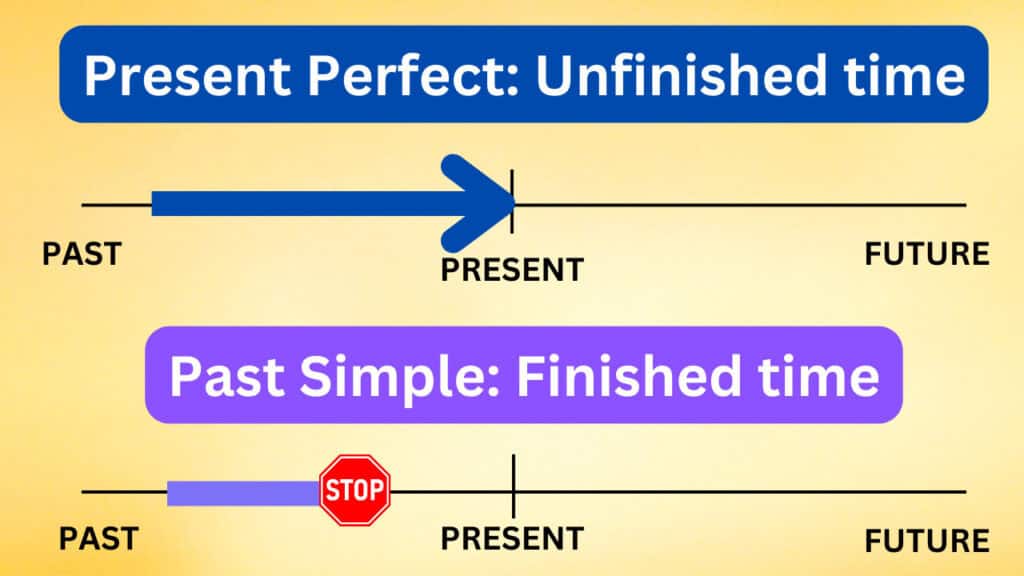
The timeline is helpful, but do not think only about dates. Think about the speaker’s purpose. Compare:
“I have visited London.”
The important information is that London is part of my life experience.
“I visited London in 2022.”
The important information is the completed trip at a specific time.
Both sentences may describe the same trip. The tense changes because the focus changes.
Forming the two tenses accurately
The present perfect uses have/has + past participle.
| Subject | Form | Example |
|---|---|---|
| I / you / we / they | have + past participle | We have finished the report. |
| he / she / it | has + past participle | She has finished the report. |
For regular verbs, the past participle often ends in -ed:
- work: worked
- visit: visited
- finish: finished
Some common irregular past participles are different:
| Base verb | Past simple | Past participle |
|---|---|---|
| go | went | gone |
| see | saw | seen |
| do | did | done |
| write | wrote | written |
| eat | ate | eaten |
Notice this important difference:
I went to a conference last year.
I have gone to a conference.
In everyday English, we more often say “I have been to a conference” when we mean that we attended one as an experience. The central grammar point is that went is past simple, while gone/been are past participles.
For negatives and questions:
I haven’t tried that platform.
She hasn’t replied yet.
Have you ever worked remotely?
Has he ever given a presentation online?
The past simple usually uses the past form in positive statements:
I sent the email yesterday.
She went home early.
But use did / didn’t + base verb in questions and negatives:
Did you send the email yesterday?
I didn’t send the email yesterday.
A frequent error is using the past form after did:
- Incorrect: Did you sent the email?
- Correct: Did you send the email?
Life experiences: present perfect
Use the present perfect to ask or talk about experiences in a person’s life without saying when they happened.
I have worked with international clients.
She has learned English online.
They have travelled abroad.
We have used this software before.
Questions about life experience often use ever:
Have you ever attended an online workshop?
Have you ever had a difficult video call?
Have you ever spoken English with someone from another country?
Use never for an experience that has not happened in your life up to now:
I have never used that app.
He has never travelled by plane.
We have never met in person.
Here is a natural conversation pattern:
A: Have you ever had an online job interview?
B: Yes, I have.
A: When did you have it?
B: I had one last September.
The first question is about the person’s experience up to now, so it uses the present perfect. The follow-up question asks for a completed time, so it uses the past simple.
'I've done' or 'I did'? Ask BBC Learning English
Watch “I've done” or “I did”? from BBC Learning English. It gives a short, clear explanation of the connection between past events and the present, including the key contrast between general experience and a finished event.
Watch present results to see why “I’ve lost my phone” and “I lost my phone last week” give different messages. Then watch time periods for finished versus unfinished time, and life experiences for the exact contrast between a general experience and a particular past occasion. Focus on what information the speaker chooses not to give: the exact time.
Finished events: past simple
Use the past simple when the event belongs to a finished time. This time may be clearly stated:
- yesterday
- last week / last month / last year
- in 2023
- two days ago
- when I was at school
I started my new job last month.
We spoke on the phone yesterday.
I watched a useful English video two days ago.
She moved to this city in 2021.
It is not correct to combine the present perfect with a completed time expression:
-
Incorrect: I have started my new job last month.
-
Correct: I started my new job last month.
-
Incorrect: Have you ever visited Paris last year?
-
Correct: Did you visit Paris last year?
The word when is a strong signal that you need the past simple, because it asks for a particular past time.
When did you start learning English?
I started three years ago.
Compare the two questions:
| Question | What the speaker wants to know |
|---|---|
| Have you ever used English at work? | Your general experience up to now |
| Did you use English at work last week? | A specific, completed situation |
The same contrast works in professional situations:
Have you completed the training?
The speaker wants to know your current status—whether it is complete now.
Did you complete the training on Friday?
The speaker is asking about a particular finished deadline.
Sometimes both forms are possible without a time expression, but the meaning changes slightly:
Did you send the document?
This sounds like a question about a past task or event.
Have you sent the document?
This focuses on the present situation: is the document available now?
So, do not choose a tense only by looking for a time word. Also consider the context and the information the listener needs now.
Present perfect | LearnEnglish
Read the British Council’s “Present perfect” explanation to consolidate the main distinction between a present connection and a finished past period. Its examples also show how the choice changes when a speaker adds a specific time.
In the “Grammar explanation,” read the parts on “Unfinished time and states,” “Finished time and states,” and “Past actions with a result in the present.” Begin with unfinished time and notice that a period such as this year includes the present if it has not ended. Next, read finished time, including the examples that give a year or a finished stage of life. Finish with present results, and compare each pair of examples: what changes when the speaker says exactly when the action happened?
A practical decision method
When you want to talk about the past, pause briefly and make this choice:
-
Is it a general experience in my life up to now?
Use the present perfect.I have taken online English classes.
-
Am I giving a specific past time or telling a finished event?
Use the past simple.I took an online English class last Tuesday.
-
Is the past action important because of its result now?
Usually use the present perfect.I have broken my headphones, so I cannot hear the meeting.
-
Has the past situation become a completed story?
Use the past simple.I broke my headphones last week, but I bought new ones yesterday.
This does not mean every present perfect sentence must have a visible result such as a broken object. With life experiences, the present connection is simply that the experience is part of your knowledge or history now.
For example:
“I have given presentations in English.”
This may be useful information in a job interview because it describes your experience and ability now. If an interviewer asks for details, move to the past simple:
“I gave a presentation to an international team in March.”
Make your conversations more natural
A good conversation often moves from the present perfect to the past simple.
Start broad:
Have you ever worked from home?
Have you ever used English in a meeting?
Have you ever visited another city for work?
Then ask for details:
When did you do that?
Where did you go?
Who did you speak to?
What happened?
Here is a short model:
A: Have you ever used English with a customer?
B: Yes, I have.
A: When did that happen?
B: It happened last year. I spoke to a customer from Canada.
A: Was it difficult?
B: At first, yes, but the conversation went well.
For brief speaking practice, record a 45-second voice note with this structure:
- one general experience with have/has + past participle;
- one specific example with the past simple;
- one sentence explaining why the experience matters to you now.
For instance:
“I have used English in online meetings. Last month, I spoke to a client from another country. It was challenging, but it helped me feel more confident.”
Listen back and check two things: Did you use a past participle after have/has? Did you use the past simple after a finished time phrase such as last month?
Key takeaways
The present perfect and past simple both refer to the past, but they have different focuses:
- Use the present perfect for life experiences and past actions connected to now: “I have visited London.”
- Use ever in present perfect questions and never for experiences you have not had: “Have you ever worked online?” “I have never worked online.”
- Use the past simple for completed events at a finished time: “I visited London in 2022.”
- Use past simple after questions with when: “When did you visit London?”
- In conversation, it is natural to begin with a present perfect experience question, then use past simple to ask for the details.
Next, you will look forward rather than backward: choosing future forms to talk about plans, arrangements, and predictions.
Can't find a good explanation? Sign up and we'll make it for you
Sign up