
Hello again. In the previous lesson, you practised choosing the present simple for routines and stable facts (“I work online”) and the present continuous for actions happening now or temporary situations (“I’m working from home today”).
Now we move back in time. This lesson focuses on a very common storytelling pattern: an action was already in progress, and another past event happened during it. By the end, you will be able to say things such as:
“I was joining an online meeting when my internet connection failed.”
This pattern is useful when explaining a problem, telling a short story, or describing what happened at work or in daily life.
Two views of a past moment
The past simple presents an event as complete. It tells us what happened:
- The client called.
- My laptop crashed.
- I received a message.
- We arrived late.
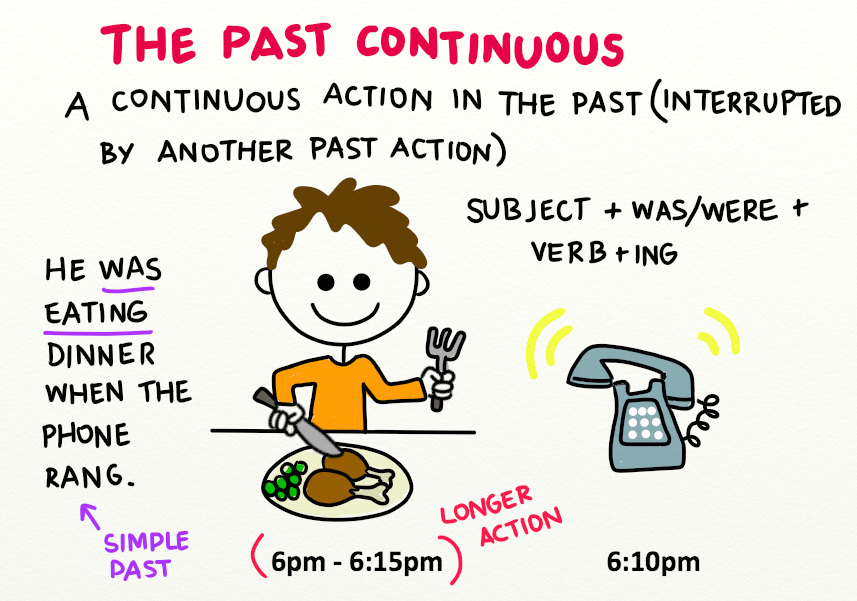
The past continuous presents an action as in progress at a particular time in the past. It gives the background situation:
- I was working.
- She was driving.
- They were having dinner.
- We were waiting for the meeting to start.
When you combine them, the past continuous is usually the background action, and the past simple is the event that happened during it.
I was working when my manager called.
background action — main event
The word interrupted is useful, but it does not always mean that the first action stopped completely. It means that the second event happened while the first action was in progress. For example, you may continue eating after the phone rings.
Learn English Tenses: PAST CONTINUOUS
Watch “Learn English Tenses: PAST CONTINUOUS” by Learn English with Rebecca · engVid. It gives a clear visual distinction between a completed past event and an activity that was in progress, then applies it to interruptions.
Begin with the timeline, which contrasts “I worked” with “I was working.” Then watch an interruption for the key pattern “They were having dinner when we arrived.” Finally, watch a common error and notice why “I am studying when you called” must become “I was studying when you called.”
Forming the two tenses
You already know that continuous forms need a form of be plus a verb ending in -ing. In the past, use was or were.
| Subject | Past continuous | Example |
|---|---|---|
| I / he / she / it | was + verb-ing | She was speaking to a customer. |
| you / we / they | were + verb-ing | We were waiting outside. |
For the past simple, use the regular past form ending in -ed, or an irregular past form:
- worked, started, arrived
- called, emailed, stopped
- went, saw, had, got, came
Now combine them:
| Background: action in progress | Main event: completed action |
|---|---|
| I was writing an email | my computer froze. |
| They were travelling home | the train stopped. |
| She was cooking | the smoke alarm went off. |
The usual sentence pattern is:
Past continuous + when + past simple
- I was checking my messages when the meeting started.
- We were talking when the connection dropped.
- He was walking home when it began to rain.
Think of the past continuous as the scene already in progress. The past simple tells the event you want the listener to notice.
Past continuous or past simple? - Cambridge Grammar
Read Cambridge Grammar’s short explanation to consolidate the difference between an action in progress and a completed main event. Its examples closely match the communication pattern in this lesson.
In the opening comparison, read the continuous explanation and compare it with the past simple example directly below it. Then find the subsection “Emphasising main events with the past simple” and read the main-event explanation. Focus on which clause gives background information and which clause moves the story forward.
Choosing the tense by meaning, not by the length of the action
A common misunderstanding is: “Use the past continuous only for a long action.” Length can help, but it is not the main idea.
Instead, ask:
-
What was already happening at that past moment?
Use the past continuous. -
What happened during that situation?
Use the past simple.
Compare these sentences:
-
At 4:00, I was preparing a presentation.
You are looking inside the activity at that moment. -
At 4:00, I finished the presentation.
You are reporting a completed event. -
I was preparing a presentation when my colleague sent new information.
The preparation is the background; the message is the main event.
This is especially useful for short explanations in professional settings:
“I was trying to upload the document when the website stopped working.”
“We were discussing the schedule when the manager joined the call.”
“I was travelling to the office when I received your email.”
The past continuous gives context. The past simple gives the important occurrence.
Using when and while
Both when and while can connect the two parts of the story, but they have slightly different jobs.
When: the event happens during the background action
Use when very naturally before the past simple event:
I was having lunch when my phone rang.
They were waiting for the bus when it started to rain.
I was talking to a customer when the line went dead.
You can also begin with the main event:
My phone rang when I was having lunch.
It started to rain when they were waiting for the bus.
The meaning is essentially the same. In the first order, you introduce the background first; in the second, you begin with the main event.
While: emphasis on the action in progress
Use while especially with the past continuous:
While I was working, my computer crashed.
While we were having the meeting, the internet connection failed.
While she was driving, she saw an accident.
In writing, use a comma after the opening time clause:
- While I was working, my computer crashed.
- When my computer crashed, I was working.
But if the time clause comes second, you normally do not need a comma:
- My computer crashed while I was working.
- I was working when my computer crashed.
Questions and negatives in real conversations
This grammar helps you ask for details about a past situation.
Asking about the background action
What were you doing when I called?
The question asks about the action in progress at the time of the call.
Other useful questions:
- What was she doing when the problem happened?
- Where were they going when they saw the accident?
- Why were you waiting outside?
Making negative statements
Put not after was or were:
- I wasn’t sleeping when you called.
- They weren’t using the system when it stopped working.
- She wasn’t paying attention when the instructions changed.
For a past simple negative, use didn’t + base verb:
- The manager didn’t reply immediately.
- We didn’t hear the announcement.
- My phone didn’t ring.
Notice the difference:
“I wasn’t using my phone when the message arrived.”
The activity was not in progress.
“I didn’t use my phone yesterday.”
The completed past day is the focus.
Common mistakes to avoid
1. Using the present continuous for a finished past situation
- Incorrect: I am studying when you called.
- Correct: I was studying when you called.
Both actions happened in the past, so both verb forms must be in the past.
2. Forgetting was or were
- Incorrect: She working when I arrived.
- Correct: She was working when I arrived.
The form is always was/were + verb-ing.
3. Using the past simple for both actions when you want an interruption
- Less clear for this meaning: I worked when my manager called.
- Clear: I was working when my manager called.
“I worked” reports a completed activity. “I was working” places the listener in the middle of the activity when the call happened.
4. Using continuous forms with state verbs
Like the present continuous, the past continuous is not normally used with many state verbs, such as know, need, want, believe, and understand.
- Incorrect: I was needing help when you called.
- Better: I needed help when you called.
Use the past continuous mainly for actions or activities in progress: working, walking, talking, waiting, driving, studying.
Turn a simple event into a short story
A good practical habit is to add one background sentence before the main past event. This makes your English clearer and more natural.
A basic report might be:
“The meeting started late.”
A fuller version is:
“We were waiting for the meeting to start when the host joined the call late.”
Here is another short example:
“Yesterday afternoon, I was preparing for an online meeting when my internet connection failed. I restarted my router, but the problem continued. I joined the meeting from my phone.”
Only the first sentence needs the past continuous plus past simple pattern. The later sentences use the past simple because they report a sequence of completed actions.
For a brief speaking practice, record a 30–60 second voice note about a real or imagined interruption. Include:
- one action that was in progress;
- one event that happened during it;
- one completed action afterwards.
For example:
“I was travelling home when I got an important email. I stopped at a cafe and replied to it.”
Listen once after recording. Check that your background action has was/were + -ing, and your main event has a past simple verb.
Key takeaways
To describe an interrupted past event:
- Use the past continuous for an action in progress: “I was working.”
- Use the past simple for the event that happened during it: “My manager called.”
- Combine them with when or while: “I was working when my manager called.”
- Use was with I, he, she, and it; use were with you, we, and they.
- Remember that the past continuous creates background context, while the past simple usually highlights the main event.
Next, you will learn when to use the present perfect and the past simple: for example, the difference between “I have visited London” and “I visited London last year.”
Can't find a good explanation? Sign up and we'll make it for you
Sign up