
Welcome back. In the last lesson, you completed a 20-minute sprint by setting one clear goal, using a timer, and making distractions harder to reach. That helps you start and stay with maths.
But even in a well-planned sprint, there will be moments when your mind says, “I’m stuck.” Today you will turn that vague feeling into something useful: identify exactly what is blocking you, then choose one small next action. This is how you avoid spending ten minutes staring at the same line—or giving up before you have found out what help you need.
Being stuck is information
Getting stuck does not mean you are bad at maths. It usually means one particular link in the chain is missing:
- you do not understand the words in the question;
- you are unsure what the question is asking for;
- you do not know which method to use;
- you know the method but cannot carry out a calculation;
- or you have an answer but do not know whether it makes sense.
Those are different problems, so they need different next actions.
A useful rule is:
Do not say only “I can’t do it.” Finish this sentence instead:
“I am stuck because …”
For example:
- “I am stuck because I do not know what means.”
- “I am stuck because I do not know whether this is multiplication or division.”
- “I am stuck because I know I should divide, but I cannot work out .”
- “I am stuck because I have an answer, but I do not know how to check it.”
That sentence is a diagnosis. Once you have it, you can choose a sensible next move.
A short clip from How to study MATH so FAST that it feels ILLEGAL by simple, actually makes an important point: difficult questions should come after examples and simpler questions, not before them.
How to study MATH so FAST that it feels ILLEGAL
Watch this short section to see why moving straight to the hardest problem can cause a “wall,” and why returning to a worked example or simpler question is a smart action rather than a failure.
Watch the problem pyramid. Focus on the order: worked example, simple practice, intermediate practice, then harder questions. When you are stuck, you may simply be attempting a level before you have enough steps underneath it.
The RESET routine
Use this five-step routine whenever you have been stuck for about a minute. Write it at the top or side of your maths page:
| Step | What to do | What it might sound like |
|---|---|---|
| R — Read | Read the whole question slowly. Read the final question again. | “What does it actually want me to find?” |
| E — Explain | Name the exact difficulty. | “I understand the numbers, but not the word ‘difference’.” |
| S — Sort | Write what you know and what you need to find. Draw a quick sketch if useful. | “I know the total is 36 and groups have 6. I need the number of groups.” |
| E — Elect | Choose one small action that matches the difficulty. | “I will draw groups of 6” or “I will find a worked example.” |
| T — Try and check | Try that action for a few minutes. Decide whether it helped. | “Now I know it is division. I can continue.” |
The aim is not to finish every question instantly. The aim is to make your next move sensible.
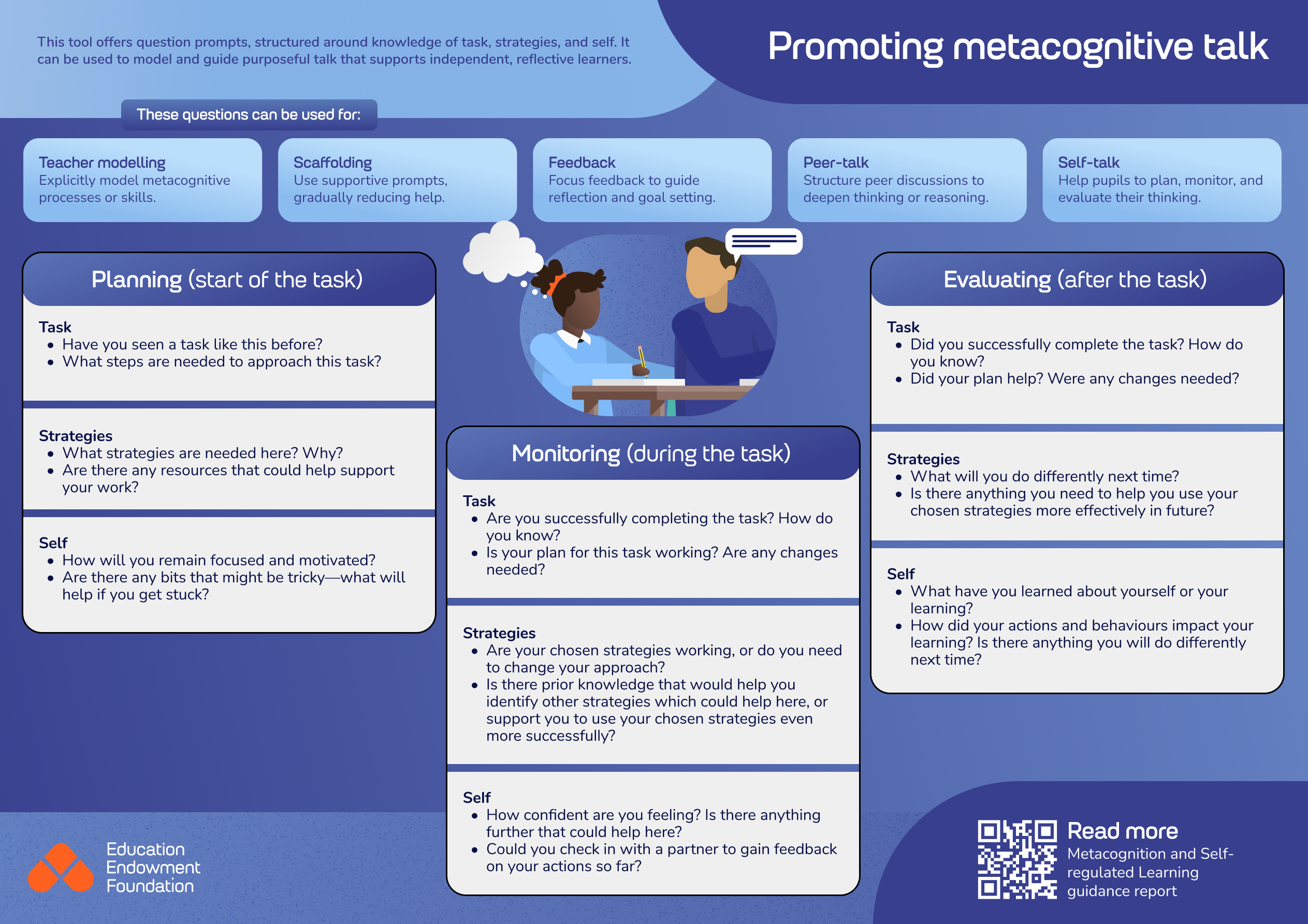
Match the action to the blockage
Here is a practical action menu. Do not try all of these at once—select the one that fits your diagnosis.
| If your exact difficulty is… | Choose this next action |
|---|---|
| “I do not understand a word or the question.” | Read it aloud; circle the final question; rewrite it in your own words. |
| “There are too many numbers or facts.” | List known information and the unknown separately; draw a simple diagram. |
| “I know what it asks, but not the method.” | Look at one fully worked example of a similar question; identify its first step; ask a targeted question. |
| “I know the method, but cannot do one calculation.” | Write the calculation on its own line; try an easier related fact; use notes or a multiplication table if allowed. |
| “I have an answer but it seems strange.” | Estimate, use the inverse operation, reread the units, or check whether the answer fits the situation. |
| “I have tried one sensible action and still cannot move.” | Mark the exact point, take a brief break or move on, then ask for help using your diagnosis. |
Notice the difference between these two requests for help:
- Less useful: “I don’t get any of it.”
- Useful: “I know the question asks for the number of equal groups, and I wrote , but I do not know how to calculate that division. Can you show me one similar example?”
The second request gives a teacher, parent, friend, or tutor a clear place to begin. It also proves that you have already taken a useful next action.
Use the routine on a problem
Consider this question:
The school collected 36 cans for recycling. The cans are packed into boxes of 6. How many full boxes can be packed?
Imagine you look at it and feel stuck because you see both 36 and 6, but you do not know what to do with them.
1. Read
The final question is: How many full boxes can be packed?
So the answer is not the number of cans. It is the number of boxes.
2. Explain the blockage
A precise diagnosis could be:
“I understand the story, but I do not know which operation finds the number of equal boxes.”
This is much more useful than “I cannot do it.”
3. Sort
Write:
- Known: 36 cans altogether
- Known: 6 cans in each box
- Need to find: number of boxes
The phrase “6 in each box” tells us that we are splitting a total into equal groups.
4. Elect one action
Choose one action: draw equal groups, or write a division number sentence.
If the division fact is the new blockage, choose an even smaller action: count in sixes.
There are six jumps, so:
5. Try and check
Check by reversing the operation:
So six boxes is reasonable. The routine has done its job: it turned one large feeling of being stuck into two manageable actions—choose division, then work out the division fact.
Useful moves before asking for an answer
The article 20 Effective Math Strategies for Problem Solving from Third Space Learning gives a set of moves that fit the middle of RESET: read carefully, identify important information, work out the unknown, then make a plan. It also explains why diagrams and number sentences can help turn words into maths.
20 Effective Math Strategies For Problem Solving
Read the selected parts of Third Space Learning’s article to build your menu of next actions when a word problem feels unclear.
In the section “Strategies to understand the problem,” read the five short subsections from “Read the problem aloud” through “Make a plan.” Start with these understanding moves. Notice how each one helps you identify what is missing before you calculate. Then go to “Strategies for solving the problem.” Read the parts on drawing a model and writing a number sentence, using diagrams and equations. Focus on choosing one representation that makes the relationship between the numbers clearer.
A key idea from the reading is that a diagram is not “extra work.” It can be the correct next action when the words are difficult to hold in your head.
For example, later in this course you will work with an accessible-ramp situation. If a written ramp question feels confusing, your first next action will not be to guess a formula. It will be to draw the ramp as a triangle and label what each measurement represents. The drawing makes it possible to see what information you have and what measurement is missing.
A five-minute stuck-log practice
Use the page of squares from your previous study sprint. Find one fact you starred or marked with a question mark. If you did not mark one, use:
Do not rush to find the answer. Instead, write these five lines and complete them honestly:
- Read: The question asks me to find ____________________.
- Explain: I am stuck because ____________________.
- Sort: I know ____________________. I need ____________________.
- Elect: My one next action is ____________________.
- Try and check: After trying it, I can now ____________________.
For instance, if the difficulty is the symbol, your next action could be:
“I will write the square as a multiplication of the number by itself.”
That would turn the question into:
You do not need to memorise every square today. What matters is noticing whether your problem is about meaning the notation, doing the multiplication, or remembering a fact. Each needs a slightly different next action.
Finish your log with one short reflection:
The next time I am stuck in maths, I will first say: “I am stuck because …”
Key takeaways
Being stuck is normal; remaining vague about it is what wastes time. Use RESET:
- Read the question and its final target.
- Explain the exact blockage.
- Sort what you know from what you need.
- Elect one small next action.
- Try and check whether that action moved you forward.
A worked example, a diagram, a simpler related question, a written number sentence, or a targeted request for help are all useful actions—when they match the actual difficulty.
In the next module, you will begin the maths foundation for the ramp problem by learning what square notation means and how to calculate squares using multiplication.
Can't find a good explanation? Sign up and we'll make it for you
Sign up