
Hello again. In the previous lesson, you learned to distinguish business terms such as proprietorship, business plan, and GAAP by spotting their definition clues. A proprietorship has one owner, which makes owner’s equity especially important: it is the owner’s financial claim on the business.
This lesson focuses on the central relationship that holds basic accounting together:
By the end, you should be able to recognize what this equation says in words, identify which term belongs on each side, and use it to find a missing amount on a test.
The big idea: what the business has, and who has claims to it
The accounting equation states that a business’s total assets always equal its total liabilities plus its owner’s equity.
Think of the equation as answering two related questions:
| Part of the equation | Question it answers | Meaning |
|---|---|---|
| Assets | What does the business have? | Resources the business owns or controls |
| Liabilities | What does the business owe outsiders? | Debts owed to creditors, such as banks or suppliers |
| Owner’s equity | What is the owner’s claim? | The value remaining for the owner after liabilities are subtracted |
For a simple business, suppose it has:
- cash and equipment worth total;
- a bank loan of .
The business’s assets are , but not all of that value belongs to the owner because the business must repay the loan. The owner’s equity is what remains:
So the full equation checks:
The equation is balanced.
A useful test-ready wording is:
The accounting equation shows that a business’s assets equal its liabilities plus its owner’s equity.
Another way a test may express the same relationship is:
Everything the business owns is financed by creditors or by the owner.
“Creditors” points to liabilities. “Owner’s claim,” “net value,” or “what remains after debts” points to owner’s equity.
ACCOUNTING EQUATION: Explained in (Almost) 2 Minutes!
Watch ACCOUNTING EQUATION: Explained in (Almost) 2 Minutes! from Accounting Stuff for a compact visual explanation of why assets must balance with liabilities and equity.
Watch the core relationship to hear the equation stated in words. Then watch the three components, focusing on the distinction between property the business has, debts owed to outsiders, and the owner’s remaining stake. Finish with the recap and say the complete equation aloud once without looking.
Why liabilities and owner’s equity are on the same side
At first, it may seem strange that liabilities and owner’s equity are added together. One is debt, while the other represents ownership. The connection is that both are claims on the assets.
If a business owns in assets:
- a lender may have a claim to , because the business owes that amount;
- the owner has a claim to the remaining .
Together, their claims equal the total value of the business’s resources.
This is why the equation is not simply a formula to memorize. It describes the structure of the business:
Owner’s equity can also be called equity. In this course’s vocabulary, use owner’s equity when the definition specifically refers to the owner’s claim in a proprietorship.
The accounting equation – Accounting and Accountability
Read The accounting equation from Accounting and Accountability. It explains the equation as a relationship between business resources and the claims against those resources.
In the “Introduction to the accounting equation,” read from the opening explanation through the paragraph that describes assets as obtained through liabilities or owner contributions. In “Components of the accounting equation,” read the complete definitions of assets, liabilities, and owners’ equity, beginning with the three components. Then, in “Rearranging the accounting equation,” read from the balance principle through the Felix’s Fresh Flowers example. Focus on the three forms of the equation and how subtraction finds the missing amount.
Three forms worth memorizing
The basic equation is the most important form:
But a test may give two amounts and ask for the third. Rearranging the equation gives you two more forms:
Use the wording of the question to choose the formula.
| If the question asks for... | Start with... |
|---|---|
| Total assets | Liabilities plus owner’s equity |
| Owner’s equity | Assets minus liabilities |
| Liabilities | Assets minus owner’s equity |
For example, if assets are and owner’s equity is , liabilities are:
Then verify the original equation:
Checking the original form catches many subtraction mistakes.
The equation stays balanced during transactions
Every business transaction must preserve the accounting equation. This does not mean every transaction changes all three parts. It means the total on the asset side must always equal the total on the liabilities-plus-owner’s-equity side.
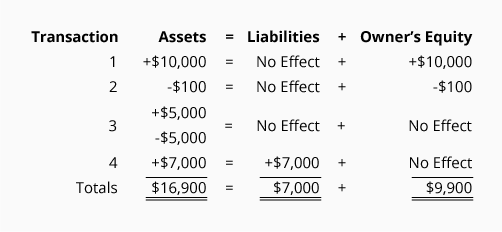
The transaction table illustrates several patterns.
1. An owner invests cash
When an owner puts cash into the business:
- assets increase because the business has more cash;
- owner’s equity increases because the owner has contributed value.
Both sides rise by the same amount.
2. The business exchanges one asset for another
Suppose a business uses cash to buy equipment.
- cash decreases by ;
- equipment increases by .
Both are assets. Total assets do not change, and neither liabilities nor owner’s equity changes.
This is an important point: a transaction can affect two individual accounts while having no net effect on the overall accounting equation totals.
3. The business borrows money
Suppose the business receives a bank loan.
- assets increase because cash increases;
- liabilities increase because the business now owes the bank.
The business has more resources, but it also has more debt.
The table’s row showing an asset decrease and an owner’s equity decrease represents another balanced pattern. The detailed effects of business costs and other transaction types will come later. For now, keep the essential rule: every valid transaction leaves the equation in balance.
A fast recognition method for the word-bank test
When you see a definition, locate its key clue before choosing a term.
| Definition clue | Correct term |
|---|---|
| “Resources owned or controlled by a business” | Assets |
| “Debts or obligations owed to outsiders” | Liabilities |
| “Owner’s claim after liabilities are subtracted” | Owner’s equity |
| “Assets equal liabilities plus owner’s equity” | Accounting equation |
| “Net value of the business” | Owner’s equity |
Memorize this compact verbal version:
Assets are what the business has. Liabilities are what it owes outsiders. Owner’s equity is what remains for the owner.
Then attach the equation:
Assets equal liabilities plus owner’s equity.
A short recall routine for test preparation:
- Write the basic equation from memory.
- Say what each term means in six words or fewer.
- Cover the formulas and reconstruct the two subtraction versions.
- Check that you can identify whether a described amount is an asset, a liability, or owner’s equity.
Key takeaways
The accounting equation is:
- Assets are business resources.
- Liabilities are debts owed to outside parties.
- Owner’s equity is the owner’s remaining claim, or net value, after liabilities are subtracted from assets.
- The equation must always balance.
- To find a missing amount, subtract the known amount on the right or left as needed.
In the next lesson, you will move from the equation itself to the vocabulary used to record its changes: transactions, accounts, account titles, and account balances.
Can't find a good explanation? Sign up and we'll make it for you
Sign up