
Welcome back. In the previous lesson, you used the accounting equation to distinguish what a business has (assets), owes (liabilities), and the owner’s remaining claim (owner’s equity). You also saw that each valid business event keeps that equation balanced.
Now we focus on the vocabulary used to record those events. By the end of this lesson, you should be able to match transaction, account, account title, and account balance to their definitions quickly in a word-bank question—and avoid the common mix-ups among them.
Four terms, four different jobs
These words belong together, but they do not mean the same thing. Think of a business’s records as answering four different questions:
| Term | The question it answers | Test-ready definition |
|---|---|---|
| Transaction | What happened? | A business event involving an exchange of value that affects the accounting records. |
| Account | Where is this type of information collected? | A record used to classify and summarize changes and balances for one item. |
| Account title | What is that account called? | The specific name used to identify an account. |
| Account balance | How much is currently in that account? | The amount, or net amount, in an account at a given time. |
The most important distinction is this:
- A transaction is an event.
- An account is the record that stores information about one category.
- An account title is the name on that record.
- An account balance is the current amount in that record.
A compact memory line is:
Event, record, name, amount.
Transaction, account, account title, account balance.
Transaction: a business event with a financial effect
A transaction is a business event that accounting needs to record. It involves something of financial value: the business pays, receives, buys, sells, borrows, earns, or owes.
Examples include:
- buying supplies with cash;
- paying rent;
- receiving cash from a customer;
- borrowing money from a bank;
- selling a service to a customer.
Not every business activity is an accounting transaction. For example, choosing a logo, discussing a future advertising idea, or interviewing an applicant may matter to the business, but it is not necessarily a recorded financial event at that moment.
A transaction commonly affects at least two parts of the accounting records. This connects directly to the accounting equation you learned previously. For instance, buying supplies for cash changes the types of assets the business owns: cash decreases while supplies increase.
Bookkeeping: In-Depth Explanation with Examples
Read AccountingCoach’s introduction to recording transactions. It gives concrete examples of financial events, then shows why businesses sort many transactions into separate accounts.
In the section “Recording Transactions,” read from the opening explanation through the examples ending with financial transactions. Then continue with the paragraph beginning “The transactions will be sorted” through sorting records. Stop before the “Accrual Method” section. Focus on identifying which phrases describe an event and which describe a place where similar events are collected.
Do not confuse a transaction with its record
In formal accounting language, a journal entry is the written or digital record of a transaction. The transaction is what happened; the journal entry is one way accountants document it.
For this word-bank lesson, use the clue words:
- event, activity, exchange, business occurrence, or financial effect point to transaction;
- recording a transaction points more specifically to a journal entry, not to the transaction itself.
Account: the record that gathers similar information
An account is a separate record for one kind of business item. It collects the increases, decreases, and current balance for that item.
For example, a business may use separate accounts for:
- Cash
- Supplies
- Accounts Receivable
- Equipment
- Accounts Payable
- Sales Revenue
- Rent Expense
The Cash account collects every transaction that affects the business’s cash. The Rent Expense account collects the costs of using rental space. Keeping these categories separate lets the business answer useful questions, such as how much cash it has or how much rent expense it incurred.
An account is therefore not the business item itself. Cash is the asset; the Cash account is the record that tracks the cash amount.
Accounts, Journals, Ledgers, and Trial Balance | Accounting 101
Read the opening explanation from Lumen Learning for the formal meaning of an account and the role of account titles. This is especially useful for definitions that use words such as “classify,” “summarize,” or “consistent.”
In “Accounts, Journals, Ledgers, and Trial Balance,” locate the paragraph immediately after the review of prior learning. Read the definition of an account and its Cash-account example. Then read the following paragraph, including the account title discussion. Notice that an account gathers information, while its title identifies what information belongs there.
Account title: the account’s identifying name
An account title is the specific name assigned to an account. It tells you what the account is for.
For example:
- Cash is an account title.
- Accounts Receivable is an account title.
- Sales Revenue is an account title.
- Rent Expense is an account title.
The title should be logical and used consistently. A business could use either Loans Payable or Notes Payable as the name for an account tracking borrowed money, but once it chooses a title, it should use that same title throughout its records.
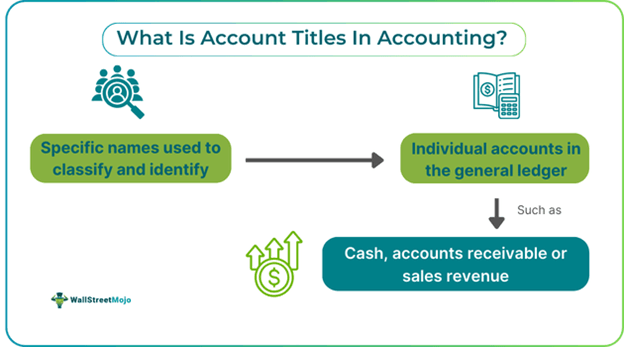
Here is the key grammar clue for a test:
- If the definition says “the name of an account” or “used to identify an account,” choose account title.
- If it says “a record used to collect or summarize similar information,” choose account.
The words Cash and Sales Revenue can name accounts, but the vocabulary term for the name itself is account title.
Account balance: the current amount in the account
An account balance is the amount currently in an account after its recorded increases and decreases have been considered.
Suppose a business begins with in its Cash account. It receives from a customer and later pays for supplies. Its Cash account balance is:
The account title is Cash. The account is the record tracking cash activity. The account balance is .
In full bookkeeping, an account balance is found by comparing the total debit amounts and total credit amounts recorded in the account. The side with the larger total determines whether the balance is a debit balance or credit balance. For your word-bank test, the essential definition is simpler:
Account balance = the amount in an account at a particular time.
T Accounts: Debit and Credit Simplified.
Watch “T Accounts: Debit and Credit Simplified” from Farhat Lectures to see the difference between an account’s title and its balance in a visual layout.
Watch account structure to see where an account title appears and how an individual account is organized. Then watch account balances for the precise idea that a balance is the net difference between the two sides of an account. Do not try to memorize which categories normally have debit or credit balances yet; focus on the meaning of “balance.”
One example, labeled four ways
Consider this business event:
A landscaping business pays cash to buy supplies.
This single sentence contains all four vocabulary ideas.
| Part of the situation | Correct term | Why |
|---|---|---|
| Paying cash for supplies | Transaction | It is a financial business event. |
| The record that tracks cash changes | Account | It collects information about cash. |
| The word “Cash” at the top of that record | Account title | It identifies the account. |
| The amount remaining in Cash after the payment | Account balance | It is the account’s current amount. |
The transaction also affects a Supplies account. If the business had no supplies before the purchase, the Supplies account balance becomes .
Notice the difference between the individual account balances and the accounting equation:
- Cash decreases by .
- Supplies increases by .
- Total assets do not change, because one asset was exchanged for another.
This is why businesses need individual accounts. The overall accounting equation remains balanced, but the accounts show the useful details inside each category.
Fast word-bank recognition
Use the definition clues rather than trying to memorize long sentences word for word.
| If you see these clues... | Choose... |
|---|---|
| Business event; financial activity; buying, selling, paying, borrowing | Transaction |
| Record; place used to classify, summarize, or store similar information | Account |
| Name; label; identifies an account | Account title |
| Amount in an account; net amount; current or ending amount | Account balance |
Common traps
| Incorrect match | Why it is wrong |
|---|---|
| “Cash” matched to account balance | Cash is normally an account title. A balance needs an amount, such as . |
| “A record for cash activity” matched to account title | That describes the Cash account, not merely its name. |
| “Buying equipment for cash” matched to account | That is a transaction, because it is an event. |
| “The amount remaining in the Cash account” matched to transaction | That is an account balance. |
For a quick recall routine before a test, write these four prompts from memory:
- Transaction: What happened?
- Account: Where is similar information recorded?
- Account title: What is the account called?
- Account balance: How much is in it now?
Key takeaways
The four terms describe different parts of the accounting-recording process:
- A transaction is a financial business event.
- An account is a record that collects changes and balances for one category.
- An account title is the account’s specific identifying name.
- An account balance is the current net amount in that account.
Use the memory sequence: event, record, name, amount.
Next, you will distinguish a capital account, which records the owner’s equity interest in a proprietorship, from a creditor, an outside party to whom the business owes money.
Can't find a good explanation? Sign up and we'll make it for you
Sign up