Hello! Welcome back to your module on launching on Walmart Marketplace.
In our last session, you got a full tour of the Walmart Seller Center. You now know where to manage your products, orders, and pricing. Today, we'll shift from navigation to creation. The goal of this lesson is to learn how to create a new product listing optimized for Walmart's search algorithm.
A successful product page on any marketplace has two jobs:
- Get Found (Discovery): It must be optimized so Walmart's search algorithm shows it to the right customers.
- Convert (Persuasion): Once a customer lands on your page, the content must persuade them to buy.
This lesson will give you the practical, step-by-step framework to achieve both. We'll break down each component of a Walmart listing, from the title to the backend attributes, so you can build pages that rank well and sell effectively.
1. The Foundation: Understanding Walmart's Algorithm
Before you start writing, you need to understand what Walmart's algorithm values. Unlike just stuffing keywords, Walmart heavily relies on structured data and product categorization to understand and rank your product. Your IT background will be an advantage here, as this is all about providing clean, well-organized data.
Choosing the Right Product Type
The single most important step for discoverability is placing your product in the correct Product Type. Walmart associates specific search queries with each product type. If you're in the wrong one, you may be invisible for your most important keywords.
Walmart Guide to SEO and Product Listing Optimization
To understand the critical role of Product Type and Attributes, start with this guide from Helium 10. It explains why this is the most important part of Walmart SEO.
Read 'Part 1: Product Type and Attributes'. Focus on understanding what a Product Type is, how it affects your keyword ranking, and how to check if your product is in the right one within Seller Center.
Filling in the Attributes
Attributes are the specific details about your product (e.g., color, material, size, compatibility). These backend fields directly power the filters customers use on the search results page. The more relevant attributes you fill in, the more chances you have to appear in filtered searches.
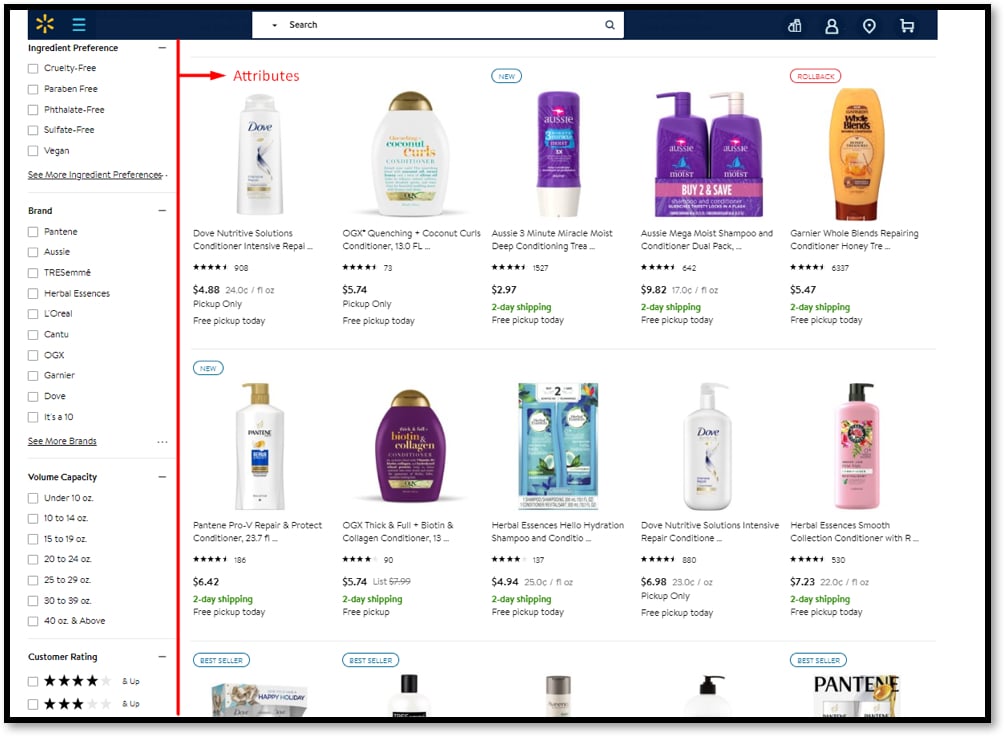
Walmart is continuously updating its requirements for this structured data. The current standard, Item Spec 5.0, emphasizes more structured fields (like dropdowns) and fewer free-text fields. This helps the algorithm process your listing with greater accuracy.
Walmart Product Listing Optimization: Best Practices for 2025
The article 'Walmart Product Listing Optimization' provides an excellent technical breakdown of the latest content standards, which will be useful given your background.
Read the section titled 'Walmart Item Spec 5.0: What Sellers Need to Know...'. Pay attention to the concepts of 'Smarter Categorization', 'Attribute Trim', and 'Structured Inputs'. This explains the 'why' behind filling out every relevant field.
2. Building Your Listing: The Core Components
Once you've done your foundational keyword research (using tools like Helium 10, which you're already familiar with from Module 2) and understand your product's category, it's time to build the customer-facing parts of your listing.
The following video gives a great overview of each creative asset and its purpose.
How to Win on Walmart Marketplace - Product Listing 101
This video, 'How to Win on Walmart Marketplace', breaks down the purpose of each part of a product listing. It will serve as our guide as we go through each component.
First, watch from 03:39 to 06:04 for a recap on keyword research. Then, watch the overview from 09:22 to 10:08, where the speaker introduces the five main creative assets we are about to cover: the main image, title, key features, description, and rich media.
Now, let's break down each of those assets.
A. Product Title
The title is your first and best chance to tell both Walmart and the customer what your product is. It must be clear, concise, and keyword-rich.
Best Practices:
- Structure: Walmart prefers a specific formula:
Brand + Item Name/Key Keywords + Style + Key Attribute + Pack Count + Size - Length: Aim for 50-75 characters to ensure it's fully visible on mobile devices.
- Keywords: Include your most important keyword phrase naturally.
- Formatting: Use Title Case. Do not use special characters (!, *, #) or promotional text ("Sale," "Best Seller").
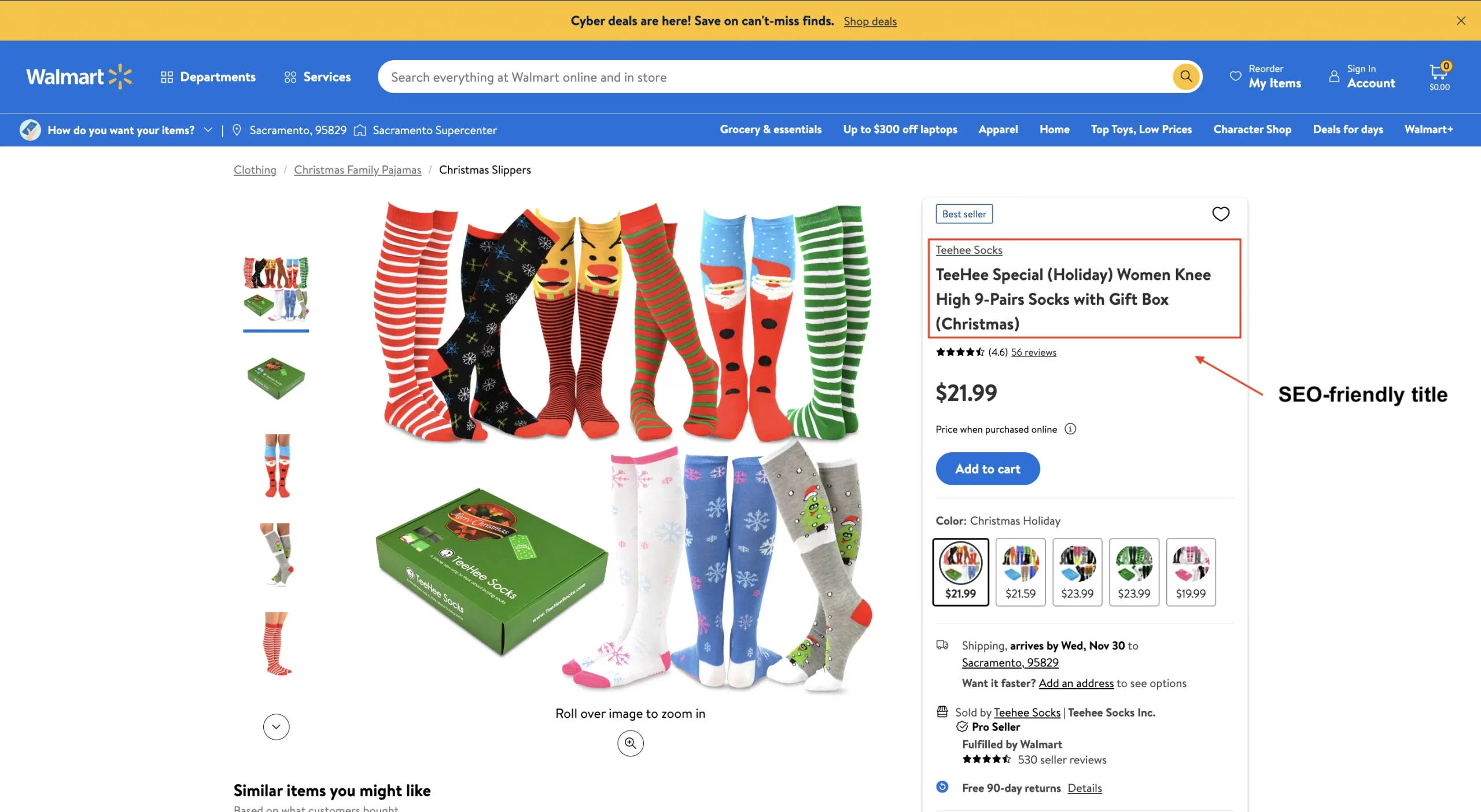
For detailed rules on title construction, refer back to the Walmart Guide to SEO (resource LINK, section 4) and Walmart Product Listing Optimization (resource LINK, section 5).
B. Images and Video
High-quality visuals are essential for conversion. Customers can't touch your product, so your images must tell the whole story.
Best Practices:
- Main Image: Must be on a pure white background, showing only the product. It should be clear and high-resolution (at least 1500x1500 pixels, as mentioned in the
Ecomclipsvideo). - Secondary Images: Use 5-7 additional images. Show the product from different angles, highlight key features with text overlays (infographics), and show it in use (lifestyle images).
- Video: If possible, include a short video (15-45 seconds) demonstrating the product. This dramatically boosts engagement and conversion.
How to Win on Walmart Marketplace - Product Listing 101
Let's return to the 'How to Win on Walmart Marketplace' video for specific guidance on creating compelling visuals.
Watch from 10:08 to 11:37 for advice on the main image. Then, watch from 15:25 to 16:33 to understand how to use secondary images and video to tell a story and set yourself apart.
C. Key Features (Bullet Points)
This is where you make your sales pitch. Key Features are highly scannable and should quickly communicate the main benefits of your product.
Best Practices:
- Quantity: Use 3 to 5 bullet points.
- Length: Keep each bullet under 80-100 characters. They must be short and punchy.
- Content: Lead with the benefit, then mention the feature. Instead of "10,000 mAh battery," say "All-Day Power with a 10,000 mAh battery."
- Formatting: Start each bullet with a capital letter. Do not use periods at the end. Do not use all caps or special characters.
How to Win on Walmart Marketplace - Product Listing 101
The 'How to Win on Walmart Marketplace' video provides an excellent breakdown of what makes a good (and bad) set of Key Features.
Watch from 12:43 to 14:50. The speaker analyzes a poor example and explains how to write clear, concise, and informative bullet points that help the customer, rather than just stuffing keywords.
D. Product Description
The description allows you to go into more detail, tell your brand story, and answer questions a customer might have.
Best Practices:
- Length: Aim for at least 150 words.
- Formatting: Use short paragraphs. Unlike Amazon, Walmart's standard description does not allow HTML or bullet points. It should be in sentence case.
- Content: Elaborate on the benefits mentioned in your Key Features. Tell a story about the product or your brand. Naturally include secondary keywords.
Test your understanding!
Let's say you're listing a product: a "Waterproof Bluetooth Speaker" from the brand "Acoustica," which is blue and has a 24-hour battery life.
- Following the recommended formula, write an optimized Product Title.
- Write one Key Feature (bullet point) for the battery life, following all formatting rules.
Show answer
-
Product Title Example:
Acoustica Wave Waterproof Bluetooth Speaker, 24-Hour Battery, Blue
This includes Brand (Acoustica), Item Name (Wave), Keywords (Waterproof Bluetooth Speaker), a Key Attribute (24-Hour Battery), and another attribute (Blue). -
Key Feature Example:
Enjoy non-stop music for up to 24 hours on a single charge
This is under the character limit, starts with a capital, has no period, and focuses on the benefit ('non-stop music') rather than just the feature.
3. Tying It All Together: The Listing Quality Score
How do you know if you've done a good job? Walmart tells you with the Listing Quality Score (LQS). This is a grade from 0-99% found in your Seller Center that analyzes your listing across four areas: Content & Discoverability, Offer (price & shipping), Ratings & Reviews, and Post-Purchase Quality.
For this lesson, we are focused on the Content & Discoverability score. By correctly filling out your title, images, features, description, and—most importantly—your backend attributes, you directly improve this score. A higher score leads to better visibility.
This next video provides a fantastic practical demonstration. You will see a seller take a listing with a score of 17% and, by filling in the details we've just discussed, raise it to 96%.
Walmart Content Optimization | Strategy on Product Listing Optimization for Big and Small Business
Watch this screen-share from 'Walmart Content Optimization' to see the direct impact of these optimizations on the Listing Quality Score within the actual Seller Center.
Watch from 01:30 to 03:00. Observe how the seller navigates to 'Edit Item' and fills in attributes like Brand, Key Features, Manufacturer details, and dimensions. Then, see the immediate result as the Listing Score jumps to 96%.
Conclusion
Congratulations! You now have a complete framework for building a product listing that is optimized for both Walmart's algorithm and for converting customers. You've moved beyond simply filling out fields and can now think strategically about each component.
Key Takeaways:
- Optimization is two-fold: You must satisfy the algorithm (for discovery) and the customer (for conversion).
- Structured Data is King: Correctly choosing your Product Type and filling out all relevant Attributes is the most critical step for being found in Walmart's search and filters.
- Follow the Formulas: Use Walmart's preferred structure for your Title and the specific formatting rules for Key Features and Descriptions.
- Visuals Sell: Use high-quality images and video to tell a story and build trust.
- Measure Your Success: Use the Listing Quality Score (LQS) in Seller Center as your report card to identify and fix areas for improvement.
Next Up:
With a perfectly optimized listing, the next crucial factor for winning sales is price. In our next lesson, we will focus on the "Offer" component of the Listing Quality Score. You will learn how to set a competitive price for your product by analyzing competitor pricing and understanding the Walmart Buy Box.