
Hello again. In the previous lesson, you learned to read tables and graphs carefully: identify the measurement, units, scale, and pattern, then separate the data itself from an explanation of why that pattern might exist. That habit is essential here, because variation in results can have several very different causes.
This lesson introduces three major sources of uncertainty in forensic and laboratory work:
- random error: unpredictable variation among repeated measurements;
- systematic error: a consistent distortion caused by a method, instrument, or procedure;
- cognitive bias: an unintentional influence of expectations, context, or mental shortcuts on judgment.
By the end, you should be able to classify a described problem into one of these categories and suggest a sensible response. Plan for about 40 minutes.
Uncertainty is not one thing
A measurement is never just a number. It is the outcome of a process involving an item, an instrument, a method, and a person. Each part of that process can introduce uncertainty.
Suppose a laboratory weighs the same reference sample five times and records:
The small up-and-down variation may come from tiny changes in the balance reading, air movement, or how the sample was placed on the pan. That is different from a balance that reads every object too heavy because it was not calibrated. It is different again from an examiner who gives extra weight to features that appear to support an expected conclusion after learning that a suspect confessed.
All three can affect a conclusion, but they require different safeguards.
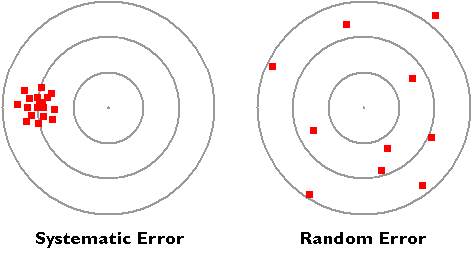
The target illustration is a useful starting model:
- A tight cluster away from the center suggests a consistent offset, characteristic of systematic error.
- A scattered set of points suggests unpredictable fluctuation, characteristic of random error.
- Cognitive bias is not usually visible as a simple pattern of dots. It affects which features a person notices, how they interpret ambiguous results, and sometimes even which tests they choose.
Watch the following short explanation before examining the categories in detail.
Random and systematic error explained: from fizzics.org
Watch “Random and systematic error explained” by Fizzics Organisation for a visual introduction to why repeated measurements vary and why a repeated mistake needs a different remedy from chance variation.
Watch random error to see how reaction-time variation creates spread in repeated timings and why repeated measurements help. Then watch systematic error, focusing on the parallax and unzeroed-scale examples and on the fact that the same procedure can repeat the same error.
Random error: variation that does not repeat in one direction
Random error is the unpredictable variation that occurs when a measurement is repeated under apparently identical conditions. Individual results may fall above or below the best estimate of the true value, without a stable directional pattern.
Common sources include:
- small fluctuations in electronic instrument signals;
- limited resolution of a measuring scale;
- minor changes in temperature, lighting, or positioning;
- variation in human reaction time;
- difficulty deciding the exact edge of a stain, fiber, or peak.
Imagine measuring the length of the same glass fragment five times with a ruler. If the readings are:
the measurements vary slightly, but no value is consistently high or consistently low. This is consistent with random error.
Random error often reduces the precision of repeated measurements. Precision means how closely repeated results agree with one another. A wide spread means lower precision; a narrow spread means higher precision.
What helps with random error?
Random error generally cannot be removed entirely. Instead, laboratories reduce its effect by:
- taking repeated measurements where appropriate;
- calculating a mean or otherwise summarizing repeated results;
- using suitable instruments with adequate resolution;
- standardizing conditions and technique;
- recording uncertainty and avoiding excessive certainty in reports.
The mean is useful because positive and negative fluctuations can partly balance across repeated measurements. But repetition only helps if the error is genuinely random. Repeating a flawed method many times can give a very consistent wrong answer.
Systematic error: a consistent shift away from the correct value
Systematic error is a recurring distortion that shifts measurements in the same direction or according to the same pattern. It comes from an identifiable feature of an instrument, method, calibration, or procedure.
For example, suppose a certified reference mass is weighed repeatedly:
These readings are tightly grouped, so they appear precise. But because the known reference value is , the balance is reading high by about . The problem is systematic.
This distinction is crucial:
| Pattern in repeated measurements | Likely concern |
|---|---|
| Values fluctuate unpredictably above and below a central value | Random error |
| Values are consistently shifted high, low, or in another recurring direction | Systematic error |
| A conclusion changes because expectations or irrelevant context influence judgment | Cognitive bias |
A systematic error may arise from:
- a balance that was not zeroed or calibrated;
- a pipette that consistently delivers too much liquid;
- a thermometer with an offset;
- measuring from the wrong starting point on a ruler;
- consistently reading a scale from an angle, producing parallax error;
- using a procedure that loses a predictable portion of material.
Read the following concise treatment of the two measurement-error categories.
Appendix A: Treatment of Experimental Errors - Chemistry LibreTexts
Chemistry LibreTexts explains the central distinction between systematic and random errors, then connects them briefly to accuracy and precision. Read it to sharpen the classification rules used in laboratory work.
In the section “Types of Error,” read both error types. Notice the contrast between recurring calibration problems and positive-and-negative fluctuations. Then, in “Accuracy and Precision,” read the accuracy distinction. Focus on the idea that close agreement among repeats does not by itself prove that results are correct.
Detecting and reducing systematic error
Unlike random error, systematic error will not necessarily become obvious when you repeat the same measurement. In fact, repeated agreement may conceal it.
Laboratories use external checks, such as:
- calibration against standards with known values;
- positive controls, which should produce a known detectable response;
- negative controls, which should not produce the response;
- instrument maintenance and documented performance checks;
- independent review or comparison with another validated method;
- clear standard operating procedures.
For example, if a balance repeatedly weighs a certified mass as , the reference material reveals a systematic problem. Averaging a hundred readings would not solve it; calibration, repair, or an appropriate correction is needed.
A useful caution: systematic error is not necessarily deliberate carelessness. A well-trained person can unknowingly use a miscalibrated instrument or a method with an unrecognized limitation. The purpose of quality controls is to reveal such problems before they affect case conclusions.
Cognitive bias: when information changes judgment
Cognitive bias occurs when beliefs, expectations, prior knowledge, emotion, or situational context unintentionally affects how someone collects, perceives, evaluates, or interprets evidence.
It is important not to confuse cognitive bias with deliberate dishonesty or discrimination. An examiner can be ethical, skilled, and sincerely trying to be objective while still being influenced by information that should not affect the task.
Consider a fingerprint examiner who first receives a suspect’s known fingerprint card and is told that the suspect confessed. Later, while examining a partial and unclear mark from a crime scene, the examiner may be more likely to notice features that resemble the known print and discount discrepancies. The issue is not necessarily misconduct; it is the risk that expectation has changed perception and interpretation.
In forensic work, cognitive bias is particularly important when evidence is incomplete, degraded, complex, or open to judgment. In these situations, the same ambiguous feature may seem more meaningful when someone expects a particular result.
The forensic-science article below provides a practical account of this issue.
This article explains cognitive bias in forensic decision-making and describes safeguards that reduce the influence of unnecessary information. Focus on the practical distinction between relevant information needed for a task and information that can improperly steer an interpretation.
In the “Introduction,” read the definition and scope, noting why conscious good intentions alone are not a complete safeguard. Then go to “Category A, source 2: reference materials” in “Specific suggestions for practitioners” and read the targeting risk. Next, in “Category A, source 3: contextual information,” read relevant versus irrelevant context, followed by the examples immediately below it, including confessions and eyewitness accounts.
Sources and forms of cognitive bias
Cognitive bias has many forms. You do not need to memorize every label, but you should recognize the main sources of influence.
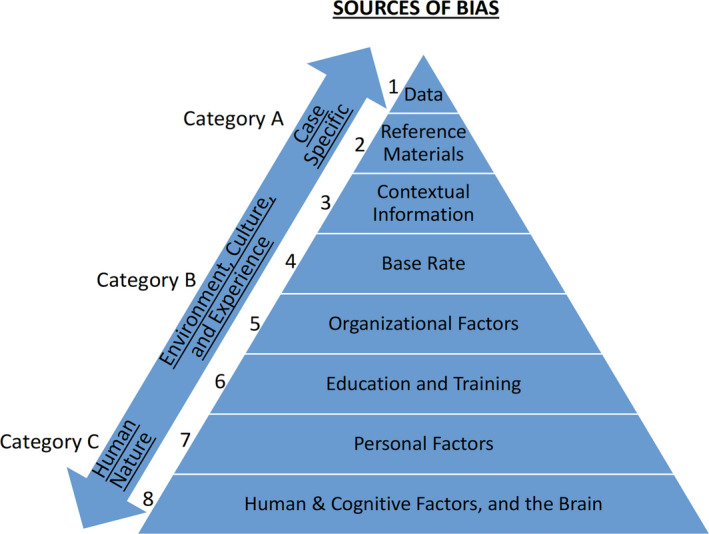
Case-specific influences
These arise from information connected to the item or case.
- Reference-material or target bias: Seeing a suspect’s known sample first can lead an examiner to search the questioned evidence for that expected pattern.
- Contextual bias: Information such as a confession, criminal history, witness identification, or an investigator’s opinion may be irrelevant to a laboratory comparison but still influence interpretation.
- Emotionally charged evidence: Offensive writing, graphic images, or other disturbing material can influence a practitioner’s reactions even when it is unrelated to the analytical question.
Not all context is inappropriate. For example, information that clothing was exposed to desert conditions for months may be relevant to explaining faded fibers. The key question is:
Is this information necessary to perform or interpret this specific examination?
Practitioner and workplace influences
Experience and training help forensic practitioners, but they can also create expectations. If an analyst has often found gasoline in debris samples flagged by a particular source, that experience may make a borderline future sample seem more likely to contain gasoline.
Workplace pressure can also matter. A laboratory culture that emphasizes speed, assumes a particular side’s theory is correct, or discourages people from reporting uncertainty can distort decisions without anyone explicitly asking for a false result.
General human cognitive influences
Human beings use mental shortcuts, often called heuristics, to process information efficiently. These shortcuts are useful in daily life, but they can mislead in difficult analytical work.
Two important examples are:
- Anchoring bias: Early information becomes overly influential. A confession known at the beginning of a case may anchor later interpretation.
- Confirmation bias: A person gives extra attention to information supporting an emerging expectation and less attention to information that challenges it.
Cognitive bias can combine with ordinary pressure, fatigue, stress, or ambiguity. That is why a strong forensic system relies on procedures rather than assuming that individual willpower alone can guarantee impartiality.
Safeguards match the source of uncertainty
A central professional skill is choosing a response that fits the problem. The table below connects each category to its most useful controls.
| Source of uncertainty | Primary problem | Helpful safeguards |
|---|---|---|
| Random error | Unpredictable spread among measurements | Repeat measurements, average where appropriate, standardize technique, estimate uncertainty |
| Systematic error | Consistent shift caused by instrument or procedure | Calibrate instruments, use reference standards and controls, validate methods, check maintenance records |
| Cognitive bias | Unintentional influence on perception or interpretation | Limit task-irrelevant information, document decisions before comparison, use blind or independent review, follow predefined criteria |
Several safeguards are especially important in forensic comparison work:
-
Examine and document questioned material first.
Record what is present before viewing a suspect’s reference sample whenever feasible. This reduces the tendency to work backward from an expected target. -
Control task-irrelevant context.
A case manager or another designated person can provide the examiner with the information genuinely needed for the task while withholding irrelevant details, such as a confession or investigators’ preferred theory. -
Set criteria in advance.
Define what will count as a feature, a threshold, or an exclusion before seeing a potentially influential comparison sample. -
Use independent or blind review.
A reviewer who does not know the original examiner’s conclusion is better positioned to assess the evidence independently. -
Document reasoning contemporaneously.
Notes should explain what was observed, what decision was made, and why. This makes the path to the conclusion reviewable rather than relying on memory after the result is known.
Worked classifications in a forensic setting
The following examples use the same question: What is causing uncertainty, and what would help?
Example 1: fluctuating instrument readings
A technician measures the concentration of a control solution five times. Results differ slightly above and below the expected concentration, with no consistent direction.
Classification: random error.
Reasoning: The pattern is variable rather than consistently high or low. The result may be affected by small instrument fluctuations, pipetting differences, or reading limitations.
Response: Repeat the measurements, summarize their spread, check whether the variation remains within acceptable limits, and investigate further if the spread becomes unusually large.
Example 2: consistently high mass readings
A balance measures several certified reference masses. Each reading is approximately above the certified value.
Classification: systematic error.
Reasoning: The shift is stable and in the same direction across different reference masses. This suggests a calibration, zeroing, or instrument problem.
Response: Stop relying on the balance for affected measurements until it is checked, calibrated, repaired, or replaced according to laboratory procedure.
Example 3: knowledge of a confession before a comparison
Before examining a weak partial fingerprint, an examiner reads that the suspect confessed and has already been identified by an eyewitness.
Classification: cognitive bias risk, specifically task-irrelevant contextual influence that may foster anchoring or confirmation bias.
Reasoning: The confession and eyewitness account do not determine whether the ridge detail in the print supports a comparison. Yet the information can shape expectations about what the examiner sees.
Response: Restrict irrelevant case information before analysis, document the information exposure if it occurred, and consider independent review by an examiner who has not received the same context.
Example 4: a mixed situation
A laboratory analyst is exhausted after prolonged overtime and is asked to assess a difficult, borderline result. The instrument is functioning normally, but the analyst feels pressure to finish quickly because of a backlog.
Classification: primarily cognitive and human-factor uncertainty, rather than random or systematic measurement error.
Reasoning: Fatigue and time pressure can affect attention, judgment, and willingness to consider alternatives. The concern is not a predictable calibration offset or an ordinary spread in numerical readings.
Response: Follow workload and review procedures, pause or transfer the task if needed, document the basis for decisions, and ensure appropriate independent review.
The examples show why simply saying “human error” is often too vague. A stronger statement identifies how the uncertainty arose: random fluctuation, a recurring procedural distortion, or influence on judgment.
A quick classification routine
When you read a case scenario or quality-control record, use these questions in order:
-
Are repeated measurements scattered unpredictably?
If yes, classify the issue as likely random error. -
Is there a repeated shift in the same direction, especially compared with a known standard?
If yes, classify the issue as likely systematic error. -
Did expectations, irrelevant case information, emotions, reference samples, workload pressures, or mental shortcuts influence a decision?
If yes, identify a cognitive bias risk. -
What evidence supports the classification?
Use the actual pattern, control result, procedure, or information exposure. Avoid guessing. -
What safeguard addresses the particular risk?
More repeats help random error; calibration addresses systematic error; information management and independent review address cognitive bias.
A final caution: real cases can involve more than one source of uncertainty. A method may show random variation while an examiner is also exposed to potentially biasing context. Good scientific practice identifies each source separately instead of treating uncertainty as a single undifferentiated problem.
Key takeaways
- Random error produces unpredictable variation among repeated measurements. Repetition and appropriate statistical summaries can reduce its effect, though they do not eliminate it.
- Systematic error causes a recurring directional distortion, often from calibration, instrument, or procedural problems. Averaging repeated measurements does not correct it; controls and calibration are needed.
- Cognitive bias is an unintentional influence of expectations, context, prior knowledge, or mental shortcuts on judgment. It is not the same as deliberate misconduct.
- A close cluster of results may be precise but still systematically wrong.
- Robust forensic practice matches safeguards to the source of uncertainty: repetitions for random variation, quality controls for systematic distortion, and information management and independent review for cognitive bias.
This completes the Scientific Reasoning and Quantitative Foundations module. Next, the course moves into chemistry and cell biology, beginning with how to classify matter as an element, compound, or mixture.
Can't find a good explanation? Sign up and we'll make it for you
Sign up