Hello! Welcome back to our course on building your accelerator.
In the last lesson, we distinguished between the three primary investment instruments: priced equity rounds, convertible notes, and SAFEs. We established that for the pre-seed stage you'll be operating in, SAFEs are the market standard in the US, primarily because they are simple, fast, and founder-friendly. We also briefly introduced the core economic terms that live inside these instruments, like valuation caps and discounts.
Today, we're diving deep into those terms. Your learning outcome is to evaluate key economic terms in a term sheet (valuation cap, discount, and liquidation preference). These terms are the engine of any investment deal; they determine the financial outcomes for both you as the investor and the founders you back. Mastering them is non-negotiable for structuring fair and effective deals for your accelerator fund.
1. Valuation Cap & Discount: Pricing the Future
In our last lesson, you learned that convertible instruments like SAFEs defer the valuation negotiation. But investors who get in early take on more risk, so they need to be rewarded for it. The valuation cap and discount are the two primary mechanisms for providing this reward.
Let's start by getting crisp definitions for each.
SAFE Caps and Discounts: Setting the right terms for your ...
The article 'SAFE Caps and Discounts' from Equidam offers clear definitions and examples of these two core terms. Understanding the 'what' is the first step.
Please read the first part of the article, covering the sections titled 'The key components of convertible instruments', 'What is a cap?', and 'What is a discount?'.
As the article explains:
- Valuation Cap: A ceiling on the valuation at which your investment converts into equity. It protects your upside. If you invest with a $10M cap and the company's next round is at a $20M valuation, your money converts at the $10M valuation, effectively doubling the number of shares you get compared to the new investors.
- Discount: A percentage reduction off the share price of the future priced round. A 20% discount means you buy shares at 80% of the price paid by new investors.
Most SAFEs will include either a valuation cap or a discount. Some may include both, with the investor getting to choose whichever is more favorable at the time of conversion. However, the standard Y Combinator SAFE, which you will encounter most often, separates them.
Choosing Between a Cap and a Discount
The choice between using a cap or a discount isn't arbitrary; it reflects the predictability of the startup's trajectory.
SAFE Caps and Discounts: Setting the right terms for your ...
Let's continue with the Equidam article to understand the strategic thinking behind choosing a cap versus a discount.
Now, please read the sections 'The purpose of convertible instruments' and 'Choosing the appropriate mechanism'. Focus on the different risk profiles and scenarios that make one term more appropriate than the other.
To summarize the strategic difference:
- Use a Cap when the startup has a relatively predictable growth path (e.g., a SaaS company with early metrics). The cap acts as a shared agreement on a reasonable future valuation target. This is the most common approach.
- Use a Discount when the future is highly uncertain (e.g., a deep tech or biotech company with long R&D cycles). A discount provides flexibility, ensuring the early investor gets a reward relative to the eventual valuation, whatever it may be.
Post-Money vs. Pre-Money SAFEs
In 2018, Y Combinator updated their standard SAFE from a "pre-money" to a "post-money" framework. This was a significant shift that impacts how you calculate your ownership. As a fund manager, you must understand the difference.
Understanding SAFEs and Priced Equity Rounds by Kirsty Nathoo
In this segment from the YC video we viewed previously, Kirsty Nathoo explains the 'post-money' SAFE and provides the simple formula for calculating investor ownership.
Please watch the clip from 10:17 to 12:48. Pay close attention to the formula she presents for calculating ownership. This is the key insight of the post-money SAFE.
The core concept is this:
With a post-money SAFE, your ownership percentage is determined at the time of the SAFE investment, independent of how many other SAFEs are raised later. The formula is simple and powerful:
For example, if you invest $500k on a SAFE with a $10M post-money valuation cap, you have effectively purchased 5% of the company ($500k / $10M). This 5% is locked in, and it will only be diluted by future priced rounds, not by other SAFEs that might be raised after yours. This provides clarity and certainty about how much of the company you are buying.
Test your understanding!
You are considering a $250,000 investment in a pre-seed AI startup. They offer you a post-money SAFE with a $10 million valuation cap and a 20% discount.
The startup later raises a Series A at a $20 million pre-money valuation. At conversion, will you choose the cap or the discount? Which gives you more equity?
Show answer
Let's evaluate both options:
- Using the Valuation Cap: Your investment converts at the $10 million cap, which is lower (and thus better for you) than the $20 million Series A valuation.
- Using the Discount: Your investment converts at a 20% discount to the Series A valuation. The effective valuation is $20M * (1 - 0.20) = $16 million.
You would choose the valuation cap, as it allows your investment to convert at a lower valuation ($10M vs. $16M), granting you more shares and a larger ownership stake.
2. Liquidation Preference: Protecting Your Capital
Now, let's shift from convertible instruments to priced rounds. While your accelerator will likely invest via SAFEs initially, those SAFEs will eventually convert into preferred stock during a priced round (like a Series A). The most important economic term in a priced round is the liquidation preference.
A liquidation preference is a contractual right that ensures preferred shareholders (investors) get their money back before common shareholders (founders and employees) in the event of a "liquidation event"—typically a sale of the company. It's the primary tool for downside protection.
There are two main types: non-participating and participating. The difference has a massive impact on the financial outcome.
What Is a Liquidation Preference? with Peter Harris
Peter Harris, a venture capitalist, provides an exceptionally clear explanation of liquidation preferences in this video. He walks through concrete examples for both types.
Please watch from 01:09 to 07:55. The first part (01:09 - 05:18) covers non-participating preference. The second part (05:18 - 07:55) covers participating preference. Focus on how the cash is distributed in the different exit scenarios he presents.
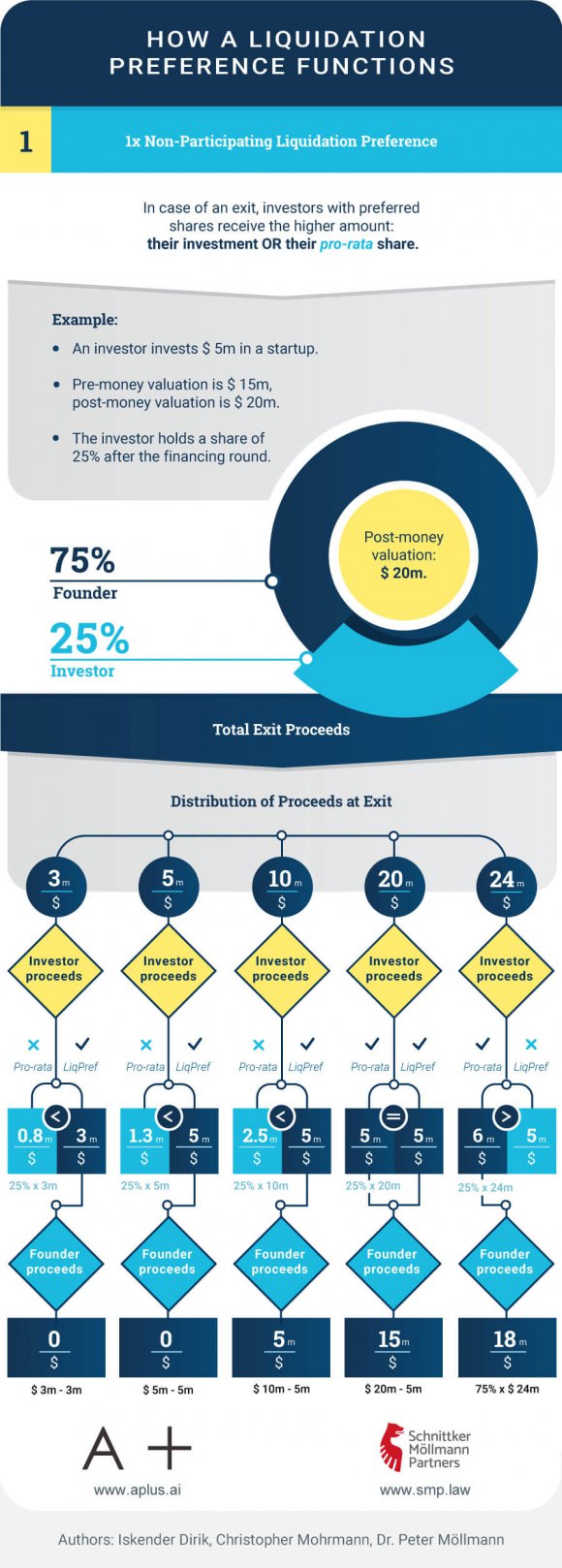
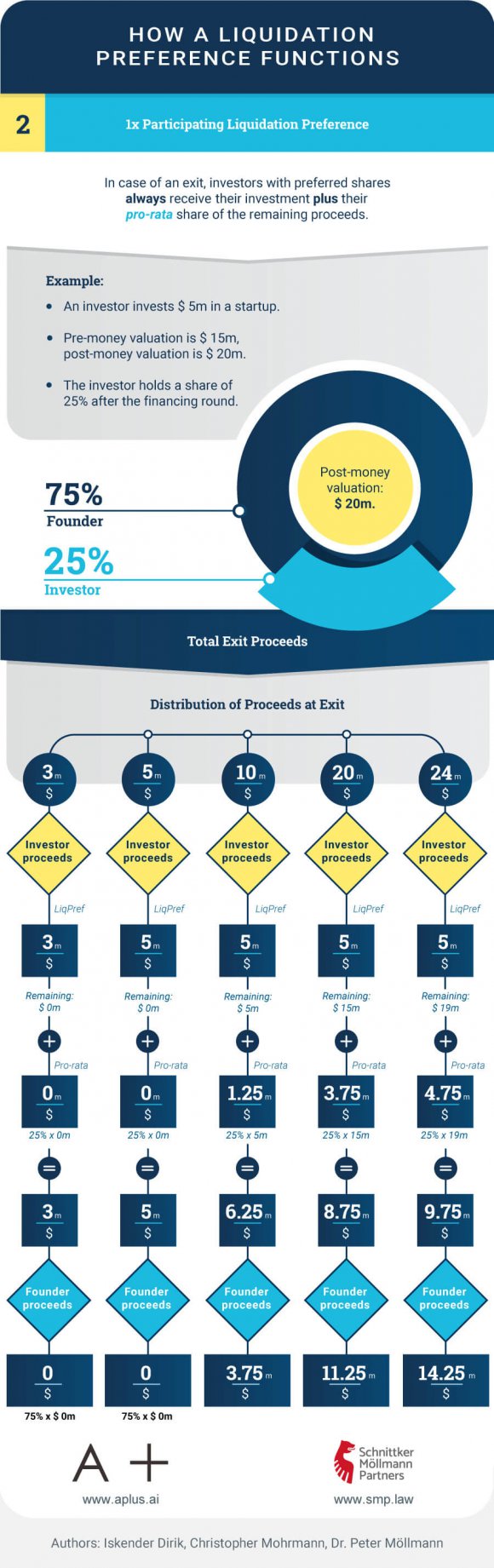
Let's use a pair of infographics to visualize and solidify what you just learned.
Non-Participating Liquidation Preference
This is the current market standard and is considered founder-friendly. The investor has a choice: either (A) take their money back (e.g., 1x their investment), OR (B) convert their preferred shares to common stock and receive their pro-rata share of the exit proceeds. They will choose whichever option yields a higher return.
Participating Liquidation Preference
This is a more aggressive, investor-friendly term. The investor gets to "double-dip." They first get their money back (the preference), AND then they also share pro-rata in the remaining proceeds.
As an accelerator manager and fund GP, you should know that 1x non-participating liquidation preference is the strong market standard. Pushing for participating preference is seen as aggressive and can damage your reputation with founders, as explained in the video and reinforced in this article.
Founder Term Sheet Guide: Key Clauses & Negotiation Tips
The 'Founder Term Sheet Guide' provides a good summary of the economic terms and reinforces the market standard for liquidation preferences.
Please read the section titled 'Understand Investment and Deal Metrics That Matter', focusing on the subsection '2. Liquidation Preferences and Voting Rights'. This will confirm the market context for what you've just learned.
The key takeaway is that while you need to understand the mechanics of both, your term sheets should almost always propose a 1x non-participating liquidation preference to align with founders and maintain a strong reputation in the ecosystem.
Conclusion
In this lesson, we've dissected the three most critical economic terms that drive investment deals. Your ability to understand and strategically deploy these terms will be fundamental to your success as an accelerator manager.
Key Takeaways:
- Valuation Cap: Sets the maximum conversion valuation for a SAFE, protecting an early investor's upside in a successful outcome. The post-money cap provides clear, upfront calculation of ownership.
- Discount: Offers a percentage discount on a future round's share price, serving as an alternative reward for early-stage risk, especially in highly uncertain ventures.
- Liquidation Preference: Protects investor capital in a downside exit. It dictates the order and amount of payouts in a sale.
- 1x Non-Participating is the founder-friendly market standard for liquidation preference. Participating preference ("double-dipping") is highly investor-friendly and generally seen as an off-market or aggressive term in today's venture landscape.
Preview of the next lesson:
We've just covered the economic terms—who gets what money. But money isn't the only thing negotiated. The other side of the coin is control—who gets to make decisions. In our next lesson, we will evaluate the key control terms in a term sheet, including voting rights, protective provisions, and board seats.