Hello! Welcome to the first lesson in Module 4, "Investment Instruments and Term Sheets."
In our last lesson, we concluded the Venture Finance module by working through a practical case study. We valued a startup, Synapse AI, and arrived at a defensible pre-money valuation range of $4.5M to $5.5M for their $500,000 pre-seed investment. This begs the question: how do we actually structure that investment?
This lesson addresses that question directly. Your learning outcome is to distinguish between convertible instruments (SAFEs, notes) and a priced equity round. Understanding these instruments is a fundamental skill for you as a future accelerator manager and fund GP. The choice of instrument affects the speed and cost of the deal, the rights you have as an investor, and your relationship with the founder.
Let's dive into the three primary ways to structure an early-stage investment.
1. The Fundamental Choice: Priced Equity vs. Convertible Instruments
At the highest level, you have two choices when investing in a startup: set the price of the company's stock today, or agree to set it later.
Priced Equity Round
This is the traditional way of investing.
- What it is: You and the founder negotiate and agree on a pre-money valuation for the company today. The investment is used to purchase a specific number of newly issued "preferred" shares at a fixed price per share.
- The result: The investor immediately becomes a shareholder with a known percentage of ownership. For example, if you invest $500k into Synapse AI at a $4.5M pre-money valuation, the post-money valuation becomes $5M. You would own 10% of the company ($500k / $5M).
- When it's used: Typically for more mature funding rounds (Series A and beyond) where the company has enough traction to make a valuation defensible. It's also used in seed rounds when a lead investor is willing to undertake the necessary work.
Priced rounds involve significant legal work, due diligence, and negotiation, making them expensive and time-consuming. This led to the rise of a simpler, faster alternative for early-stage deals.
Convertible Instruments
- What they are: Instead of pricing the company now, an investor provides capital in exchange for a right to receive equity in the future. The investment "converts" into equity during a future priced round (like a Series A).
- The result: The valuation is deferred. This avoids a lengthy and difficult valuation negotiation when the company is very young and has little data.
- When they're used: Predominantly in pre-seed and seed rounds.
To understand why this method is so popular for early stages, let's watch a short clip.
Startup Financing 101: How SAFEs and Convertible Notes Work | Equity funding explained
The following video from Carta, a leading platform for managing company equity, provides a clear explanation of why early-stage startups often prefer convertible instruments over priced rounds.
Please watch from 00:24 to 02:08. Focus on the two main reasons given for using convertible instruments: speed/cost and founder control.
As the video explained, the main drivers are:
- Speed and Cost: Convertible instrument deals can be closed in weeks with standardized documents and lower legal fees, whereas priced rounds can take months.
- Simplicity and Control: They postpone complex negotiations and avoid immediately granting new investors the voting rights and control terms that come with preferred shares.
There are two main types of convertible instruments you need to know: the Convertible Note and the SAFE.
2. The Two Types of Convertibles: Notes vs. SAFEs
While both serve to defer valuation, their legal structures are fundamentally different. This is a critical distinction.
Convertible Note
A convertible note is debt. Think of it as a loan that is intended to convert into equity rather than be paid back in cash. Because it is debt, it includes two key features that a simple contract does not:
- Interest Rate: The principal investment accrues interest (e.g., 4-8% annually). This accrued interest also converts into equity, giving the investor slightly more shares as a reward for the time their money has been at risk.
- Maturity Date: The loan has a deadline (e.g., 18-24 months). If the startup hasn't raised a priced equity round by this date, the note "matures." At maturity, the investor technically has the right to demand repayment of the principal plus interest. In practice, investors often extend the date or negotiate to convert the note into equity at a pre-agreed valuation, but the repayment risk for the founder is real.
SAFE (Simple Agreement for Future Equity)
A SAFE is not debt. It is a simple contract, or warrant, that gives the investor the right to equity in the future. Developed by the accelerator Y Combinator in 2013, it was designed to be even simpler and more founder-friendly than the convertible note.
- No Interest Rate: The investment amount does not accrue interest.
- No Maturity Date: There is no deadline. The SAFE sits patiently on the company's capitalization table until it is triggered by a future priced round, whenever that may be. This removes the repayment risk posed by a convertible note's maturity date.
To solidify your understanding of these differences, let's turn to a helpful article.
Should I Raise a SAFE, Convertible Note, or Priced Equity Round?
The article 'Should I Raise a SAFE, Convertible Note, or Priced Equity Round?' from Lighter Capital provides an excellent, direct comparison of these instruments.
Please read the following parts of the article: The introductory section '1. Should my startup raise a SAFE or a convertible note?' including the 'Convertible Notes vs. SAFEs' table. The sections 'What is a SAFE?' and 'What is a Convertible Note?'. Focus on how the debt structure of a note creates different risks and obligations compared to a SAFE.
The key takeaway is that the Maturity Date on a convertible note creates a "ticking clock" for the founder that does not exist with a SAFE. This is the primary reason why SAFEs have become the dominant instrument for pre-seed investing in the US.
3. Visualizing the Differences
Now that we have the concepts down, let's look at a visual summary. The table below, from the venture firm Latitud, clearly lays out which clauses typically appear in each type of agreement.
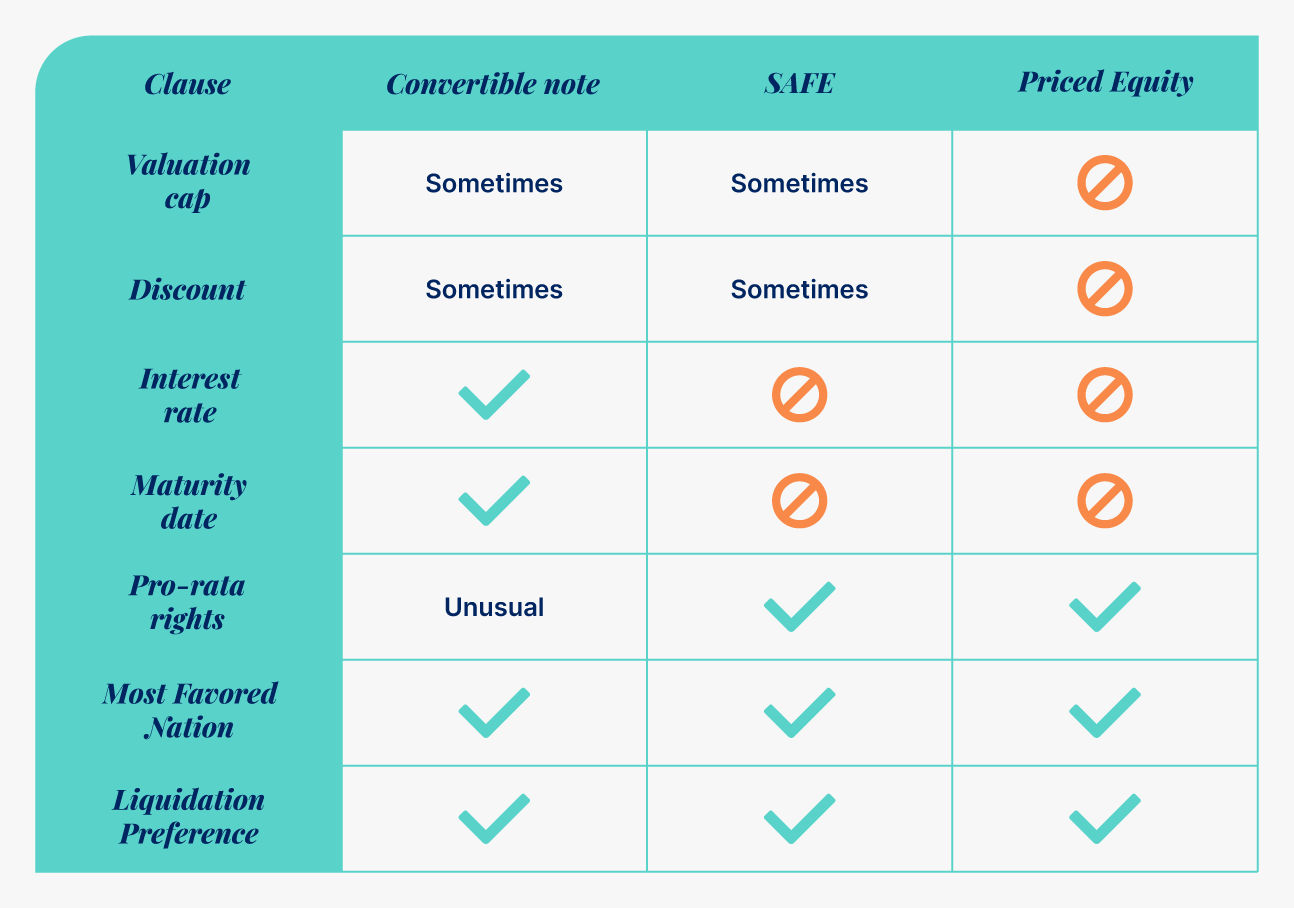
You'll notice two key terms in this chart for SAFEs and Notes that we haven't discussed: Valuation Cap and Discount.
- Valuation Cap: This is the maximum valuation at which an investor's money will convert into shares, regardless of how high the valuation is in the next round. It protects the early investor's upside. For example, if you invest on a SAFE with a $10M valuation cap and the company raises its Series A at a $20M valuation, your money converts as if the valuation were only $10M, getting you twice as many shares.
- Discount: This gives the investor a percentage discount (e.g., 20%) off the share price of the next funding round. It's another way to reward the early investor for taking on more risk.
These economic terms are the heart of a convertible instrument. We will dedicate our entire next lesson to analyzing them. For today, the goal is just to know what they are and which instruments they belong to.
Test your understanding!
A pre-seed startup founder tells you they've received two investment offers for $100,000.
- Offer A is a Convertible Note with an $8M valuation cap, 20% discount, 6% interest, and an 18-month maturity date.
- Offer B is a SAFE with an $8M valuation cap and a 20% discount.
From the founder's perspective, what is the single biggest difference in the risk profile between these two offers?
Show answer
The single biggest difference is the repayment risk associated with the Convertible Note's maturity date. If the founder fails to raise a priced equity round within 18 months, the investor in Offer A could legally demand their $100,000 back, plus accrued interest. The investor in Offer B has no such right, as the SAFE has no maturity date.
4. Market Standard: The Rise of the SAFE
As a future accelerator manager, it's vital to know the current market standard. While priced rounds and convertible notes still have their place, the SAFE has become the default for pre-seed investments in the US startup ecosystem.
To understand why, let's hear from the source.
Understanding SAFEs and Priced Equity Rounds by Kirsty Nathoo
Kirsty Nathoo, a partner and the former CFO at Y Combinator, was instrumental in creating the SAFE. In this video, she explains the rationale behind the SAFE and its core structure.
Please watch the following three segments: Introduction (00:00 - 03:49): Kirsty introduces the SAFE and contrasts it with priced rounds and convertible debt. Anatomy of the SAFE (03:49 - 07:11): She walks through the sections of the SAFE document, highlighting its simplicity. Pay attention to the two main negotiation points: amount and valuation cap. Top Tips (41:08 - 44:41): She offers practical advice on using SAFEs vs. notes and warns against over-optimizing valuation caps. This will give you a strategic, high-level perspective from the creators of the instrument you'll most likely use.
As Kirsty Nathoo emphasized, the goal of the SAFE is to make fundraising faster, simpler, and more transparent. A general rule of thumb in the market today is:
- Rounds under ~$5M: Likely to be done on SAFEs.
- Rounds over ~$5M: More likely to be a priced equity round, often led by an institutional VC.
Conclusion
You can now distinguish between the three primary instruments for early-stage investment. This knowledge is crucial for structuring deals for your accelerator and advising the startups in your portfolio.
Key Takeaways:
- Priced Equity Rounds establish valuation upfront, granting immediate ownership and shareholder rights. They are complex, slow, and best suited for later-stage rounds (Series A+).
- Convertible Instruments defer valuation, allowing for faster and cheaper funding rounds.
- A Convertible Note is a debt instrument with an interest rate and a maturity date, creating a repayment risk for the founder.
- A SAFE is a contract for future equity, not debt. It has no interest rate or maturity date, making it the most founder-friendly and common instrument for pre-seed rounds in the U.S.
Preview of the next lesson:
We now know what these instruments are. But how do you negotiate the numbers that go inside them? What is a "good" valuation cap? When is a discount more important? In our next lesson, we will dive deep into the key economic terms of a term sheet—valuation cap, discount, and liquidation preference—and learn how to evaluate them from an investor's perspective.